
Safety
The intelligent safety switch
Safety modules and safety switches that communicate at I4.0 level simplify troubleshooting. However, the communication capability also has interesting potential for predictive maintenance and tamper protection.
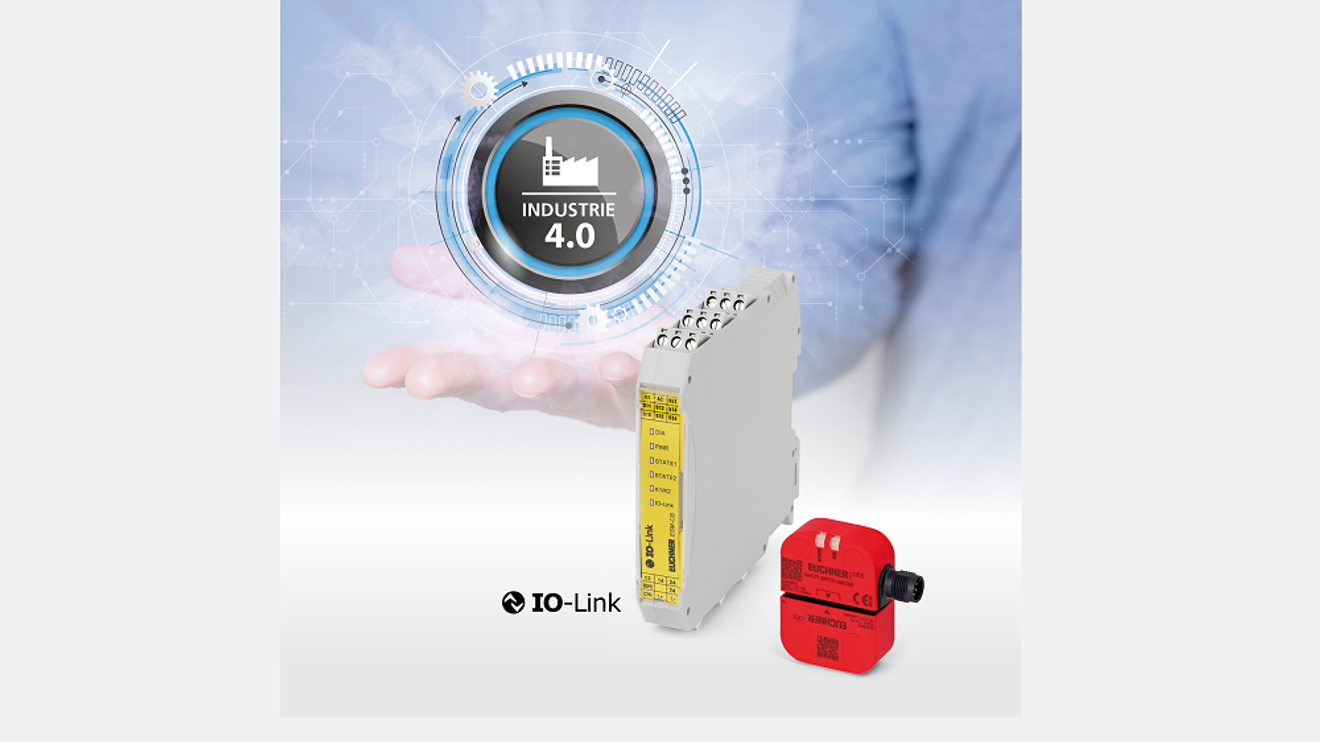

The 'CES-C07' safety switch provides process-relevant parameters in real time, guaranteeing information for preventive maintenance.
© EuchnerWith safety switches without communication, it is only possible to locate the switch that has triggered a machine stop with a great deal of effort when sensors are connected in series. Troubleshooting is often difficult and leads to unnecessarily long downtimes.
The situation is different when safety switches and safety modules are able to communicate at Industry 4.0 level, such as the 'CES-C07' safety switch and the 'ESM-CB' safety module from Euchner. These devices open up new freedoms in the design of safety solutions for smaller systems up to category 4/PLe.
The safety switch supplies process-relevant parameters in real time, helping to identify acute problems and also provide information for preventive maintenance. For example, the sensors measure relevant environmental parameters and signal in good time whether a system failure is imminent.
Intelligent information hierarchy
Each individual bit in the process data provides the user with essential information on what needs to be observed in a specific problem situation. More detailed explanations can then be called up via the acyclic data. A single cable is sufficient for communication and an integrated eight-pin M12 connector is used for the connection.
Four bits of process data are transmitted from each switch to the control unit. For example, the OD signal indicates whether the safety guard is open. The operator therefore knows exactly which door is responsible for the standstill of his system. If the weak area display OW appears, there is an actuator in the edge area of the transponder field. This is usually caused by the doors being lowered after prolonged use. Previously, the switches only drew attention to this by flashing, which was easy to overlook in everyday industrial use. With the message from the control unit on the Human Machine Interface, this can hardly happen any more. The OI display informs the operator that there is a current message, which he should call up as soon as possible via the acyclical data.
This acyclical data includes, for example, the current diagnostic codes that describe what is wrong with the switch. A total of over 30 different messages are stored. Each individual wiring error is displayed, which saves time, especially during commissioning. At the same time, the code contains precise instructions for the operator on how to rectify the fault as quickly as possible.
Predictive maintenance
The displays of the voltage currently applied to the safety switch and the temperature measured in the switch provide valuable information for predictive maintenance. If certain threshold values are exceeded or not reached, preventive maintenance can be requested automatically if the appropriate settings are made. The recording of the number of switching cycles provides further indications of a possible imminent defect. The switch itself is wear-free, but not the mechanics of the safety gate, which can be easily monitored in this way. The fact that the safety switches can be replaced under voltage makes a further contribution to avoiding downtimes.
Protected against manipulation
A similarly important topic is the protection of systems against manipulation. The acyclical data also provides information for this. By checking the number of switches in a row, the control system can detect whether the circuit has changed since the last check, i.e. whether the row has been shortened. The function for querying the currently read actuator can be used with Unicode switches to determine whether this code differs from the learned code. In the case of multicode switches, the system checks whether the current actuator code matches those stored in the control system. This provides added safety, for example, for machine tools whose chip conveyors are only blocked with metal chip baskets, as the verification of the code ensures that the correct basket is always positioned in front of the respective ejection opening, even if baskets of different sizes are in use.
In combination with the 'ESM-CB' safety module, all information is queried by each switch in the chain and made available to the control system via IO-Link. The device fulfills several functions at once, as it is an evaluation device, safety relay and IO-Link device in one. Two safety circuits can be connected on the input side: for example, one with which the device monitors an emergency stop chain or the switching contacts of mechanical safety switches, and a second for evaluating a chain of 'CES-C07' safety switches. Two redundant, safe relay contacts enable the direct switching of loads with up to 6 A. The safety module is in constant dialog with the connected devices and records the system status, the ambient conditions and the sensor's own data for each sensor.
Communication via IO-Link
In addition to cost aspects, the 'team player' properties of the point-to-point wiring system played a major role in the decision to communicate via IO-Link. Because regardless of whether Profibus or Profinet, AS-Interface, CC-Link or Ethernet/IP are used: All common automation systems have access to IO-Link, meaning that the safety switch and the safety module have a direct connection to the fieldbus world.
On the one hand, this makes them interesting for all types of systems - from machine tools and packaging machines to fences that need to be safeguarded. On the other hand, it opens up the possibility for plant manufacturers to supply their products with identical safety technology to all regions of the world.
Author:
Jens Rothenburg is Product Manager at Euchner in Leinfelden-Echterdingen.


You might also be interested in
Safety first
The development of cobots into a commodity product is closely linked to the issue of safety in robotics - a challenge that needs to be mastered efficiently.
 read more...
Locking with need for clarification - help with risk assessment
DIN EN ISO 1419 has already been available for five years. However, there are always uncertainties regarding the actual safety functions of a guard locking device, which the machine manufacturer must evaluate based on his risk assessment. Here is...
read more...Safe operation via radio - (how) does it work?
Many machine builders want to use tablets in addition to the existing machine operation. Demanded features such as WLAN, camera, multi-touch and much more are available here - but if safety functions are required, these devices reach their limits.
read more...Heavy-duty HRC requires new safety approaches
The topic of HRC is not just for 'lightweights'. In the field of heavy-duty robotics, solutions will also be in demand in the future that allow humans and robots to work together directly without the need for a safety fence. However, this requires...
read more...Secure hold in the slip ring
Transmitting safety-relevant data via slip rings is no trivial matter. Motion control experts from Kollmorgen have developed a TÜV-certified safety solution, including UL approval, together with slip ring manufacturer Stemmann-Technik.
read more...Validation neglected
EN ISO 13849 is decisive for the integration of safety-related control functions in machines. However, the part of the standard relating to validation is often neglected in practice - a major shortcoming.
read more...Dangerous movements well secured
How can dangerous movements be safeguarded? A challenge for the user, as there are a wide variety of functional and normative requirements. An overview.
read more...The vampire effect of quantification
There are always controversial discussions regarding the determination of risks for products and systems. But which approaches actually make sense in the context of safety and security? What approach does the new framework for safety and security -...
read more...Warnings - less is often more!
Many operating instructions contain warnings 'to death'. This may be reassuring for the manufacturer, but for the reader it means that relevant information is barely noticed - possibly with fatal consequences for people, the environment and the...
read more...