
Zimmer Group
Special gripper for the production cell
Automated machine tools are the future of production. Robots play a decisive role here, and with them the grippers.
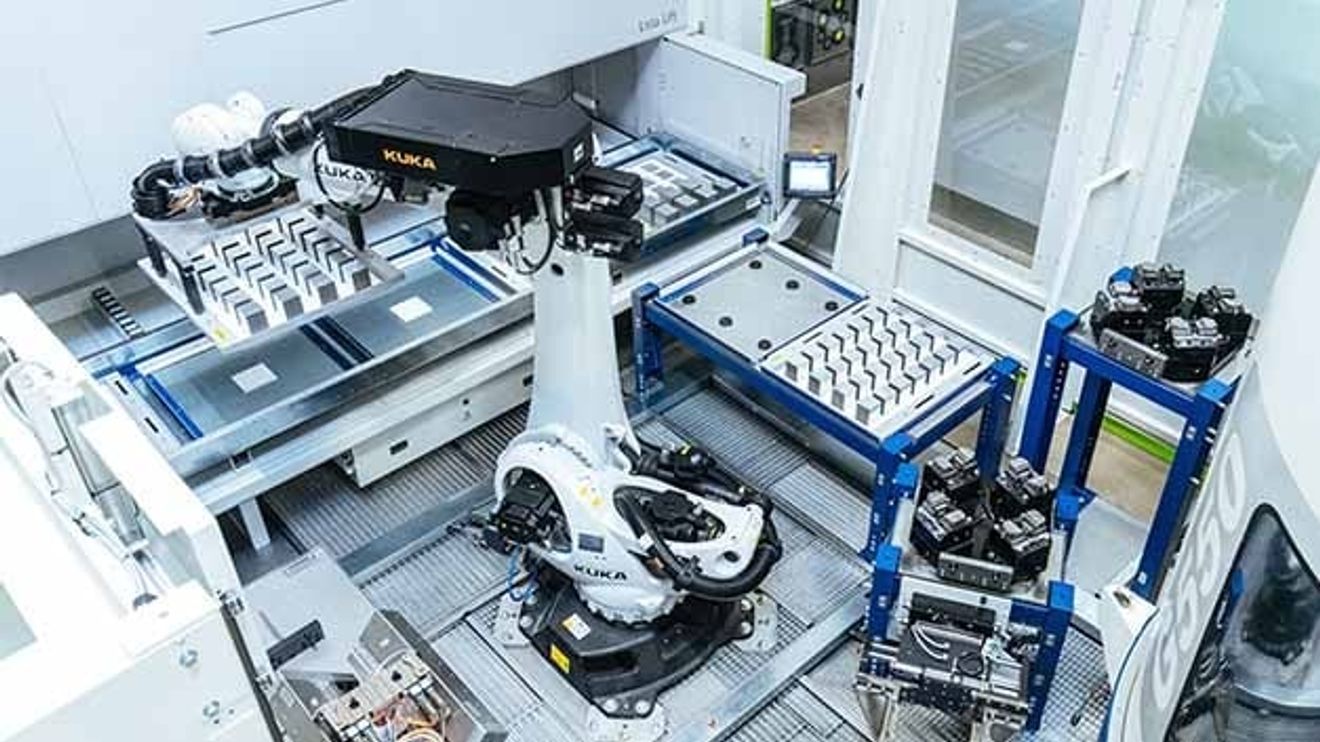
Around 30 different types of worm gear screw jacks - electromechanical drives that convert a rotary motion into a linear motion - are manufactured by the Austrian company Zimm. Previously, the components were clamped onto plates manually, but the company has automated this process with the help of Vischer & Bolli. Together with other cooperation partners, they developed a flexible production cell consisting of a five-axis milling machine from Grob and two robots from Kuka. The latter take over the fully automated loading and unloading of the fixtures and workpieces in the production cell with their subsequent post-processing. Specially coordinated clamping technology and sensors from Vischer & Bolli ensure reliable processing in the cell and the machine.
Special gripper solution for the robots

A special gripper from the Zimmer Group on a Kuka KR Quantec robot removes a pallet of blanks. It loads the milling machine with the components, removes them after machining and automatically places them for post-processing.
© KukaFor the special gripping tasks in the robot cell, those responsible called in the systems engineering department of the Zimmer Group. The department developed a special version of a double gripper with servo technology for the production system at Zimmer. This can grip components of all types and different geometries. It has a stroke of 150 mm and a holding force of 5000 Nm or 3000 Nm with a secure hold via a trapezoidal threaded spindle in the event of an unforeseen power failure. In addition, the clamping pressure on the gripper can be variably programmed depending on the workpiece.
Almost all tasks that previously had to be carried out manually are now performed fully automatically by a KR Quantec and a KR Agilus from Kuka. The five-axis milling machine is supplied with raw material via a lift system. To do this, employees load trays within a 4 m high lift system. In addition to raw material and finished parts, the clamping devices and, if necessary, tools are also stored here.
The subsequent processes are fully automated: A special gripper, which is docked to the KR-Quantec robot via the zero-point clamping system, first removes the trays filled with raw parts (aluminum and cast cubes) in various sizes from the lift system in the robot cell and places them on an attachment table. The robot then uses the gripper to automatically position four blanks in the fixture and places them in the milling machine. The machine can produce around 30 different components in batch sizes between 1 and 200 from aluminum and cast iron. Loading the quadruple fixture outside the machine avoids unnecessary downtimes on a table machine.
Automatically correct tolerance deviations
While the milling machine processes the four workpieces, the Zimmer gripper on the KR Quantec loads another fixture. Once the components have been machined from both sides - the turning process is also automated - the gripper places them on the workstation for post-processing. There, a KR Agilus type KR 10 R900-2 deburrs and cleans the aluminum and cast parts, while the Procam master computer of the modular robot cell takes over the entire logistics. The next stage of automation involves checking all measurement parameters in a further process step. Tolerance deviations can then be transmitted and automatically corrected via a feedback loop to the milling machine.
Flexibility through modular cell design
The modular design of the robot cell opens up a wide range of possible applications. All project participants see automated machine tools as the future in machine and mold construction as well as in the automotive and medical technology sectors. Particularly in the field of parts handling, there will be no other option in the future due to economic efficiency.
Sebastian Schuster
is Global PR and Content Manager at Kuka.
Gregor Neumann
is responsible for media and communication at Zimmer Group.


You might also be interested in
Subsidiary established in Mexico
The Zimmer Group is opening a branch in Querétaro, Mexico, on August 1, 2021, thereby strengthening its activities in Central America.
 read more...
First nationwide digital Girly Robot Challenge
Playfully program virtual robots without any prior knowledge: With this call, the Maker Faire and the i-bot team are inviting interested girls aged ten and over to take part in the hackathon. The Girly Robot Challenge will be presented as part of...
read more...Speed up to 6 m/s
Comau launches Racer-5-0.80 (Racer-5 cobot) to meet the increasing demand for fast, cost-effective cobots that can be used in confined spaces and in a variety of applications.
read more...Automated pallet transport
A-Mate from Finnish manufacturer K.Hartwall is an autonomous mobile robot (AMR) and, according to the manufacturer, the market's first fully electric free-lift AGV (automated guided vehicle) for pallets with omnidirectional drive.
read more...Robotics&AUTOMATION 1/2021
The latest Robotics&AUTOMATION special is here! The e-paper provides you with practical information on current trends and developments - as well as first-hand information on the extent to which robots can secure Germany as a technology location.
read more...Belgian research team wins Innovation Award
Artificial intelligence to automate demanding two-handed tasks - with this idea, a team of researchers from Leuven, Belgium, won the innovation competition with prize money of 20,000 euros.
read more...Integrating cobots more easily into complex systems
In future, UR's cobots will be easier to integrate into complex systems and production lines: The company is working on integrating them into the TIA Portal from Siemens. This will make it easier to include them in the condition monitoring of...
read more...Development Collaboration for Humanoid Robotic Hands Launched
Schunk is entering into a new development partnership with Robert Bosch Robotics. Their shared goal is to develop an industrial-grade robotic hand that can be integrated into various humanoid robot systems.
read more...Nominations for Electrifying Ideas Award have been announced
An independent jury of top-class experts from business, research and society has nominated three companies for the Electrifying Ideas Award 2026: Ideas from Philips, Rittal and ZeMA - Center for Mechatronics and Automation Technology convinced the...
read more...