
Automatica trend index
Robots to compensate for demographic change
According to the IGZA (Institute for the History and Future of Work), the German labor market will be 10 million people short in 2040 due to demographic change. To compensate for the consequences, 77% of decision-makers are relying on "colleagues" robots.
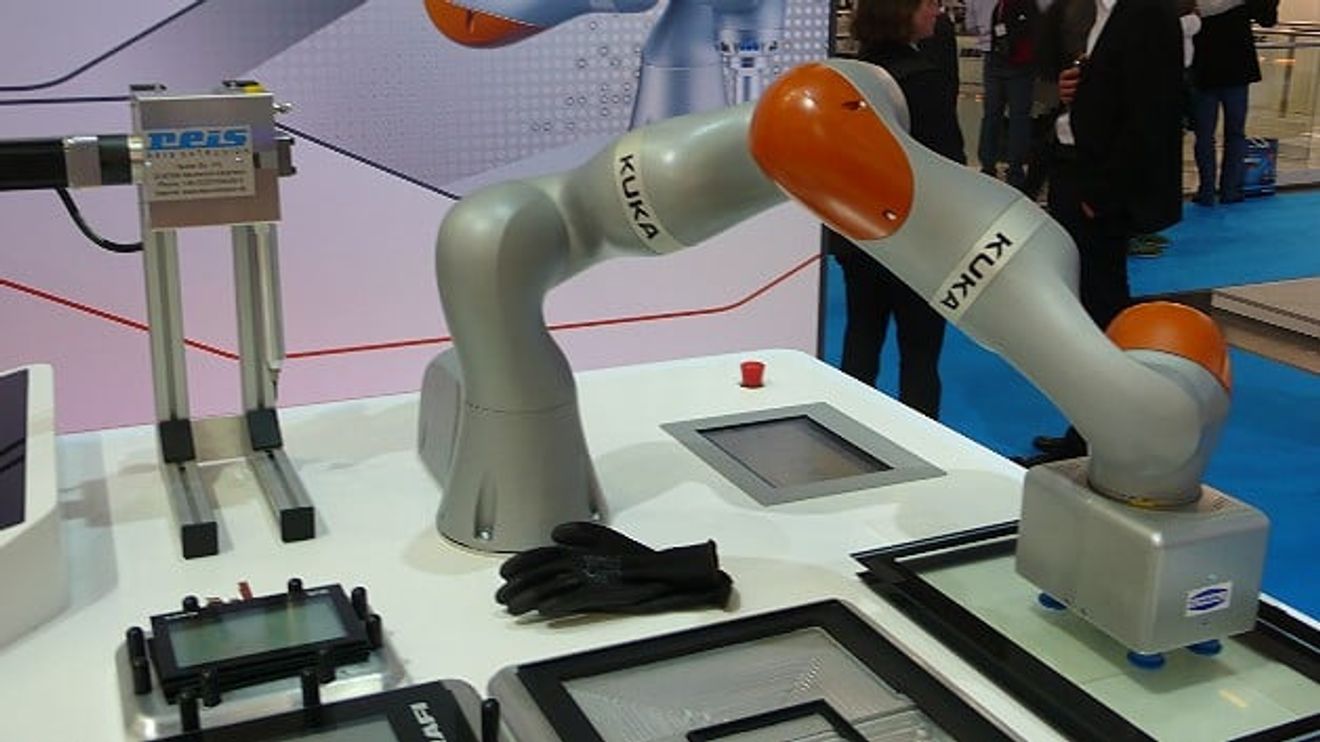
In addition to corporations, this development is also increasingly affecting smaller companies: According to the forecast, 84 percent believe that widespread use of robot technology in medium-sized companies is not a question of "if", but of "when". These are the findings of the Automatica Trend Index 2020, for which a market research institute commissioned by the Automatica trade fair surveyed a total of 100 specialists and managers in Germany who make decisions about robotics and automation in industrial companies.
According to the Federal Statistical Office, around a quarter of all employees currently work in industry - that is around 11 million people. At the same time, a total of around 216,000 industrial robots are currently in use in this sector. This puts Germany in fifth place worldwide - according to the latest figures from the International Federation of Robotics. In terms of robot density, there are around 1270 units per 10,000 employees in the automotive industry and around 340 in the manufacturing sector.
"Against the backdrop of demographic change and the changing world of work, robotics and automation are making a very important contribution to securing global competitiveness and keeping people in work for longer," explains Patrick Schwarzkopf, Managing Director of the VDMA Robotics+Automation Association. "Robots are excellent at taking on individual tasks. For example, working in a team with a robot relieves workers of dangerous, unhealthy and monotonous tasks. At the same time, the speed and precision of robots can significantly increase productivity." According to the survey, 77% of industrial decision-makers confirm that robots are already playing a key role in responding to labor shortages and driving automation.
According to around 80 percent of experts in industrial companies, the most important reasons for producing with robots in the future include relieving people of heavy loads and monotonous work as well as handling hazardous materials. At the same time, 81% report that the programming of robots has tended to become easier, paving the way for their use in medium-sized companies.
"From June 16 to 19, Automatica in Munich will show how robotics and automation can help industry remain competitive," says Falk Senger, Managing Director of Messe München. "The trade fair provides an overview of all relevant solutions and products for increasing automated production and also brings together all future-oriented key technologies under one roof."
Automatica Trend Index 2020
The Automatica Trend Index was conducted by a market research institute and consists of two sub-surveys:
For Part 1, a total of 100 specialists and managers in Germany who make decisions about robotics and automation in industrial companies were surveyed. The participants work in mechanical and plant engineering (37%), the automotive industry (22%), the electrical industry (14%), the food industry (9%) and other industrial sectors (18%).
For Part 2, a total of 7,000 participants in seven countries were surveyed on a representative population basis to find out how robots and digitalization are changing the world of work: USA (N=1000), China (N=1000), Japan (N=1000), Germany (N=1000), France (N=1000), Italy (N=1000) and the UK (N=1000).


You might also be interested in
Dr. Lars Friedrich appointed to the Executive Board
Dr. Lars Friedrich is a new member of the Executive Board of the VDMA Robotics + Automation Association. He succeeds Dr. Jürgen Hohnhaus, who stepped down from the board for statutory reasons.
 read more...
Sub-area to be realigned
Kuka is realigning a sub-division in the Robotics segment, which is responsible for automated manufacturing solutions such as cells and special machines. The aim is to give it a sustainable business model in economically challenging times.
read more...The woodworker's assistant
The timber construction industry has so far only made limited use of automated production processes. A joint project between the University of Stuttgart and plant manufacturer BEC at this year's Federal Horticultural Show (Buga) demonstrates what...
read more...The hand as a yardstick
The human hand is still considered the benchmark when it comes to the flexibility of gripping tools. In service and assistance robotics in particular, humanoid manipulators that enable a wide range of gripping variants will be increasingly in demand...
read more...Division for software and digital business established
Kuka has founded a new business division. With 'Kuka Digital', the Augsburg-based company known for its orange industrial robots and automation solutions is expanding its software and digital business.
read more...Finalists for the Innovation Award 2025 have been announced
The motto of the Kuka Innovation Award 2025 is 'Medical Robotics Challenge 2.0'. Five international teams have made it to the final with their robotics ideas for the future of medicine. The winner will receive 20,000 euros in prize money.
read more...Great career opportunities for women in robotics
The IFR supports the career advancement of women in the robotics industry because, according to a World Bank forecast, the gross domestic product per capita would increase by almost 20 percent worldwide if the employment of women reached the same...
read more...Cobot assistant for SMEs
A user-friendly cobot application for small and medium-sized companies that can be used without programming - a team of researchers from Belgium received the Kuka Innovation Award 2024 for this concept.
read more...Handles handling and spot welding
The 'KR Fortec' from Kuka is an energy-efficient and dynamic heavy-duty robot that can be used in particular for tasks such as handling and spot welding.
read more...