
Robotics
The woodworker's assistant
The timber construction industry has so far only made limited use of automated production processes. A joint project between the University of Stuttgart and plant manufacturer BEC at this year's Federal Horticultural Show (Buga) demonstrates what robotics could achieve in this area.

The Federal Garden Show has long been more than just a traditional garden exhibition: it also presents modern developments in urban planning and architecture. At this year's Buga in Heilbronn, an innovative wooden pavilion was on display alongside trees and flowers. The construction, inspired by nature, was designed by the Institute for Computational Design and Construction at the University of Stuttgart (ICD). Since its foundation in 2008, the ICD has been dedicated to the development of innovative, computer-aided design and construction processes. One focus is on the possible applications of robots. These were also used in the production of the innovative wooden elements for the Buga pavilion: "The production of the components is complex, time-consuming and individual, so it can only be realized with the help of robots," says Hans Jakob Wagner, research assistant and doctoral student at the ICD.

The ICD was supported by BEC in planning the required system. The plant manufacturer based in Pfullingen, Baden-Württemberg, plans and integrates complex robot systems. For the automated production of the wooden pavilion in question, he used two Kuka KR 500 Fortec robots in addition to the DKP-400 two-axis positioner. Their task was to assemble, glue and mill the components.
Inspired by nature
"One focus of our work is in the field of biomimetic research," explains Professor Achim Menges, Head of the ICD, and goes into more detail: "Forms, materials and structures in nature often have a higher material efficiency and functionality than conventional construction methods. The innovative shell construction of the wooden pavilion is also based on a natural phenomenon: the shell of the sea urchin. This consists of several panels that grow independently of each other and depending on their position in the shell."
As with the sea urchin, the 376 elements of the pavilion are absolutely unique. They were assembled from wooden panels and beams made of laminated veneer lumber. Inside, the cassettes are hollow and vary in shape: There are pentagonal, hexagonal and heptagonal elements that are 16 cm thick. Once all the components have been assembled, the pavilion spans 30 meters - without beams or supports inside. This lightweight construction method is unique in the world. "Each cassette is tailor-made for its respective situation - and fully automated," explains Wagner. Without the automated solution, which was developed in collaboration with BEC, the project would have been unthinkable due to the immense amount of work involved.
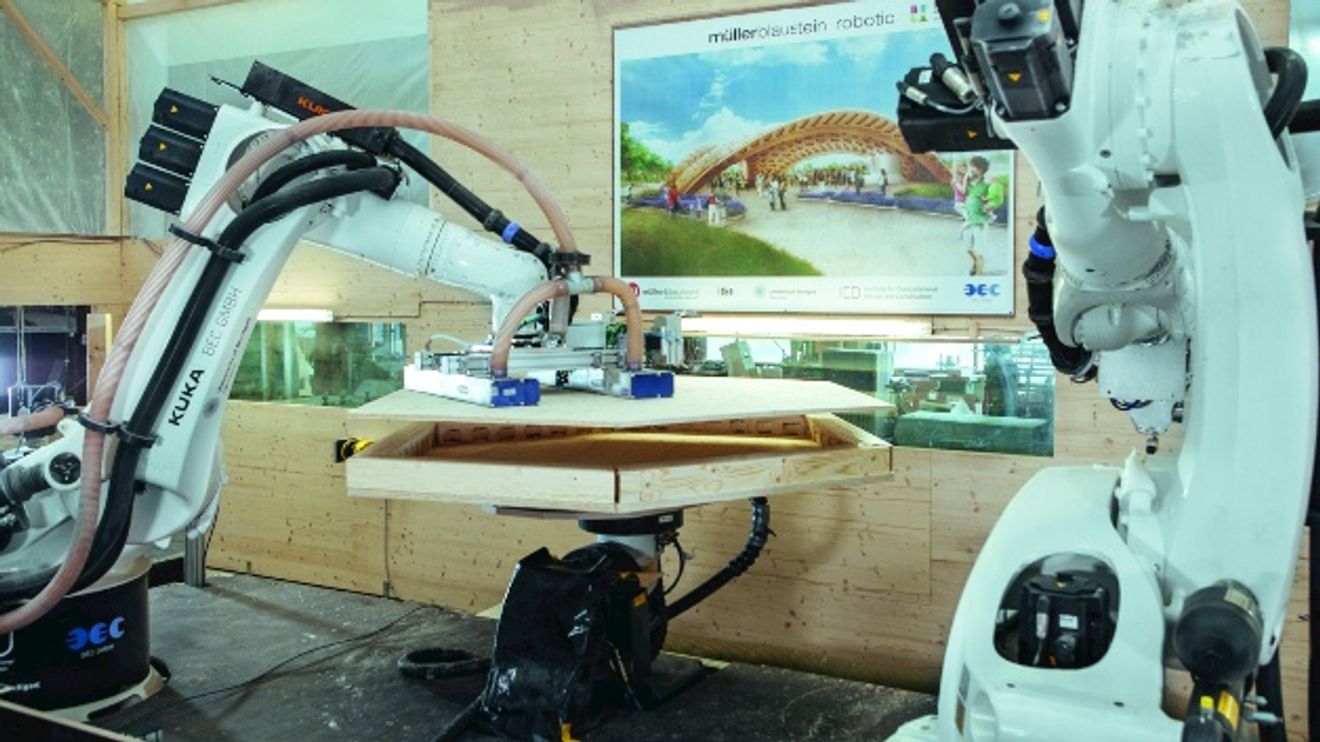
At the start of the project, there was no construction plan of the planned pavilion on paper; the entire construction was designed digitally. "The information on the individual components was generated directly in the software environment and transferred to the robot," explains BEC Managing Director Matthias Buck. The robots work together perfectly in the system as follows: First, robot 1 picks up a veneer wood panel and positions it on the two-axis positioner. The panel is attached to the turn/tilt positioner using vacuum clamping technology. While robot 2 applies the adhesive to the base plate, robot 1 picks up a support beam. As soon as the beam is on the adhesive, robot 2 nails it down with wooden nails.

These work steps are repeated until all the beams in a cassette have been glued and nailed together. Robot 1 then takes the cover plate out of the magazine and places it on the adhesive applied to the beam by robot 2 in the meantime. Robot 2 also fixes the cover plate with nails. Robot 1 then places the partially finished cassette on the press magazine. Once the adhesive has hardened, the cassettes are picked up again by the robot and positioned on the DKP-400. Robot 2 takes over the milling of the corner contours and tine connections as well as the drilling of the pin holes. Once all the milling work has been completed, the robot places the finished cassette in the finished parts magazine.
Advantages of robot production in timber construction
"Gluing and milling the cassettes is much easier in robot-based production," says Hans Jakob Wagner, citing one of the advantages of robots in timber construction. As the adhesive is only liquid for a limited period of time and special conditions, such as application quantity and uniformity, must be met during application, speed and reliability play a major role. Given the weight of the individual elements - one cassette weighs up to 200 kg - robots also make work much easier.
The precision of the construction robots offers a further advantage: when milling the elements, the dimensional tolerance is less than 0.3 mm. The robots work precisely, efficiently and cost-effectively, which made it possible to vary the pavilion's parts. The robots are also extremely adaptable: "We were able to change the construction plan of individual elements during the production process," emphasizes Matthias Buck.
Matthias Buck sees great potential for the further use of the system: "Thanks to its ideal transport dimensions, the system can also be used directly by the timber constructor or on the construction site." This opens up innovative possibilities for the construction industry and timber construction - a sector that has hardly been automated to date.
Author:
Sebastian Schuster is PR & Content Manager at Kuka Robotics.


You might also be interested in
Division for software and digital business established
Kuka has founded a new business division. With 'Kuka Digital', the Augsburg-based company known for its orange industrial robots and automation solutions is expanding its software and digital business.
 read more...
Finalists for the Innovation Award 2025 have been announced
The motto of the Kuka Innovation Award 2025 is 'Medical Robotics Challenge 2.0'. Five international teams have made it to the final with their robotics ideas for the future of medicine. The winner will receive 20,000 euros in prize money.
read more...Great career opportunities for women in robotics
The IFR supports the career advancement of women in the robotics industry because, according to a World Bank forecast, the gross domestic product per capita would increase by almost 20 percent worldwide if the employment of women reached the same...
read more...Cobot assistant for SMEs
A user-friendly cobot application for small and medium-sized companies that can be used without programming - a team of researchers from Belgium received the Kuka Innovation Award 2024 for this concept.
read more...Handles handling and spot welding
The 'KR Fortec' from Kuka is an energy-efficient and dynamic heavy-duty robot that can be used in particular for tasks such as handling and spot welding.
read more...The top articles in March 2024
New technological developments lead the most-read articles in March. Motors that redefine energy saving, a plastic wheel that discovers the road, a new Ecolabel and, last but not least, the arrival of ChatGPT in the industry. Read for yourself.
read more...Cobot in quality assurance
The 'Ligre' brand is conquering the consumer sector with the function of grinding coffee to the exact gram, which was previously reserved for coffee machines for the catering trade. Gronbach relied on Cobot support in the test setup for quality...
read more...The partner world is growing
Bosch Rexroth launched the automation platform ctrlX and the associated App Store in 2019. The App Store now has 90 partners with over 60 apps. The partner companies currently cover more than 150 use cases.
read more..."From product manufacturer to provider of solutions and software"
Robot systems play a decisive role in overcoming current challenges such as demographic change and the shortage of skilled workers, says Andreas Röhring from Kuka. He talks about this and about resilience and adaptability as a recipe for success in...
read more...