

Exner
Robot programs itself
Robot welding processes have been unprofitable in steel construction to date. This has changed with a solution in which the robot programs itself and then welds each component immediately.

Building with industrially prefabricated system elements made of steel and concrete is a business segment of Goldbeck, a company with over 7500 employees and 70 international locations, which is primarily active in hall and parking garage construction. The load-bearing framework is formed by differently shaped and dimensioned steel girders with all their connections, from the top plate to the web plates. Each of these components can have any number of special features - a conventional automated welding line was therefore not practical for Goldbeck. This is because each unique component requires individual programming: parameters such as material, exact dimensions, elements to be welded and weld seam position and design must be programmed offline (using CAD data sets). This means that a welding robot can only really exploit its economic advantages in the long term once a certain minimum batch size has been reached.
Automatically welding batch size 1 profitably

The IRPS laser (visible by the red line) scans the real component with its position and generates a point cloud, which is converted into a 3D model.
© ExnerGoldbeck had launched various research projects to find a solution for batch size 1 welding. However, the results were all rather sobering. In 2018, the company then heard about the 'Instant Robot Programming System' (IRPS) from Instantpro in the Netherlands for the first time. This company made the - at the time bold - claim that IRPS could even weld individual parts cost-effectively and fully automatically.
"The contact with Exner Ingenieurstechnik as project partner and Instantpro as manufacturer of IRPS came about via Kuka Industries, whose systems we were already using in other areas," explains Christian Schneider, Project Manager Steel Construction Production at Goldbeck. "When we were informed that IRPS would be able to recognize workpieces itself and generate welding programs from them, it sounded very futuristic, if only because of the many variants that the system was supposed to take into account. So we got in touch and went to see a test system at Exner in Holland."
The patented system can automatically weld different product families in steel construction with any dimensions and in any combination. Components known to the system no longer need to be checked, and each new material or profile is stored in the system just once, together with the optimum welding parameters. After that, everything is automatic.

How does this work in detail?
Put simply, the workpiece is placed loosely on a fixture or - if necessary - fixed in place, depending on the component and size. The positioning is irrelevant, as the robot recognizes the real dimensions. To take measurements, it receives the order by clicking on a touchscreen. It then moves over the component and reads its dimensions and position using a laser scanner. This laser scanner is permanently mounted on a linear axis or directly on the robot. As it moves over the component, a precise 3D model of the component itself is created, eliminating the need for exact zero-point fixing and searching for seams.
The result is a point cloud. The IRPS basic software uses this to recognize a component shape stored in the database - for example a double-T beam - and uses algorithmic programs to create a finished robot welding and movement program. At the same time, the optometric 3D scanner image is generated and displayed on the touchscreen.
This 3D model of the component can be rotated in space on the monitor, similar to CAD models. The display is used to check and possibly change, for example, welding seams, welding parameters or torch position.
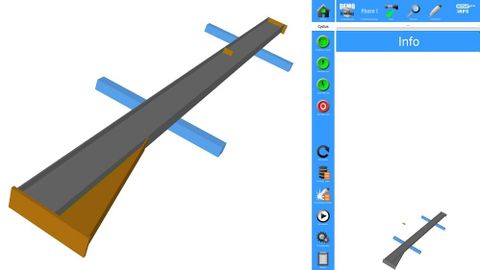
The IRPS software recognizes the double T-beam (grey) and the components to be welded to it (orange).
© ExnerThe IRPS software also functions as a higher-level controller for the welding robot. It controls the process sequence, creates the movement program for the scanning process, generates a model of the component from the 3D point cloud obtained after the scan and writes finished robot welding and movement programs. The software is linked to the IRPS hardware via a license. It controls a 6-axis robot, an additional linear axis and a scanner. Further additional axes, robots or scanners are optional.
Once the scan has recognized the component and placed the weld seams graphically, the worker releases the complete welding process with a single click on the touchscreen. Detailed robot and welding knowledge is not required.
From theory to practice

The 3D model created can be moved freely in space. The weld seams suggested by IRPS are already positioned (green).
© ExnerGoldbeck put the IRPS system into operation in spring 2019. At the time of launch, the system was configured with a focus on double T-beams with a length of up to 3000 mm. As these workpieces are very heavy, a rotary table was installed so that a workpiece can be welded while a finished part is removed and a new part inserted. Rotary positioners turn the carriers into the optimum welding position.
The laser scanner is mounted on the robot arm and the six-axis robot can be moved along a linear axis. This gives it maximum working space. The workpiece is rotated slightly around the corner along the longitudinal axis by the rotary positioner. IRPS therefore first scans two sides of the workpiece that are visible from above and generates not only the welding program, but also the position changes required for optimum welding for the rotary positioner. Once the visible and accessible planes have been welded, the workpiece is automatically turned through 180° and scanned again. This is followed by the welding process for the other two sides. A reproducible welding quality is achieved time and time again.
"In addition to this simple process, we were impressed by the fact that IRPS is capable of learning and therefore has a kind of artificial intelligence," says Christian Schneider. "Components that the system has recognized once are stored in a parameter database, as are the welding parameters used, and no longer need to be relearned for the next comparable workpiece. The accuracy of the suggested welding points and seam design was high right from the start."

In summary, IPRS enables a reproducible high seam quality and the possibility of welding components in one go compared to manual welding. The system is more profitable because it can also be used in multi-shift operation without a break and because no programmer is required to adapt programs. The increase in efficiency with IRPS led Goldbeck to the idea of expanding the product families to include several automatically weldable assemblies, thereby extending the production spectrum of this IRPS welding robot.
range of this IRPS welding robot.


You might also be interested in
Cobots with a reach of 1.80 m
Kassow Robots has added two more models to its product portfolio: the KR1805 robot arm with a reach of 1.80 m opens up new areas of application for industrial customers
 read more...
Operating cobots safely
AMO's measuring devices measure position values with deviations of less than 1 µm per signal period, which enables precise positioning of robot axes and thus the safe operation of cobots in close proximity to human workers.
read more...Increasing acceptance of industrial robots
Flexibility and health protection are the most important advantages of robotics, 80% of industrial decision-makers are certain. This is the result of the Automatica Trend Index.
read more...Dynamic visual guidance for 6-axis robots
As part of the production ramp-up for the Audi model derivatives of the A3 successor at the Ingolstadt plant, an automated system for the application of primary seals in vehicle doors was put into operation together with the image processing system...
read more...5G and AI-enabled robotics platform
Qualcomm Technologies has unveiled the world's first 5G and AI-enabled robotics platform. It offers state-of-the-art connectivity and energy-efficient inference technology for AI and machine learning.
read more...Guided by the point cloud
In assembly processes, 3D point cloud technology plays a special role in the guidance of industrial robots. Quad-camera sensor solutions that enable multi-stereo recordings are a new approach here.
read more...Robots automate machine tools
In order to increase productivity in production, more and more companies are deciding to interlink and automate their machine tools. The right automation system is crucial. Robots and the right gripping technology play an important role here.
read more...Linear axes make lightweight robots mobile
Dahl Automation and Rollon get the lightweight robots from Universal Robots up and running with a simple plug & play solution.
read more...Measuring technology function range extended
The 'Dasylab PLC Edition' software package from SL-automation enables industrial companies to access their programmable logic controllers via 'Dasylab' software. Now a further developed 'PLC Edition' with an extended range of functions is being...
read more...