

Automated guided vehicles
Control in dynamic environments - via the cloud
Adaptable production is a prerequisite for modern Industry 4.0 applications. Rigid installations such as conveyor belts or automated guided vehicles (AGVs) that follow guidelines on the floor no longer meet this requirement.

Instead, new approaches are needed that enable free navigation in dynamic environments.
No, it's not a velomobile - the vehicle developed by the Düsseldorf start-up TeleRetail Aitonomi in close collaboration with the Fraunhofer Institute for Manufacturing Engineering and Automation (IPA) (see Fig. 1). With its futuristic design, the mini transporter is reminiscent of those streamlined, muscle-powered recumbent bikes, but there is one crucial difference: the vehicle is powered by an electric motor and navigates unmanned through busy pedestrian zones and parks. It reliably avoids passers-by who suddenly cross its path. The idea behind the compact Rover is ultimately to run errands and do the shopping for people completely independently.

Image 1: The autonomous rover from TeleRetail Aitonomi is equipped with a GPS receiver and a laser scanner at the rear.
© TeleRetail AitonomiBut while autonomous driving is still a rarity in road traffic, it is already firmly established in industry and logistics. AGVs have been in use in production halls and warehouses for years. However, these are often rigid installations: The individual automated guided vehicles (AGVs) follow fixed routes, the course of which is determined by guidelines on or in the floor, for example. Their on-board sensors continuously scan the surroundings. If they detect an obstacle, the AGV stops and waits until the path is clear again.
Once set up, such an AGV can only be adapted to new conditions in production and warehousing with great effort. In order to avoid costly and time-consuming conversion measures during restructuring, six scientists from Fraunhofer IPA have developed a sophisticated technology that enables AGVs to navigate freely through dynamic environments.
Group leader Kai Pfeiffer and five of his colleagues test their flexible navigation technology in the Industry 4.0 Application Center at Fraunhofer IPA: an AGV makes its way through the hall. Just before it passes Felipe Garcia Lopez, the mathematician suddenly blocks its path. But there is no collision. Instead, the industrial service robot immediately changes its route and drives around the researcher at a safe distance.
Orientation in space
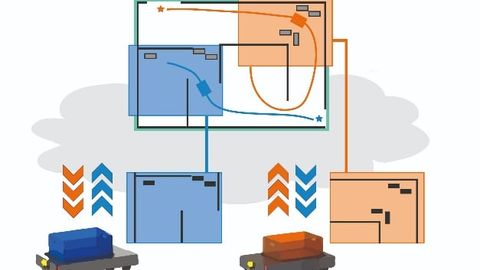
Figure 2: The principle of cooperative mapping: by providing all vehicles with their locally recorded sensor data centrally via the cloud, each vehicle can access a map that is always up to date.
© Fraunhofer IPA'Longterm-SLAM' is the name of one of the two software modules on which the new navigation method is based. SLAM stands for 'Simultaneous Localization and Mapping'. This is a process in which an AGV determines its exact position in space while simultaneously mapping its surroundings. "In a static environment, it would be sufficient for an AGV to carry out a SLAM on its first deployment," explains Pfeiffer, adding: "It could then rely on this map of its surroundings for any further path planning." However, because something changes every second in busy production halls and warehouses, the initial SLAM procedure is not sufficient: "The further the reality in the factory hall moves away from the stored map of the surroundings, the more difficult it is for an AGV to determine its current position," says the engineer with a doctorate.
Pfeiffer's colleagues have therefore developed the aforementioned long-term SLAM method: This involves an AGV continuously recording its surroundings as it navigates from one point to another. It immediately notes all significant changes on the map of its surroundings, which is therefore always up to date. This data can then be used to calculate a collision-free path to the specified destination. "The software module records both cabinets - which often remain in the same place for years - and pallet cages or parked forklift trucks that only remain in one place for a short time," says Pfeiffer.
It is these supposedly or actually static objects that provide an AGV with reference points so that it can determine its current position in the room. This is because the vehicles are equipped with laser scanners that continuously scan the surroundings. In addition, odometric calculations are included in the position estimation. For this purpose, the drive system is equipped with encoders that record the number of wheel revolutions. This allows the distance traveled to be estimated. Thanks to this data fusion, an AGV is able to constantly optimize its path and avoid all potential obstacles in good time.
The path of least resistance
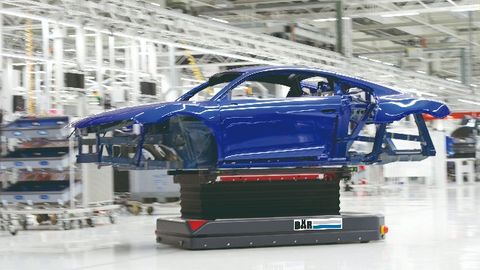
Figure 3: The AGV from Bär Automation allows Audi to evaluate the performance of the overall system and optimize it on the basis of a detailed error analysis.
© Bear AutomationNevertheless, an AGV can encounter an unforeseen obstacle at any time during navigation. Until now, mobile systems have simply stopped in front of the obstacle and alerted the driver to their situation after a predetermined waiting time. With the 'Elastic-Band' software module, which is responsible for reactive path planning and calculates an optimized alternative route, there is now a more elegant solution.
The best way to illustrate exactly how Elastic-Band works is with a rubber band with beads threaded onto it: If you stretch it from the current position of the AGV to its target point, it describes the ideal case of an exact straight line. The size of the beads symbolizes the dimensions of the vehicle together with the minimum distance that it must always maintain for safety reasons. Pfeiffer explains: "A potential field-based calculation method regulates how the beaded rubber band winds its way through the aisles of a high-bay warehouse. Repulsive forces emanate from all objects in the room, which keep the rubber band at a distance. Put simply, this means that the AGV follows the path of least resistance."
'Long-term SLAM' and 'Elastic Band' therefore optimize navigation in a dynamic operating environment - for each individual AGV and completely independently of each other. "They don't actually all have to be equipped with sensors to be able to navigate perfectly," emphasizes Pfeiffer: "They don't even have to be able to plan their own paths. A central, high-performance navigation server can just as easily do that for them."
The potential of 'cloud navigation'

Figure 4: Fraunhofer researcher Kai Pfeiffer: "In theory, an AGV can decide on an alternative route completely autonomously, even if this is not usually desired in practice."
© Fraunhofer IPAThe researchers at Fraunhofer IPA have therefore networked all AGVs and all stationary laser scanners installed on the factory floor via the cloud. Together, they collect all the data required for localization, mapping, path planning and optimization in near real time. In this so-called cooperative path planning, the computationally intensive navigation algorithms are carried out by a central server, which assigns each individual AGV its own route. This allows it to spontaneously avoid any obstacles in a dynamic environment.
According to Pfeiffer, this results in considerable savings in connection with the hardware: "The energy requirement per computing unit is reduced by 70% and the costs for sensors in certain cases even by up to 80%. Practical tests have also shown that 'cloud navigation' increases localization accuracy by up to 75 %. And that's not all: cooperative path planning shortens the distances traveled by up to 20%, while smooth traffic at intersections saves 25% of the time. "This makes AGVs both more efficient and more economical," summarizes Pfeiffer. It is also perfectly feasible to have existing AGVs networked via the cloud at a later date.
Simulation - more realistic than ever before
So far, it can be said that Networked AGVs offer interesting new perspectives for modern Industry 4.0 applications. This is because the cloud delivers data virtually in real time. From this, production planners can create a digital shadow and use it as a basis for making decisions for further optimization or rescheduling. In other words, 'cloud navigation' enables material flow simulations based on real data for the first time: so-called NUC PCs, powerful microcomputers, simulate virtual AGVs for this purpose. At the same time, stationary laser scanners record everything that happens in a factory hall.
Such an installation can be used to simulate how real AGVs react in a dynamic environment, for example to people carelessly crossing their path. This can be visualized either on a computer or using augmented reality glasses. Production planners can use this data to see what additional distance an AGV would have to travel if it encountered a dynamic obstacle, how long the resulting delay would be before it reached its destination and by what factor the battery range would be reduced. In addition, thanks to such realistic simulations, production planners can identify and eliminate dynamically occurring congestion points and other critical points in advance and not only during test operation.
Together with Bär Automation, the scientists at Fraunhofer IPA have already implemented a corresponding AGV for automotive production. It is used in Audi's R8 factory in Ne-ckarsulm, where it transports car bodies from one assembly station to another, replacing the assembly lines that do not allow flexible production. TeleRetail Aitonomi is also pleased with the lively interest in its Rover. The autonomous mini-van is already being tested in five US states and the authorities in Switzerland are considering nationwide road approval. In Dietzenbach, Hesse, the vehicle is set to run errands between the town hall and individual offices in future - the approval process is underway.
At the Fraunhofer IPA stand at Automatica, 'Cloud Navigation' will have its own demonstration area. Visitors can use augmented reality glasses to experience live how virtual AGVs drive around the adjacent areas of the trade fair stand and avoid stand visitors crossing their path in real time without even suspecting it.
Author:
Hannes Weik is editor for robotics at Fraunhofer IPA.


You might also be interested in
The first steps towards digitization
Real-time transparency in the material flow: this was the goal set by Miba when it set out to digitalize its internal logistics processes. But how successful was the close link between ERP and MES in the end? - A field report.
 read more...
How will the IoT change companies in 2020?
How will network technology in companies change in 2020? Axel Simon, Chief Technologist at HPE Aruba, takes a look into the crystal ball
read more...Digital twin revolutionizes maintenance
As virtual representatives of real machines, digital twins open up new possibilities for maintaining and servicing complex industrial plants and systems. A project report.
read more...You can't do without Edge and Swarm
The IoT has changed the requirements for processing data provided by machine sensors and actuators. This needs to happen as quickly as possible - preferably where the data is generated. Edge nodes and swarm computing systems take on this task.
read more...Online machine data under control
Turning huge amounts of data into valuable information - how can this smart industry approach be implemented? Linking PC-based controllers with Matlab and a cloud-based IoT analytics service can be a viable approach.
read more...From modeling directly into the PLC
Despite digitalization and I4.0, the technical functions in a process plant do not become simpler if you break them down to the smallest detail. Nevertheless, the high level of difficulty can be overcome by combining the right tools in the right way.
read more...Where are the new business models?
The necessary new business models are repeatedly cited as the hallmark of an Industry 4.0 environment. But to date, very few companies have seen any of this. Schneider Electric now has a few models up and running.
read more...Why predictive maintenance?
Investments in predictive maintenance systems are worthwhile in order to proactively detect damage. Not only does this increase the service life of a machine, it also opens up new business models for machine manufacturers.
read more...First customer projects via BaSys 4.0
The BMBF project 'Basissystem Industrie 4.0' expired at the end of June 2019. Together with NetApp and Objective Partner, Fraunhofer IESE now offers Industry 4.0 solutions with support and adaptation to customer systems on the basis of this project....
read more...