
Operating machines safely
Wireless panels - the safety aspect
Mobile machines or plant components place special demands on safety. When the topic of WLAN comes into play, previous solutions reach their limits. Sigmatek aims to overcome these with a new generation of handheld operating devices.
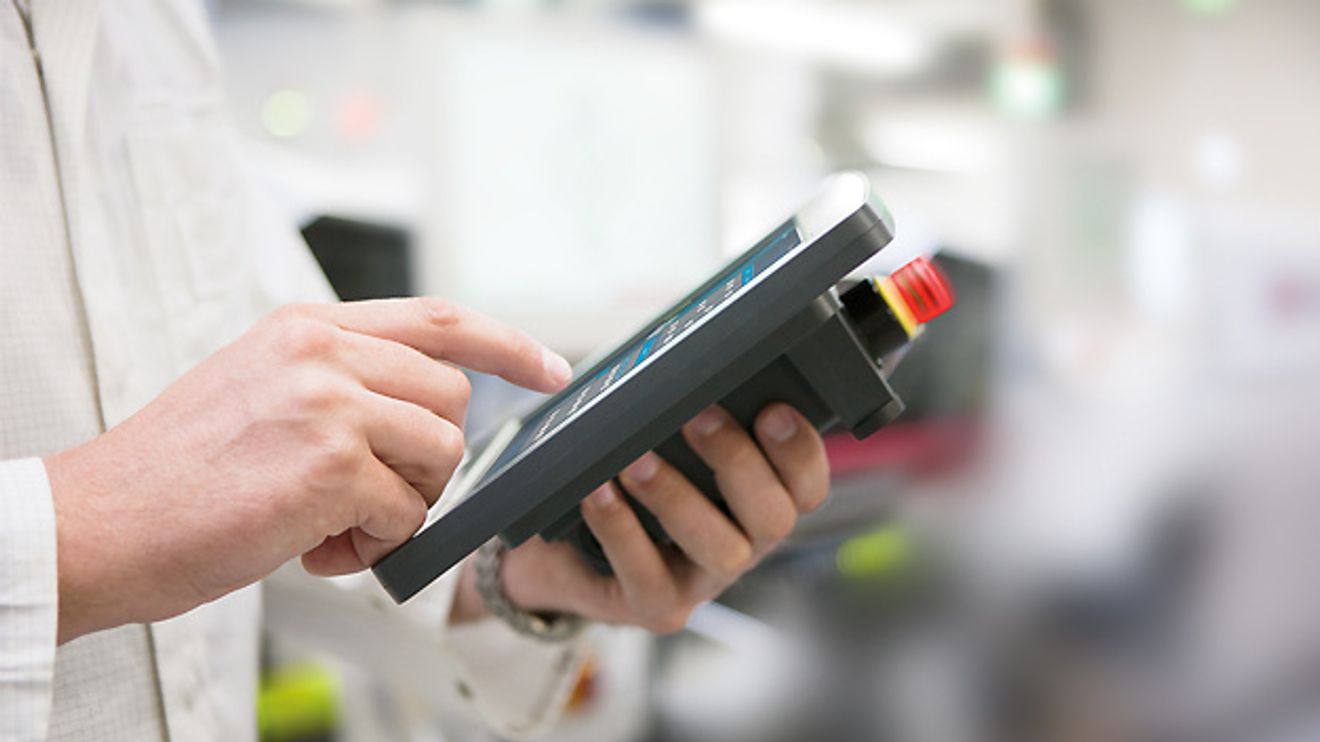
The challenge in automating mobile or mobile machines begins with the limited space available, as the solution to be implemented is often installed directly in the mobile unit - i.e. without a control cabinet. As a result, compact and slim control concepts with low power consumption and reduced power loss are required. It is also becoming increasingly important to transmit all information and process data via wireless connections - including safety-relevant data! But that's not all: functions that were previously unthinkable in compact safety CPUs will play an important role in mobile and intelligent machine networks in the future - think of VNC, web servers, OPC UA, data recording, file transfer, e-mail, PDF creation or intelligent axis control, for example. And all this under the premise of fulfilling the requirements of the Machinery Directive!
Conventional, rigid safety concepts are undoubtedly a hurdle on the outlined path to a safety solution for Industry 4.0, because highly flexible manufacturing and handling concepts with intelligent production equipment that independently adapt their configuration to changing requirements cannot be implemented with today's conventional, usually hard-wired solutions. In other words, the first basic requirement for 'Safety 4.0' is flexible, bus-integrated and programmable safety systems. In addition to greater flexibility, the much simpler cabling on the machine brings valuable benefits, as the safe signals are transmitted over greater distances on the existing system bus. And the OPC UA communication protocol has also brought the unlimited and uncomplicated exchange of information between cooperating safe units into the immediate vicinity.
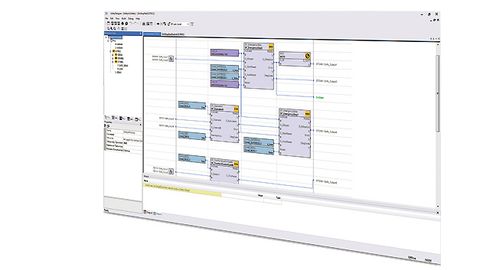
The library stored in the Lasal Safety Designer provides safety function blocks based on PLCopen - including certified blocks for Emergency Stop, Two Hand Control or Guard Locking, for example.
© SigmatekWith the modular and TÜV-certified 'S-Dias Safety' solution as an integral part of the comprehensive 'S-Dias' control and I/O system, Sigmatek laid the foundation for flexibly implementing the safety requirements of tomorrow (in accordance with SIL CL 3 as per IEC 62061 and Performance Level PL e, Cat. 4 as per EN ISO 13849-1/-2) at the end of 2012. The transmission of data between several safety controllers using 'Black Channel' via TCP/IP makes it possible to set up cascaded stand-alone architectures. The application is configured in the graphical editor of the 'Lasal Safety Designer'.
By offering the option of logging system parts on and off, the safety system creates the basis for flexible reconfiguration of machines during operation and, above all, ensures the safe handling of subsystems that are connected wirelessly - via WLAN, for example. Another major advantage of the security solution is that it is completely modular and can be easily adapted to the network structure on site: The monitoring time for secure data transmission is freely adjustable from 0 to 5000 ms. This allows the user to make the ideal setting for each application with regard to the actual latency time that occurs.
The 'missing link' in terms of safety
So far, so good. The 'missing link' in an industrial context has so far undoubtedly been a compact and safety-oriented solution for the reliable wireless operation of machines and systems. Cables prove to be a notorious trip hazard in every factory and can become a cost factor that should not be underestimated, as they can lead to machine downtime or longer maintenance times if they break - for example due to being run over.
Although market-ready solutions for safety via WLAN have been available for a number of years, series use on industrial machines has so far failed due to two factors - the size of the available systems and their high costs of up to 5500 euros. In view of this unsatisfactory situation for many machine manufacturers, Sigmatek has been working intensively on the topic and will be launching wireless WLAN hand-held pendant stations on the market with the upcoming HGW series, which will be available without and - in a second variant - also with the emergency stop function via radio.
A special feature of the new operating devices is that the mobile 10-inch operating panel weighs only around 200 g more than the previous wired version, despite the integrated battery pack. In practice, it even proves to be lighter for the user, as there is no longer any need to lug around a cumbersome and heavy cable. This is essential in terms of comfortable, fatigue-free operation - after all, who can and wants to hold a device weighing more than 2 kg in their hand for hours on end? Compared to other wireless panels, which can weigh up to 3.3 kg, the aforementioned operating device therefore belongs to the 'flyweight' class. In full operation, the battery of the HGW 1031 WLAN panel lasts for at least two hours.
The emergency stop function via WLAN
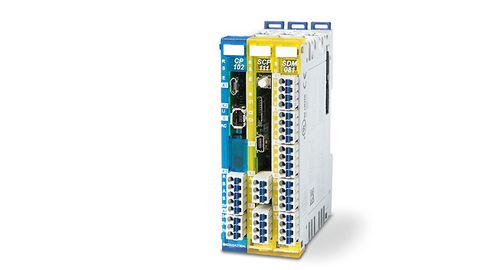
With Sigmatek's S-Dias concept, the CPU, safety controller and safety I/O modules each measure just 12.5 x 104 x 72 mm (W x H x D). Freely programmable safety solutions can therefore be implemented on a width of just 37.5 mm.
© SigmatekDecisive criteria when using devices with wireless transmission are high availability and data throughput via the WLAN. As practically all consumer products today operate via 2.4 GHz WLAN, the HGW 1031 supports both the 2.4 GHz and 5 GHz frequency bands. Depending on the environment and range requirements, users can determine the ideal solution themselves.
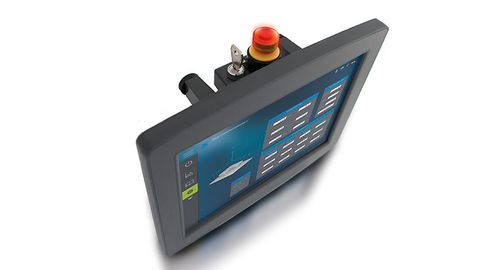
In order to be able to transmit safety data via WLAN in addition to functional data, the hand-held pendant station will be equipped with emergency stop and enabling buttons as well as a key switch. The safety-relevant data is transmitted via the standard WLAN network using the black channel principle. This means that no manufacturer or device-specific protocols are required. The safety data is automatically transferred to the S-Dias safety controller and appears there as a hard-wired emergency stop as a digital input.
For unrestricted use in the wireless network, however, aspects such as uninterrupted transmission must be taken into account. Above all, the bit error probability of the transmission medium, which plays an equally important role with wired devices, is generally higher with wireless transmission. For example, the bit error probability for wireless transmission is around 10-3 - in comparison, it is only 10-5 for a shielded twisted-pair data cable, which is two orders of magnitude better.
This circumstance is therefore of particular importance in radio transmission, whereby the safety-oriented protocol, the maximum number of participants and the transmission cycle are the decisive factors. The bit error rate is resolved with the transmission medium: the better the transmission medium, the better the bit error probability. The latter is included in the residual error probability. The protocol itself can vary depending on the project. The standard protocol for S-Dias and the real-time Ethernet solution Varan supported by Sigmatek is now the FSoE protocol (Fail-safe over Ethercat) with a maximum cycle time of 1 ms. Up to 128 safety modules can be placed in a safety project, and an FSoE-Safe CPU can process up to 1024 PDO data reads and writes. This includes FSoE and interface frames. Furthermore, a Safe CPU can manage up to 170 FSoE connections, provided that each FSoE frame only contains 6 bytes of data and no interface frames are present (170×6 results in 1020 bytes of PDO data). For longer frames, the number is reduced accordingly.
Another new feature is the task of registering the panel with the assigned machine before use. This is particularly important when transferring safety data, as this connection is not enforced by a cable via hardware, but by the safety application programming. It is equally important to log out before leaving the machine environment and before switching off. If only the connection to the integrated emergency stop button is lost, the safety controller must assume that there is a safety-relevant problem and stop the machine safely, as in the case of a cable break. Sigmatek created the necessary mechanisms for this when developing the device software - for example, to ensure that the view of the machine is unobstructed during set-up mode or to guarantee that a specific WLAN panel always connects to the robot intended for it. This also applies to the integration of system parts that are not permanently present or active. A machine-specific number is displayed on the machine, which must be entered on the HGW in order to be able to connect.
What do the standards say?
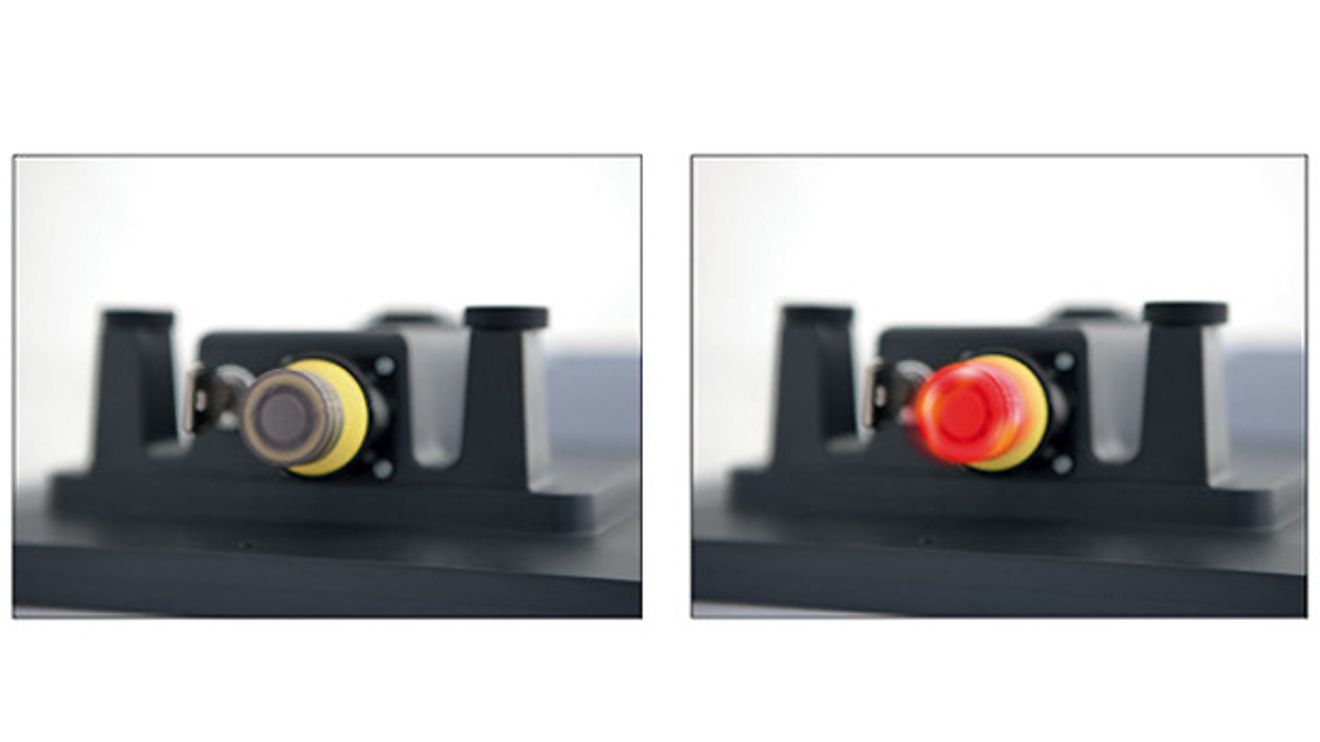
If the mobile HMI is not connected to a machine or system component, this is clearly indicated by the unlit button (left). When connected/logged in correctly, the emergency stop button lights up in red.
© SigmatekThe increasing mobile and wireless use of machines also brings with it new aspects within the applicable safety standards. Until now, it was assumed that an accessible emergency stop button would always perform its intended function - i.e. bring the machine to a safe standstill - when pressed. But what happens if the emergency stop button is pressed on a de-energized and non-functional mobile device such as an operating panel or an automated guided vehicle system? Will the other system components located in the defined environment then be brought to a safe standstill?
It is precisely these applications that are covered by new points in the EN ISO 13850:2016 standard: To avoid confusion between active and non-active emergency stop triggering elements, the color of the element must be changed by means of illumination of the active emergency stop element. Accordingly, the future WLAN hand-held operating device with safety elements from Sigmatek has an actively illuminated emergency stop button, which reduces the risk of incorrect operation. If the control panel is not connected to a machine or system component or robot, this is clearly indicated by the 'gray', i.e. unlit, button. When the mobile HMI is correctly connected or logged on, the emergency stop button lights up in red (LED), clearly indicating that the emergency stop button is working and the safety system is correctly integrated.
With the untethered HMIs, the machine operator can decide for himself where he wants to look into the system.
© SigmatekIn conclusion, it can be said: Wireless HMIs with WLAN such as the HGW 1031 take application dynamics for machine operation to a whole new level. Users can use the existing WLAN infrastructure on the shop floor and control multiple machines, plant components, robots and automated guided vehicles with a single control panel. On the one hand, this leads to cost savings and, on the other, WLAN and wired operating devices can be combined as required. Existing applications can also continue to be used on the mobile HMI variants. The HGW 1031 without safety elements will be available from the end of the second quarter of 2017, while the variant with safety elements will be available in the fourth quarter of 2017.
Author:
Franz Aschl is responsible for innovation management at Sigmatek.


You might also be interested in
Safety first
The development of cobots into a commodity product is closely linked to the issue of safety in robotics - a challenge that needs to be mastered efficiently.
 read more...
Locking with need for clarification - help with risk assessment
DIN EN ISO 1419 has already been available for five years. However, there are always uncertainties regarding the actual safety functions of a guard locking device, which the machine manufacturer must evaluate based on his risk assessment. Here is...
read more...Safe operation via radio - (how) does it work?
Many machine builders want to use tablets in addition to the existing machine operation. Demanded features such as WLAN, camera, multi-touch and much more are available here - but if safety functions are required, these devices reach their limits.
read more...Heavy-duty HRC requires new safety approaches
The topic of HRC is not just for 'lightweights'. In the field of heavy-duty robotics, solutions will also be in demand in the future that allow humans and robots to work together directly without the need for a safety fence. However, this requires...
read more...Secure hold in the slip ring
Transmitting safety-relevant data via slip rings is no trivial matter. Motion control experts from Kollmorgen have developed a TÜV-certified safety solution, including UL approval, together with slip ring manufacturer Stemmann-Technik.
read more...Validation neglected
EN ISO 13849 is decisive for the integration of safety-related control functions in machines. However, the part of the standard relating to validation is often neglected in practice - a major shortcoming.
read more...Dangerous movements well secured
How can dangerous movements be safeguarded? A challenge for the user, as there are a wide variety of functional and normative requirements. An overview.
read more...The intelligent safety switch
Safety modules and safety switches that communicate at I4.0 level simplify troubleshooting. However, the communication capability also has interesting potential for predictive maintenance and tamper protection.
read more...The vampire effect of quantification
There are always controversial discussions regarding the determination of risks for products and systems. But which approaches actually make sense in the context of safety and security? What approach does the new framework for safety and security -...
read more...