
Hy-Line
Not standard but special formats
There are many standard formats: from 4:3 to 5:4 to 16:9. But what if an application requires completely different formats? - There are various approaches to producing such a display.
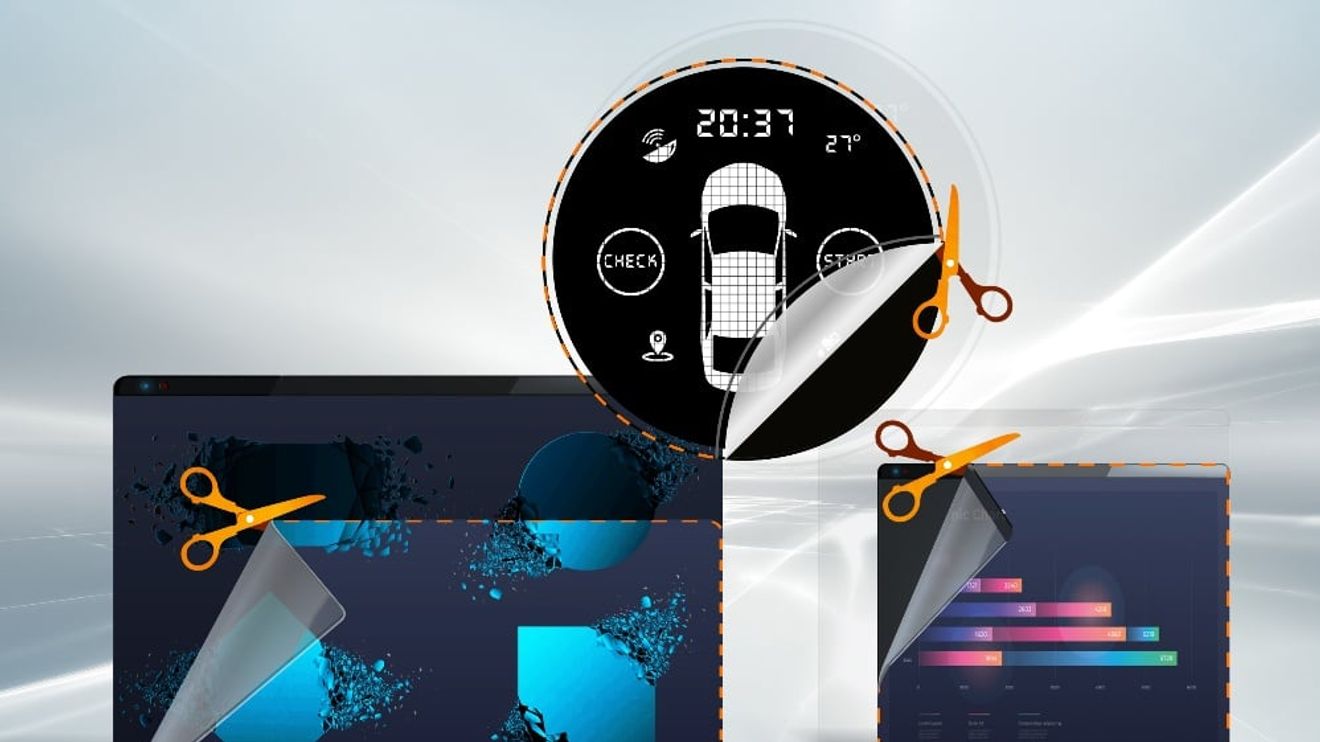

There are basically two approaches to meeting the demand for TFTs with special aspect ratios: A display is developed and manufactured to fit exactly, or a large-format display is cut to size. Both methods have advantages and disadvantages: The development of a customized TFT requires a large amount of development costs of several 100,000 euros and the number of units must be high enough to make it worthwhile to retool production.
It is easier to cut a suitable dispenser display to size. In addition to the display panel, the LED backlight, the bezel and the entire film stack must be adapted. The longitudinal cut results in displays with aspect ratios of 32:9 or 16:3, for example. What requirements must a display meet in order to be suitable for cutting?
Cut TFTs?

A TFT display modulates translucent light from white LEDs from behind, which are arranged on a strip-shaped circuit board as shown in Fig. 1.
The light is scattered onto the surface by a diffuser plate. Before it reaches the display glass, it passes through various optical foils that condition it for the application. Figure 2 shows the structure of a typical TFT module: At the bottom is the back of the module, followed at the top by the diffuser, foils and finally the panel (not shown). The mounting frame, called the bezel, holds all the components together.

TFT panels consist of two glasses between which the liquid crystal material is enclosed. The orientation of the liquid crystal and thus the light transmission is determined by an electric field that emanates from electrodes on the inside of the two glasses. These are controlled via driver components, which are positioned at the edge of the glass separately for the x (column) and y (row) directions. For displays with a higher resolution, several ICs are connected in series. For the 1080 lines of a full HD display, two or three ICs are used. If the lines are disconnected behind the first or second IC, the partial display can continue to function. The possible division results from the arrangement of the ICs: the display can only be cut in such a way that the outputs of an IC remain completely intact, i.e. only in integer fractions.
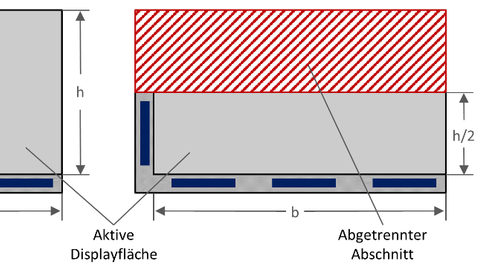
Manufacturers refer to the elongated display as a 'stretch display' or 'bar type display'. See Figure 3 for a display that has a 32:9 format after cutting. As long as there is a line and a gap driver for each pixel, the shape of the display is irrelevant. The optical properties and environmental conditions of the original display are retained.
The electrical control

Figure 4 shows the circuit board of a timing controller that converts the LVDS signal coming from the LCD controller into control signals for the drivers, which are connected via flex foils. While the connection (Figure 5) between the PCB and the glass has only a few dozen lines, the driver ICs, which are located directly on the glass, have several hundred outputs to control the display segments. Other components on the board generate the voltages required to operate the display and the LED backlight.

Figure 5: The connection between the timing controller and the LCD panel.
© Hy-Line Computer ComponentsWith form-cut displays, the timing controller board remains unchanged and is unaware of the reduced number of driver outputs. As it is controlled with the timing of the original module (e.g. 1920 x 1080), the timing parameters of the control are unchanged. Only the application software has to take the changed format of the partial screen into account.
Original displays - unusual formats
There are also displays with original square or round dimensions. Small displays of this type use a single-chip TFT controller that is integrated on the panel as a chip-on-glass. It combines the functions of timing controller, driver for rows and columns, and in some cases also the frame buffer. The host interface does not calculate with a PC environment, but with an ARM or microcontroller. In addition to MIPI, the display can be filled with data via SPI or a CPU bus. To reduce the load on the system controller, the color depth can be reduced from 24 to 16 bits.

Single-chip displays are common in diagonals of up to 5 inches and a resolution of up to
resolution of up to 720 × 720. The 26.5-inch display from LG Display, on the other hand, offers a high resolution of 1920 × 1920 in a square format and is connected via LVDS. Displays used in tablet computers such as Apple iPads have an aspect ratio of 3:2.
Smart watches or fitness trainers use round displays; control lines for rows and columns are routed along the edge of the viewing area.
Circular image section
In the display shown in Figure 6, the driver is located at the lower end of the glass as a single-chip solution, so the housing must be shaped accordingly.
Application examples
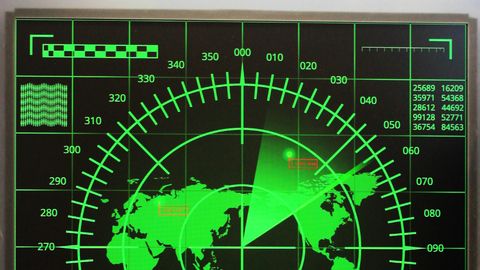
Cut displays can be used where information mainly needs to be displayed in text format - for example, for a bus stop display, a seat reservation, a route map or a variable signpost in a conference building.
The 26.5-inch square display from LG Display is well suited for displaying measured values from systems such as radar or sonar, which offer circular coverage. Small square displays fit into switch boxes in home automation.

Round displays are also used in industry as intelligent round instruments that not only record and display measured values, but also transmit them to the control station. They can be used to display not only a measured value locally, but also a trend or a warning function that provides the employee on site with valuable additional information.
In portrait format, slim displays are used where long lists need to be displayed (see Fig. 8) or where space is to be used at a drinks vending machine or elevator control system. Equipped with a touchscreen, they offer the customer added value, for example by providing further information on the selected product or displaying alternatives at the vending machine.
A special solution can be realized with the Electronic Shelf Label Display from LG Display (see Fig. 9). The touchscreen in in-cell technology is designed as an integral part of the display and is located inside the TFT cell. The driver IC operates both the display and the touchscreen without interfering with each other. At just 48 mm high, the display is slim enough to replace conventional labeling on the shelf.
This line-shaped display can also offer added value in household appliances such as washing machines, dishwashers and ovens.


You might also be interested in
The modular HMI concept
Customize HMIs according to your needs! A modular system for glass, display and touch sensor from the drawer should make this possible for machine builders.
 read more...
Products of the year - The e-paper special
"Products of the Year 2023" goes interactive: the new e-paper including video news is here! The winners of the readers' poll have been chosen and in our interactive special edition you will find all the winning products at a glance and exclusive...
read more...Operating & monitoring - The winners
Voice control, smart glasses and safe HMI were convincing in the 'Operating & monitoring' category.
read more...Products of the year 2023 - your vote counts!
96 products in 12 categories are up for election for the "Products of the Year 2023"! Take part and win Saturn vouchers worth €500, among other things!
read more...The top articles in September 2022
The top articles in September are characterized by typos, tensions between IT and OT, anticipation, opportunities through self-sufficiency and an absolute revolution in automation technology!
read more...Hello machine tool! - Voice control in the industry
Voice control has arrived in our everyday lives, whether in the car, for operating smartphones or home systems. The technology is also becoming increasingly important in the professional environment. Its use is less complicated than expected.
read more...Interview with Martin Dibold, Hy-Line
Voice control - operating without touching
What are the advantages of voice control? What about the acceptance of the technology in the industry? Is it also suitable for safety applications? Martin Dibold from Hy-Line provides insights into voice control in an industrial environment.
read more...Human Machine Interfaces - Glossary and application examples
A glossary of common abbreviations and a list of various examples of voice control applications in practice.
read more...The interactive e-paper of the winners
The interactive e-paper Computer&Automation "Products of the Year 2022" offers twelve categories, 36 winners and video interviews with the award winners at a glance! Click right in and experience the industry's pacesetters up close.
read more...