
Interview: Martin Dibold, Hy-Line
"An 'okay' is not enough"
Hy-Line has gradually built up expertise in the field of HMI and touch displays. Managing Director Martin Dibold explains the benefits of this step for the distributor's customers and how an eye for detail becomes a competitive advantage.

Hy-Line is changing from a distributor to a system partner. Has the classic distribution model had its day?
Martin Dibold: The classic distribution model is still our core business and will remain so. Many of our customers buy in displays, touch or computers, supplementing their expertise with the right hardware. One example: in the smart home sector in particular, there are many pure software providers, while we supply the hardware. But it's clear that the future is moving towards systems.
Has the pace of change accelerated due to the fast pace of change and the trend towards Industry 4.0?
Dibold : The development of PCAP technology, i.e. projected capacitive touchscreen technology, in 2008 changed a great deal: With resistive touchscreens, a housing was simply added; with PCAP, there were suddenly design possibilities. You can play with glass as a surface, make edges visible or semi-visible, polish, create different colors and milling, sliders or glass buttons. Customers spend more money on the glass surface than on the rest of the system because they can differentiate themselves through design. However, this has raised new questions that we were unable to answer at the beginning. Today, we are glass specialists: we can say exactly which glass is suitable for which requirement and how it needs to be processed.
Do you work with partners in this area?
Dibold: Very few companies that sell glass also manufacture it. The decisive factor is the finishing of glass: there are some glass manufacturers, but only a few glass finishers, i.e. those who print, polish, grind or mill glass. We work with several partners, because not everyone can do everything.
What is it like in the industry: are finger guides and milling still in demand, especially in view of the hygiene concept?
Dibold: That depends on the application: In medicine, milling is not used because it can be a dirty edge. On a machine in production, this plays a rather subordinate role.
Technical support is one of your core competencies as a distributor. How big is the step from there to becoming a development partner?
Dibold: It was important for us to have in-house expertise and to be independent. The know-how is in the calibration of the touch display. Let's take the smartphone as an example: If the display is wet, it sometimes no longer works. Unthinkable in industry: We have requirements where displays have to be able to be operated with thick gloves even in the rain.
It takes about a week to set this up. It was a huge step to bring this expertise in-house and not leave it with the manufacturer. But the time savings alone make it worthwhile: we used to have to send customer systems to the manufacturer for the smallest changes - that takes time. Today, we go to the EMC lab with the customer ourselves if necessary.
Not all fingers are the same - system settings according to customer requirements
You just said that it takes a week to calibrate the Touch. Per display or per system?
Dibold: Touch depends on the system in which it is embedded. Only when the system is ready is it calibrated. All eventualities are included in the calibration, which takes us about a week. It's not enough to just say 'it fits', so we ask our customers for precise information on the operating environment, application, etc. For example, we have the exact glove that will ultimately be used to operate the system. In addition, not every finger is the same, so we have different test fingers.
Different employees work on each system, and gloves can have different materials depending on the employee. How does that work?
Dibold: It's more about the thickness than the material itself. We don't adjust 'to the edge', but are guided by different scenarios. There is a physical limit that we push to the limit. We have to find a balance between 'it works, triggers when I touch it and is not yet over-sensitive'. The edges are challenging: I also want to be able to use the touch function on the edges without restrictions. Think of the X in the top right-hand corner, for example. This should also be operable at all times. We have special Edge Compensation setting options here. In addition, glass is scratched and broken; when it is broken, microcracks are created at the edges, which are ground out and polished. That's why I say we are also glass specialists.
Hy-Line offers touch displays with connected embedded systems. What advantages does computing power offer directly on the display?
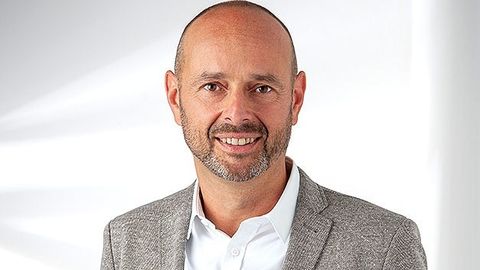
Martin Dibold: "Hardware is usually narrowly defined, there's not much leeway here. I can differentiate myself through software."
© Hy-LineDibold: On the one hand, it offers advantages in the control of the display: fewer components, fewer cables, fewer sources of error. In addition, calculations can be carried out directly on the HMI, for example for machine learning applications. However, I need the necessary computing power for this.
How can systems be upgraded and converted?
Dibold: This is where platforms come into their own: Kontron, formerly Fujitsu, for example, offers a platform with different computing power. Simply remove a board and insert a new one with a higher power density. However, sometimes the cooling has to be adapted. This is another reason why we offer a cooling concept for several performance levels.
Which sensors can be installed in the Touch?
Dibold: From proximity sensors to sensitive buttons, from cameras to RFID, temperature and humidity sensors - there are no limits to the imagination.
What role does software play?
Dibold: Software is becoming increasingly important. Hardware is usually narrowly defined, there is not much leeway here. I can use software to differentiate myself, especially in terms of design: if the hardware system already looks very good, I can use visualization software to reinforce the positive first impression. Software is particularly important for holographic displays.
Can you expand on this?
Dibold: As with every display, I have a certain pixel pitch, basically the resolution. With holographic displays I have a certain limitation, so 'normal software' doesn't look as good. The software has to be adapted so that the size of buttons, the font, the placement of elements as well as contrast and color fit. With holographic displays, the displayed image is smaller than the original image, so I have to take that into account.
Another point is user-friendliness. Intuitive usability is important, but ideas differ depending on the industry. It must be specific to the target group.
Re-design due to delivery difficulties
Apps can also be installed on smartphones. Will the smartphone or tablet replace traditional industrial HMI?
Dibold: 'Bring your own device' is the buzzword here. Great in theory, but in practice it comes with hurdles. The industrial requirements for the operating device are still high - dust, moisture, et cetera. In addition, application software always has to be adapted to the latest operating system update of common smartphones, so the effort involved is very high.
What trends have emerged or intensified in the area of operation and monitoring due to corona?
Dibold : Contactless operating concepts are particularly exciting in the public sector - not only because of coronavirus, but also because of their user-friendliness. Basically, you could say that customers want to have everything they use in their private lives in industry or at work. This means that everything I have in my car or on my smartphone today will arrive in industry with a time delay. Voice control is commonplace, gesture control will come.
Speaking of voice control: will we still need a touch display at all?
Dibold: We have been asking ourselves the question for some time: What comes after touch? What can we expect in five years' time? Voice control is exciting, but what about people who are hoarse or generally unable to speak? In environments where my hands are often full or dirty, voice control is great. I'm thinking of the medical sector or commercial kitchens. It's similar with gesture control. Touchless controls are great, but at the moment we still need another control option.
What business models are created by and with software?
Dibold: At the moment, software is mainly a means of taking the hardware and the application to the next level. In the future, however, it will also become a stand-alone product, for example voice control.
What question do you almost always get asked?
Dibold: In principle, it's mostly about long-term availability, whether in automation or medical technology. At the moment, however, the first question is: Can you deliver?
And can you?
Dibold: We have the same challenges as others. So far, things are going relatively well and we can deliver most things. Sometimes we offer alternatives. One example: a display was no longer available and we developed it to be form-fit-function compatible because the display controller was not available. We used another available controller. Only the software control for this component had to be adapted, which meant one day's work. No comparison to waiting months for the original controller.
What do you see as your main task as a development partner?
Dibold: Our job is to ask a lot of questions: What exactly are the target applications? What is the dream USP? What is 'must have', what is 'nice to have'? Basically, it's a balancing act between developers, product managers and purchasers, because three interests come together here: one wants to offer the most technically interesting solution possible, the other wants to sell a lot and the third wants to pay as little as possible. Our job is to bring everything together and offer the best possible system at the best possible price.


You might also be interested in
Please do not touch!
The operation of devices and machines without direct physical contact has attracted increased interest during the coronavirus pandemic. One option for contactless operation is holographic input.
 read more...
Not standard but special formats
There are many standard formats: from 4:3 to 5:4 to 16:9. But what if an application requires completely different formats? - There are various approaches to producing such a display.
read more...The modular HMI concept
Customize HMIs according to your needs! A modular system for glass, display and touch sensor from the drawer should make this possible for machine builders.
read more...Products of the year - The e-paper special
"Products of the Year 2023" goes interactive: the new e-paper including video news is here! The winners of the readers' poll have been chosen and in our interactive special edition you will find all the winning products at a glance and exclusive...
read more...Operating & monitoring - The winners
Voice control, smart glasses and safe HMI were convincing in the 'Operating & monitoring' category.
read more...Products of the year 2023 - your vote counts!
96 products in 12 categories are up for election for the "Products of the Year 2023"! Take part and win Saturn vouchers worth €500, among other things!
read more...The top articles in September 2022
The top articles in September are characterized by typos, tensions between IT and OT, anticipation, opportunities through self-sufficiency and an absolute revolution in automation technology!
read more...Hello machine tool! - Voice control in the industry
Voice control has arrived in our everyday lives, whether in the car, for operating smartphones or home systems. The technology is also becoming increasingly important in the professional environment. Its use is less complicated than expected.
read more...Interview with Martin Dibold, Hy-Line
Voice control - operating without touching
What are the advantages of voice control? What about the acceptance of the technology in the industry? Is it also suitable for safety applications? Martin Dibold from Hy-Line provides insights into voice control in an industrial environment.
read more...