
Ifak
It's more efficient!
How can man and machine cooperate better in production? With the ITEA project Optimum, a research association has now formulated and implemented the necessary development goals. - Article 1 of 2.
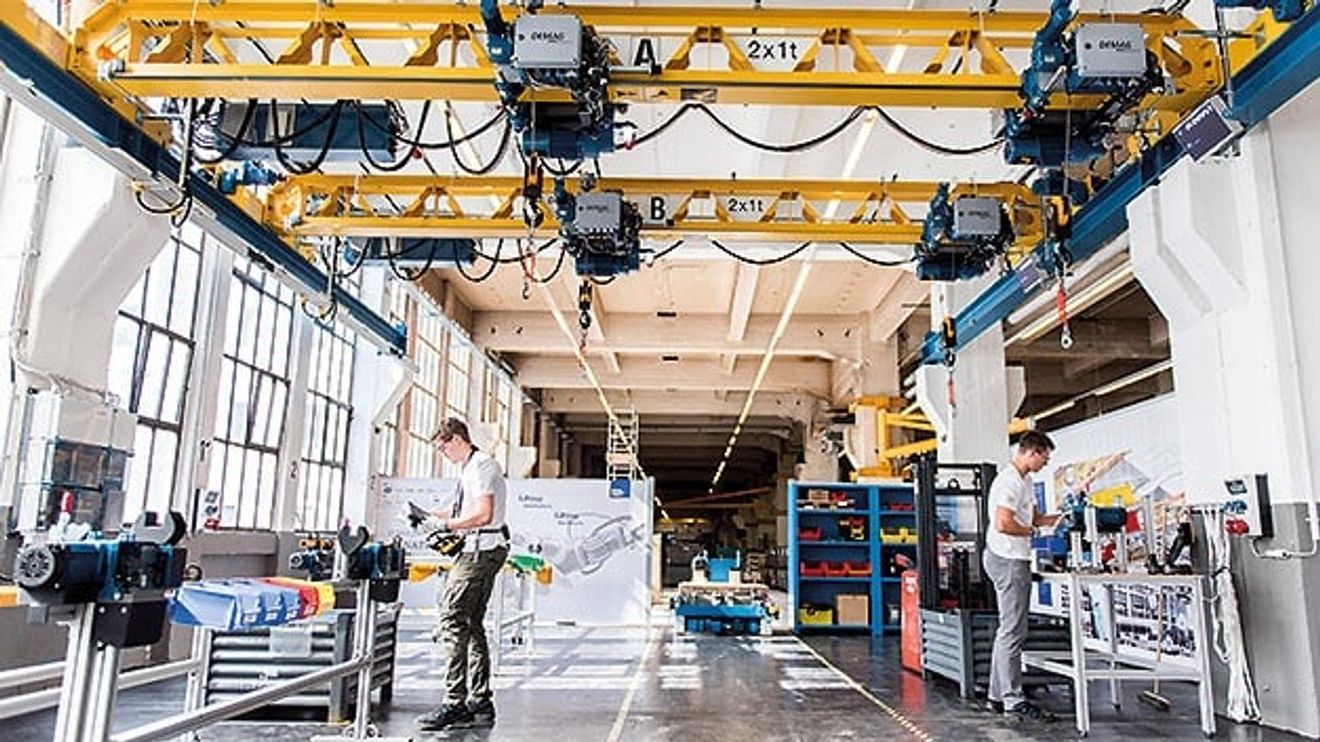
Components in the material handling segment are increasingly turning into modular units. International competitive pressure means that new requirements, such as better integration of the operator while at the same time increasing functional safety, are decisive factors for the acceptance of solutions on the market.
Today's high variance in control system design and the different interfaces represent a challenge. In order to meet the requirements of the future, the hardware diversity of machine control systems must be reduced and data protocols standardized. In-house processes must also be further developed and adapted to the new conditions. Many innovative machine functions will be determined by software in the future, meaning that sales will be less concerned with promoting purely mechanical functions and more with intelligent machine functions and networking options.
The research and development goals
In future, the above-mentioned challenges are to be solved by assistance functions that can be used on different types of devices such as smartphones, tablets, classic SCADA systems or control components. This requires, for example, extended development tools for the design in order to configure control programs with geometric data directly from the 3D planning or to simplify the engineering of distributed applications. The aim of the procedure is to design the entire application and distribute the functions in a resource-oriented manner, whereby the resulting communication between the sub-applications is implicitly established by the engineering tools or by the runtime environment and a central coordination instance is no longer necessary.
The use of radio-based communication systems such as 5G naturally requires security, so that practicable solutions must be generated to create resilient networks with distributed security means. The close involvement of operators in production-related logistics also requires the localization of both the operators themselves and the moving and static components. The automated use of cranes in particular requires consideration of areas that must not be crossed. There should also be a simple way of defining these areas in 3D planning tools and transferring them to the control systems via standardized interfaces or exchange formats.
Distributed control system
In contrast to the centralized and hierarchically structured control and application processes established in the initial situation, the innovative assistance functions envisaged require the interaction of several control components in the machines involved. This component-based and "collaborative automation" requires distributed and modular functionalities. At the heart of the concept developed are devices that are primarily used in an industrial environment and can take on various tasks. They run autonomously and are embedded directly in machines. A portable "Distributed Control Platform" (DCP) component is provided on the devices specifically to fulfill the control tasks.
It is based on the Distributed Object Model Environment (DOME) and allows any number of devices and machines to work together to solve transportation tasks, for example. Like any conventional control device, the DCP processes sensor data and generates actuator information, which is exchanged with the peripherals via suitable interfaces. Control information between DCP instances is exchanged via an efficient communication protocol, which can also be secure if IP communication is used.
The architecture concept of an industrial device provides for other components - specific to the application - to be present in addition to the pure control components. It is important to emphasize that dynamic configuration tasks are carried out via the Industrial IoT component and that no central coordination of control tasks is required. The DCP components establish communication with each other independently if there are application-specific relationships between them.
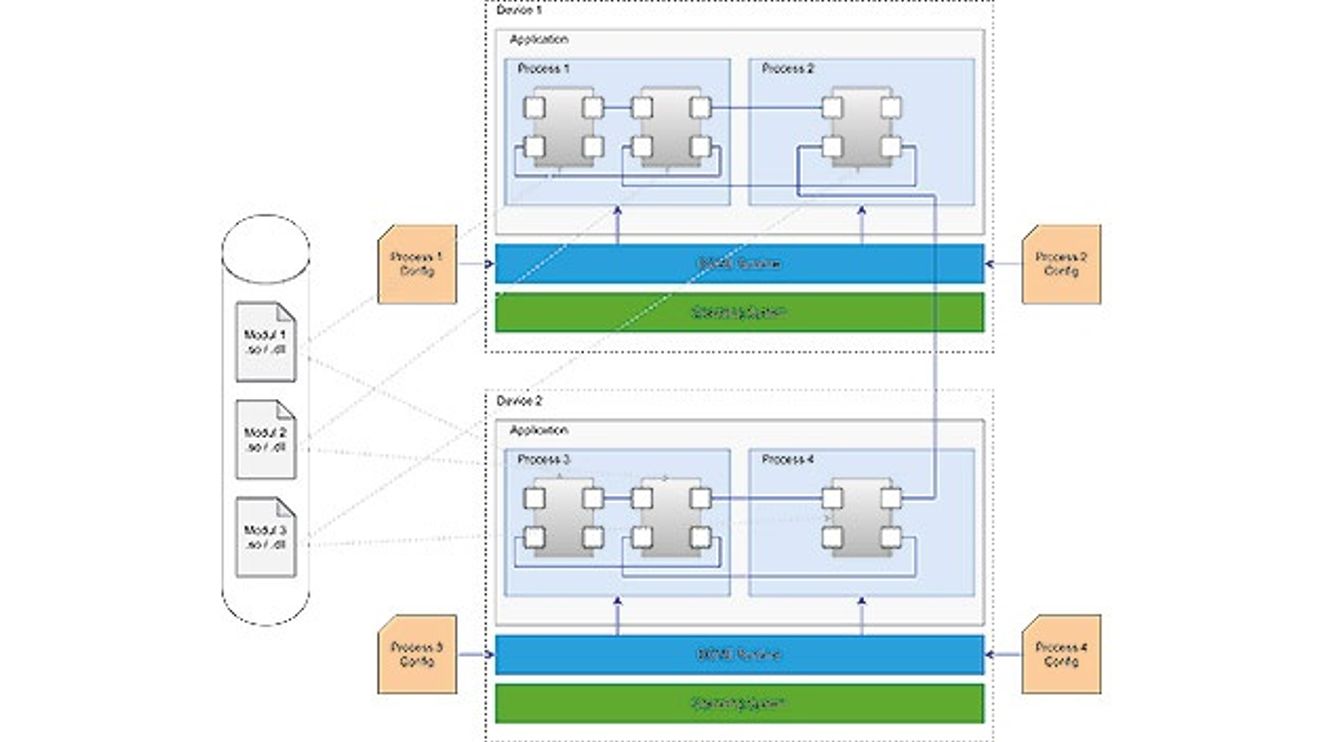
A control program in the DCP is not a monolithically developed application, but is made up of Control Application Objects (CAO) that exchange data and control flows with each other via connection points, the ports, defined by the developer. They map IEC 61131-3 function blocks into the object-oriented world for high-level language programming and allow low-code application development.
Figure 2 shows the structure of such an application. The ready-made CAOs are available in a library and can be instantiated and interconnected in the application by the application developer. The development tool generates the configuration files required for the sub-processes and the runtime environment itself creates the processes, CAO the object connections.
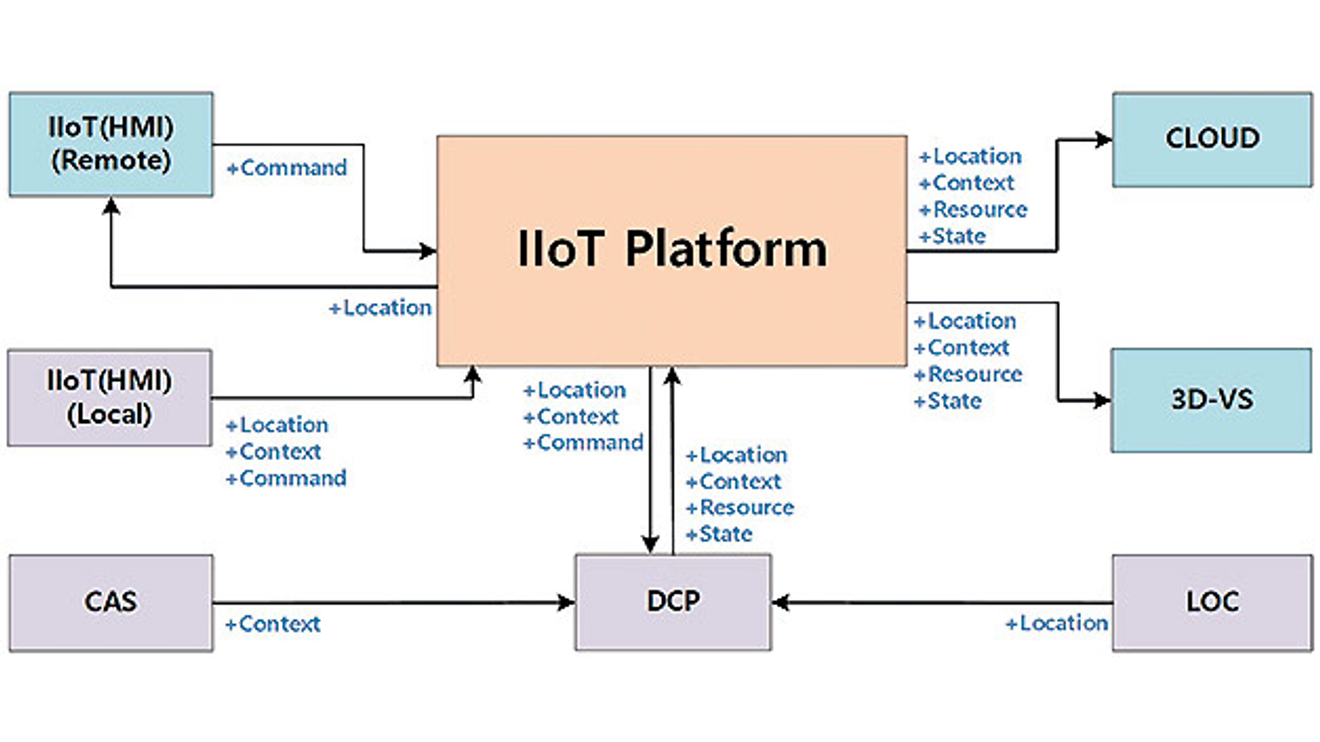
The conceptual flow of information between the components: The device-internal data exchange takes place via MQTT.
© Optimum ConsortiumThe easy-to-use Messa Queuing Telemetry Transport (MQTT) is used to decouple control tasks from non-control tasks. MQTT messages can be both generated and consumed by the COA control objects. The other components on the embedded industrial device also use MQTT for device-internal data exchange. Depending on the device design, the context or localization information, for example, is recorded, processed and forwarded directly in the DCP or processed via MQTT on the IIoT platform.
The IIoT platform
The IIoT platform enables complex communication patterns in a heterogeneous device environment. It is the central instance for vertical communication and is responsible for the exchange of system parameters and device data. A specially developed information model is used to link internal device communication via MQTT and external communication via OPC UA. This coupling initially follows the recommendations of the OPC UA standard for coupling OPC UA and MQTT, but goes beyond this, as data can be subscribed to via MQTT.
The IIoT platform can be seen as a universally applicable instance that can integrate older devices and machines into Industry 4.0 scenarios via plug & play technology. In the example shown in Figure 3, the IIoT platform is used not only for device-to-device communication but also to exchange data with the components listed below:
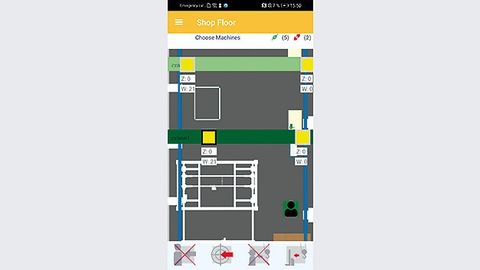
The graphical user interface: Establishes the interface between the operator and the DCP.
© Demag Cranes & Components- Context Awareness Service (CAS): Enables the processing and storage of context information in the industrial device.
- Localization (LOC): Processes the location information of the device in real time and makes it available to the DCP.
- DCP: Controls devices in real time with context and location information and provides information to other devices and external components via the llOT platform as required. It controls the local device using the status information of other devices (user interface, 3D-VS)
- User interface: Delivers control commands and operator location information (provided by separate wearable device) to the DCP and, if necessary, performs collaboration between the operator and the device by receiving the device's status information from the DCP.
- 3D Visualization (3D-VS): Provides the necessary information to monitor and visualize the working status and location of the device.
- CLOUD: Executes the request/response required to transfer the data generated in the lower layer to the upper layer.
The entire deployment of all components used on the devices follows the container concept using Docker. This makes it easier to maintain and manage different versions.
| The Itea Optimum project |
|---|
|
Consortia from Turkey, Romania, the UK, Spain and Germany, as well as South Korea as an associated country, took part in the Optimum project. The project was led by the German partner Demag Cranes & Components, with the German partners receiving funding from the Federal Ministry of Education and Research. The project was under the auspices of the European research cluster ITEA. |
The authors:
-
Matthias Riedl, Head of the ICT & Automation business unit at Ifak.
-
Anja Fischer, Project Manager for Research Projects at Demag Cranes & Components.
-
Giuliano Persico, Manager of the Research Department at Demag Cranes & Components.
-
Julian Lategahn, R & D Engineer at Comnovo GmbH.


You might also be interested in
Operating several machines with one device
ACD Antriebstechnik presents the Mobile Safety Panel SP2000.
 read more...
Grossenbacher systems at the SPS 2022
Smart Panels with Soft PLC under Linux
Grossenbacher Systeme presents a new generation of compact operating panels with soft PLC under Linux.
read more...Beckhoff Automation and Mathworks
How does the intelligence get to the controls?
Although the control software is becoming an increasingly important part of the overall machine, functional tests as part of simulations and virtual commissioning still play a subordinate role in mechanical and plant engineering. This does not have...
read more...Interview with Martin Dibold, Hy-Line
Voice control - operating without touching
What are the advantages of voice control? What about the acceptance of the technology in the industry? Is it also suitable for safety applications? Martin Dibold from Hy-Line provides insights into voice control in an industrial environment.
read more...Operating & monitoring - The winners
Innovative operating concepts, user-friendliness and flexibility characterize the winning products in the 'Operating & Monitoring' category.
read more...ifak & Paper Technology Foundation PTS
Practical test of standards
Customized Industry 4.0 solutions - this can also be implemented in conservative industries. Ifak and PTS demonstrate this with an example in the paper industry.
read more...It's more efficient! - Part 2
How can man and machine cooperate better in production? With the ITEA project Optimum, a research association has now formulated and implemented the necessary development goals. Article 2.
read more...ifak & Paper Technology Foundation PTS
Practical test of standards
Customized Industry 4.0 solutions - this can also be implemented in conservative industries. Ifak and PTS demonstrate this with an example in the paper industry.
read more...Mobile communications / Hannover Messe 2019
5G test fields and applications live at the trade fair
What benefits will the upcoming 5G mobile communications standard bring to industrial applications? Visitors to Hannover Messe 2019 will find answers to these questions in Hall 16, where the organizer - Deutsche Messe AG - is bundling the topic in...
read more...