
Multimeter
Thermal imaging camera included
RS Components‘ RS-9889 thermal imaging multimeter allows you to detect thermal overload problems in electrical equipment from a safe distance without the need for physical contact.
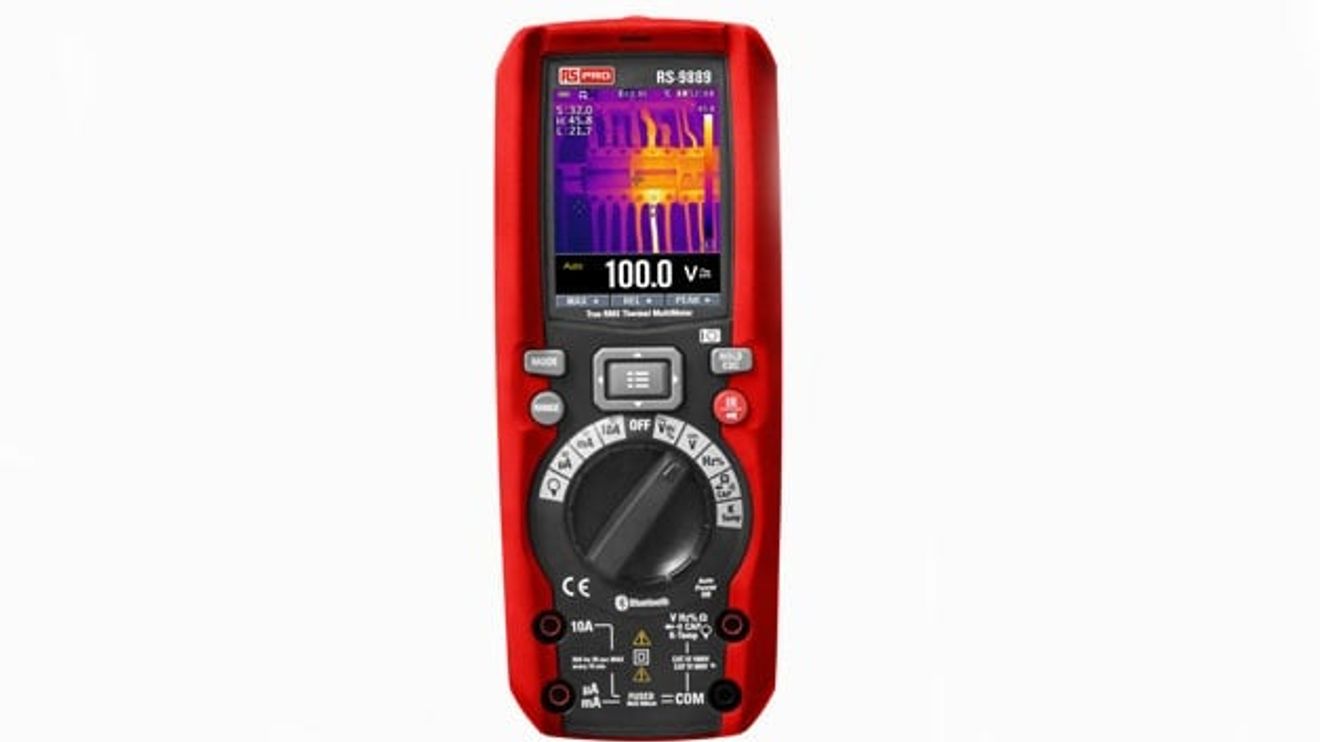
The thermal imaging DMM is an all-in-one hand-held device that combines the features of a classic digital multimeter for measuring circuit parameters such as voltages, currents and resistances with those of an infrared thermal imaging camera. In this way, hot and cool points in electrical components can be identified on a visible thermogram. The thermal imaging camera offers maximum, minimum and mean crosshair alignment to help the user identify and measure the desired temperature ranges. A Bluetooth Low Energy (BLE) connection is used to quickly transfer thermal images to other devices via the Thermview+ app. The thermal imaging camera has a 2.8 inch TFT color LCD screen with an infrared resolution of 80 x 80 pixels. The thermal image multimeter also serves as a diode, resistance and continuity tester and is equipped with a buzzer for this purpose. The device can measure temperatures up to 1000 °C with a type K thermocouple sensor.


You might also be interested in
Standstill monitor: Easy to retrofit
The sensorless standstill monitor UG 6946 from Dold's 'Safemaster S' series has a width of 22.5 mm. If a machine is no longer moving in a dangerous direction, the safety gate can be released immediately when a standstill is detected.
 read more...
Combined device enables networked measurement
AD-LU 620 GVF series power transmitters meet the requirements of today's energy management systems. By recording the individual energy consumption of all consumers, high load profiles can be identified and the simultaneous operation of...
read more...Flexible thanks to support arm system
Thanks to the combination of industrial PCs from Noax with support arm systems, the workstation can be optimally designed.
read more...Configure and parameterize field devices easily
Endress+Hauser is now offering the Field Xpert tablet PC together with Softing's mobiLink interface as a bundle for parameterization and commissioning of field devices.
read more...Data encryption via VPN
With Endian 4i Edge X from Endian, data from heterogeneous machine parks can be read out and displayed in dashboards for analysis. Remote maintenance and predictive maintenance can be implemented with the gateway.
read more...Withstand high pressure and dust
B&R now also offers the 'Acopostrak' track system in protection class IP69K. In this version, the track can be cleaned with high pressure and temperatures of up to 80 °C and is also fully protected against dust.
read more...Forecast remaining useful life
ABB is expanding the Ability Condition Monitoring service for the drive train, which connects drives, motors, pumps and bearings, with an option for condition-based maintenance of drives.
read more...Platform-independent remote access
Usually, the control of processes with a PLC runs fully automatically after the initial parameterization. In some applications, however, it is necessary for the operator or technician to be able to call up and set the process data at any time.
read more...Measure temperature, pressure and flow rate
Bachmann electronic is launching the SAI205 safety module onto the market. According to the manufacturer, it offers extremely accurate measurement of external conditions such as temperature, mechanical stress, pressure and flow rate.
read more...