
Janitza electronics
Say goodbye to load peaks
Peak loads are expensive. Even one-off 'slips' cause additional costs in the five-figure range. However, the obvious solution of temporarily switching off large consumers such as heating systems must not compromise process reliability. Modern measurement technology can help.
Mitschke Kunststoffwerk processes all types of thermoplastics. The family business manufactures parts from 1 g to 30 kg with dimensions from 10 mm to 2200 mm. Injection molding machines with a clamping force of up to 32,000 kN operate on a production area of 5000 m². The energy costs are correspondingly high.
Tobias Echtler, Head of Injection Molding at Mitschke, gives some key figures: "We have an electricity consumption of around 4.7 million kWh per year with peak loads of up to 1350 kW. These peak loads cost 93 euros per kW. This gives us fixed costs of a good 125,000 euros for the peak load alone. That's why we urgently wanted to reduce them." Some relief could be achieved by applying for individual grid charges, which means that refunds are offered if the customer does not exceed 80% of the peak load in a given period. However, this cannot always be reconciled with production requirements. In addition, the abolition of this bonus system is being negotiated. The company management is therefore looking for sustainable solutions.
Energy consumption precisely analyzed
A load peak is defined as the average value of a measuring period of 900 s, which must also be present continuously during the so-called catch time of 10 s. If the user is able to record this value quickly enough and switch off some parts of the system before the 10 s have elapsed, the peak load is not calculated.
The heaters of the injection molding machines are predestined for this.
At Mitschke, these heaters alone have connected loads of 60 kW to around 180 kW on the eight largest machines. Recording and control are problematic - "We knew the peaks, but not the respective cause," Tobias Echtler describes the initial situation. The entire system was analyzed together with the electrical department: What were the largest individual consumers? How long could they be switched off without affecting the production quality? It was known that the thick-walled cylinder tubes of the large machines would keep the melt at temperature even if the heating were to fail for several minutes. The largest consumers were also the least sensitive to a shutdown. This defined the savings potential. The next step was to find suitable measurement and control technology.
In the search for a suitable provider, Mitschke came across Janitza's measuring devices and software. The choice fell on their 'UMG 605-Pro' power quality analyzer, which is both programmable and has interfaces for communication with fieldbus modules. Peak load optimization is handled by the optionally available 'Emax' software app, which is installed directly on the measuring device.
Measuring and controlling
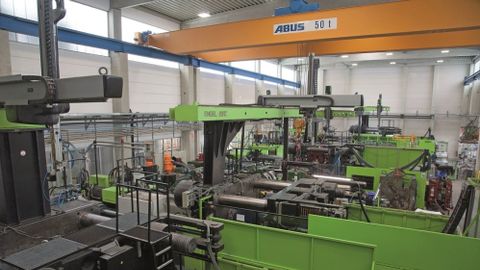
Mitschke injection molding machines with a clamping force of up to 32,000 kN produce plastic parts weighing up to 30 kg with dimensions of up to 2200 mm.
© Martin WitzschAs Mitschke has two transformer stations and three sub-distribution boards, measuring with transformer coils would have been relatively complex. However, it was easier: the devices were installed in the immediate vicinity of the utility company's meter. An additional module on the meter transmits the measured active energy and the synchronization pulse to the measuring device. The pulse signals the start of a measuring period. As no further information about the voltage quality etc. was initially required, this solution is completely sufficient. It also ensures that Mitschke works with the same measured values - especially the same measurement periods - as the energy supplier.
Switching off the heaters was similarly easy to implement. Janitza offers fieldbus modules with digital inputs and outputs under the name 'FBM'. These are connected to the UMG measurement devices as slaves via an RS485 interface with Modbus RTU protocol. At Mitschke, the fieldbus modules control relays that pull the heating contactor of a machine. They are controlled directly by the 'Emax' app on the measuring device. If it detects that the set power setpoint is about to be exceeded, the heaters of the machines in operation are switched off one after the other with priority. A minimum switch-off or switch-on time can be stored for each machine. This means that peaks cannot be completely avoided, but they can be smoothed out. Thanks to the inertia of the machines, a cylinder heater can be switched off for three minutes. Heating must then be resumed. The heating runs again until this is noticeable on the cylinder in the melt.
Eight out of 15 machines are operated in this way. This is not a problem for the machine control system itself - it only generates the warning message 'Cylinder heating off'. As long as the heating is switched on in time, there are no further malfunctions.
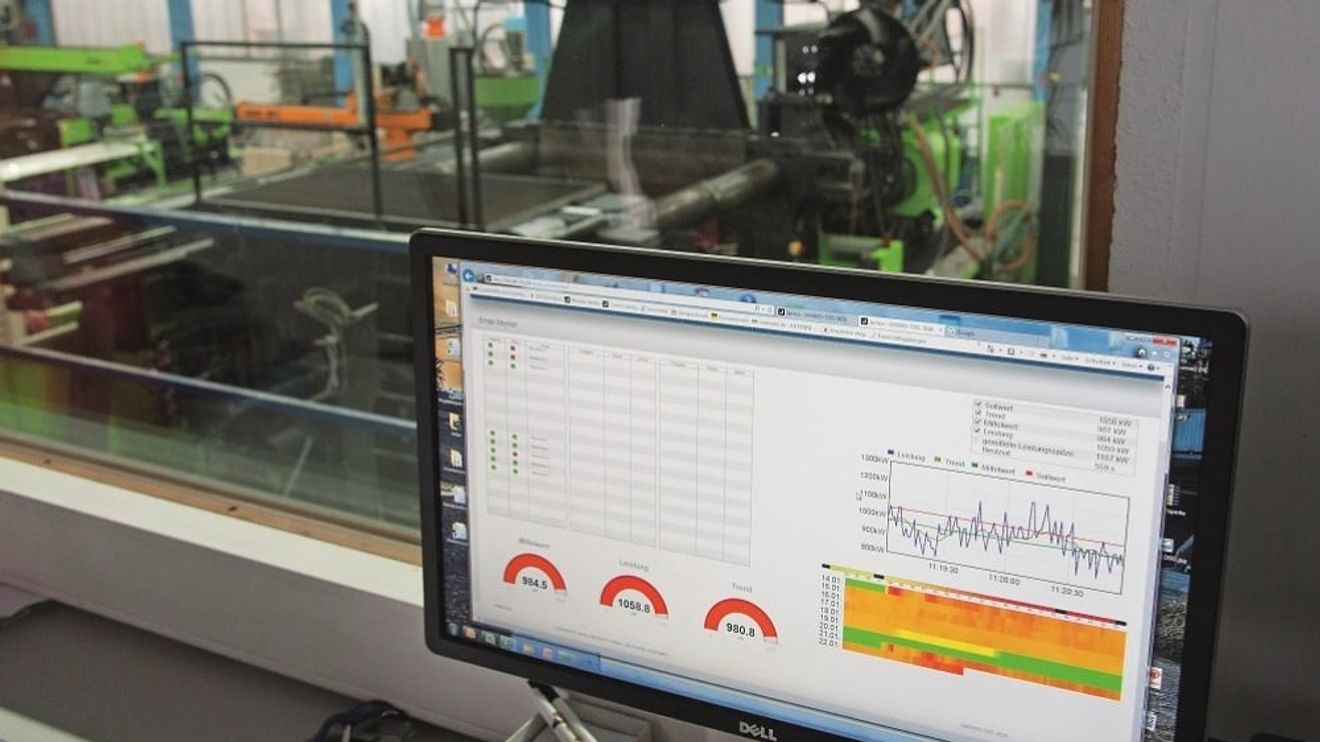
The visualization runs via the homepage of the web server integrated in the measuring device on a standard browser. The system is managed via two websites: one for configuration and one for display. This means that the user always has access to the most important data: the status of the machines, switched-off heaters, power consumption, the setpoint, the heat map over the week, current average values for the power and the trend. The 'GridVis' software regularly reads out the relevant process data from the measuring device memory, archives it and visualizes it for evaluation.
Amortized in 4.8 months
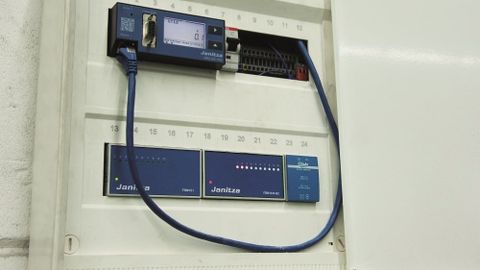
The 'UMG 605-Pro' measuring device (with fieldbus modules) obtains the measured active energy and the synchronization pulse directly from the energy supplier's electricity meter.
© Martin WitzschThe control system was kept as simple as possible, from limiting it to the eight largest consumers to connecting it to the energy supplier's meter instead of using its own measuring technology. The total cost, including installation and time spent by the company electrician, amounted to 9,000 euros. "We had already earned back the investment for the control system after 4.8 months, although the peaks were initially slightly higher than planned," explains Tobias Echtler. The initial target was 900 kW, but this caused too many switching cycles and seemed too risky. With a slight increase to 1050 kW, the necessary process reliability was achieved and the supply price was reduced by over 20,000 euros per year.
Further savings potential
Mitschke currently operates eight systems. The existing hardware and software already offers expansion reserves for up to 20 machines. Additional fieldbus modules can also be connected to the UMG without impairing performance. There are plenty of possible applications - for example, a series of dryers with a power consumption of 20 to 30 kW each.
Tobias Echtler is on the trail of further potential savings: "Eight chargers for forklifts go into operation after the end of the day. Such a peak is often underestimated and can easily be reduced by slight delays." Problems caused by energy-saving devices such as eco-drives are somewhat more complex, but can also be solved. "We used to have costant motors that consistently required 70 to 80 kW. Modern drives are much more economical, but they start moving quickly and generate peaks of 300 kW," explains Tobias Echtler.

Martin Witzsch is a freelance journalist from Nuremberg on behalf of Janitza electronics, Lahnau.
© Theben AGIn addition to the savings, the new measurement technology offers further prospects. For example, more precise measurements of consumption data for individual machines are planned in the medium term, which can be used to make calculations and allocations for a job more precise. Additional interfaces can also be used to record consumption data for heat, compressed air and water, for example.
The company is also considering its own measurements using Rogoswski coils in the company's own transformer stations. Due to the high consumption of the systems, the voltage drops from 235 V to 216 V, particularly during the switch-on period due to the load on the grid. With the 'UMG605' already in use, the current and voltage quality could be continuously monitored within the specified standards. This is also done by the measurement technology without user intervention. In the event of a deviation, an alarm is triggered with a detailed indication that the limit value has been exceeded.


You might also be interested in
Incorrect measurements excluded
The HE 5422 differential pressure regulator from Hesch has been redesigned: Thanks to the pre-coating functionality, the cleaning process is significantly simplified and the Datahold function eliminates incorrect measurements.
 read more...
Measurement data acquisition with up to 5000 measurements/s
The DAQ973A from Keysight is a modular measurement data acquisition system with USB, LAN and GPIB interfaces, consisting of a basic device and a selection of nine measurement modules.
read more...Operating cobots safely
AMO's measuring devices measure position values with deviations of less than 1 µm per signal period, which enables precise positioning of robot axes and thus the safe operation of cobots in close proximity to human workers.
read more...Measuring amplifier suitable for IoT
LCB is a universal measuring amplifier for load cells from Althen Sensors & Controls which, according to the manufacturer, meets 'Industry 4.0' requirements and is designed especially for IoT needs.
read more...Management expanded
Together with company founder Markus Janitza, Rudolf Müller will manage the business of Janitza electronics as the second Managing Director from July 1, 2020.
read more...Differential pressure transmitter with rotatable display
Labom has added a new device to the 'V-Line': the Pascal CV4 Delta P CV 4300 is a flexible digital differential pressure transmitter that has numerous functions despite its compact size
read more...Implementing intrinsically safe circuits
The 'Ex i' type of intrinsic safety has become established worldwide for measurement and control technology in systems with potentially explosive atmospheres. Compared to other types of protection, it is more cost-effective in terms of design.
read more..."Three questions for..." - the May edition
Corona: Change as an opportunity
People react differently to the coronavirus and its consequences. What is it like in everyday working life? In the new part of our "Three questions for..." series, we look at this topic and asked automation experts for their opinions.
read more...Two into one
Manner offers the XtreMA two-in-one dual-range torque transducer for recording multiple rotating torque ranges. This transducer has two torque ranges with two separate and independent signal outputs.
read more...