
Machine learning
What management must do
Machine learning is also finding its way into factory automation. But what does management need to do to integrate the technology into the company? And what does concrete implementation look like?

The first part of the article already made it clear how machine learning can be implemented technologically. However, the question arises as to how the new experts from the engineering perspective should be classified in the development process. Is it a new 'super-discipline' that can dominate all other disciplines through the principle of 'knowledge is power' - just as the CFO can ultimately turn the money tap on and off according to the motto 'he who pays creates'? Or has the literal last link in the product development chain been found, which is placed at the end of a sequential development process after the software development department?
Implementing a genuine mechatronic development process in practice is an enormous challenge in itself and requires systematic coordination of the processes in addition to the openness of the management and the people involved. If data analysis and machine learning are added as an additional discipline, the situation becomes even more confusing. To get started, it is therefore important to first create the central organizational interfaces for the colleagues entrusted with the new cross-sectional engineering task. The value of the work stands and falls with the quality of the data that is available in the development process and can later be collected and processed during the ongoing operation of the machine. If the other disciplines involved in the development process and the company's IT are not prepared for this, only a suboptimal result can be expected, if at all. Balanced and interdisciplinary cooperation is a must!
Ideally, tool support that also enables joint, parallel and cooperative work at data level should also be taken into account. This so-called concurrent engineering or simultaneous engineering begins with joint, comprehensive requirements and error management and version management through to joint project management and holistic system simulations.
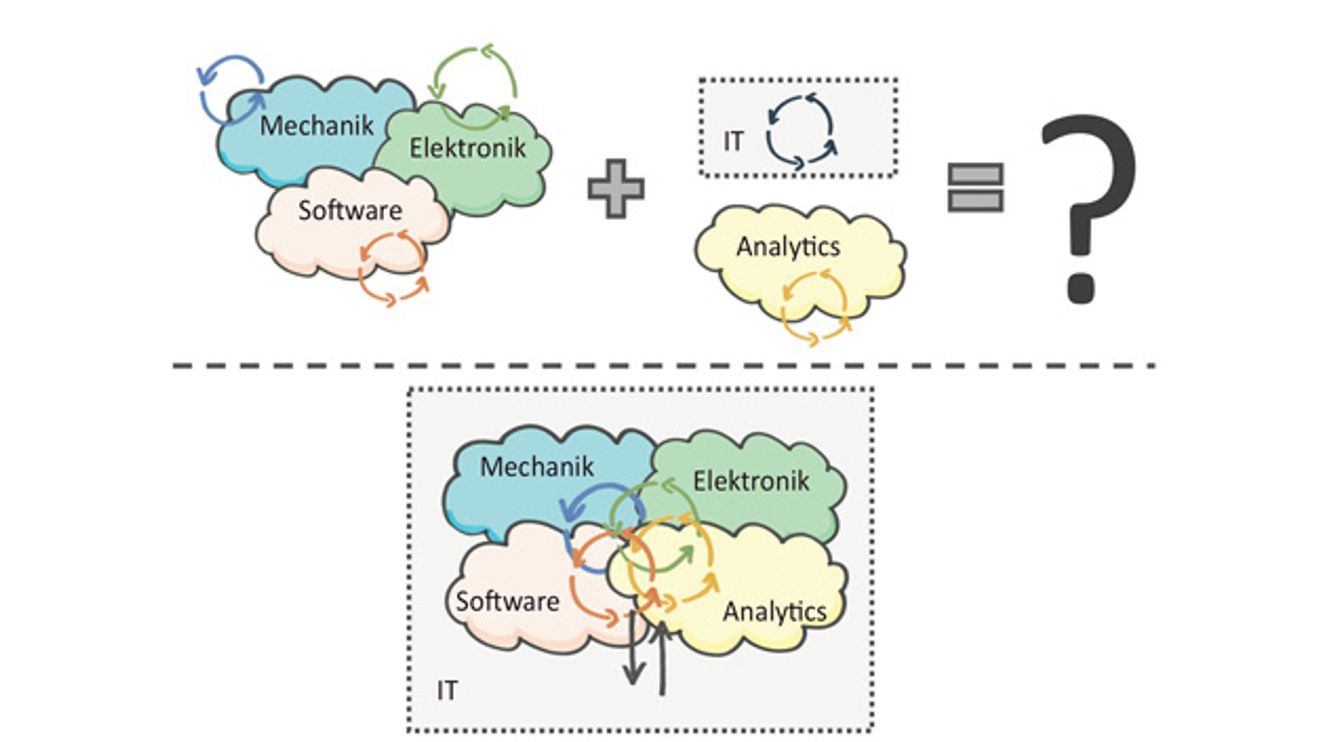
Nested processes
As with software development, the process steps in data analysis are most efficient when they can take place at very short intervals. Daily meeting cycles are often required at the start of a new project and short coordination intervals of two weeks for the entire duration of the project. This is the only way to counteract uncertainties:
- On the customer side: What do I expect from the data or what data quality can be provided for the respective question?
- On the contractor side: What must or can be achieved at all?

Figure 2: The CRISP model in an industrial context.
© Engineering office lean-digital-transformationFor the interaction with disciplines such as mechanical or electrical design, which traditionally think in longer cycles and quickly perceive short coordination rounds as a communication overhead, this means new potential for conflict in addition to coordination with software colleagues. Without active moderation by management, high friction losses quickly arise. In contrast, merging processes with software development will be much simpler in agile teams and easy to implement. In general, the pressure increases for all disciplines to coordinate at short notice. Only in this way can new findings or changed or new requirements be taken into account in a targeted manner. It is therefore not enough to simply implement information technology networking on the machine; it must also be an integral part of the cooperation between the various engineering teams(see Figure 1).
In the authors' view, the realization that only an iterative approach is effective is one of the key factors that determine the success or failure of an analytics project. This is also reflected in the fact that the 'Cross-Industry Standard Process for Data Mining' (CRISP for short) was defined more than 15 years ago, which describes an inherent cycle of process and data understanding, data preparation, modeling and evaluation before a model can be rolled out at the end(see Fig. 2).
Stakeholders of an analytics project
A practical interpretation of the CRISP model means, for example, that an initial short run-through is carried out at the start of the project in order to get a feeling for each individual point, which results are possible with simple initial approaches and which experts need to be involved for the subsequent runs. This can also counteract obstructive findings and attitudes of people involved in the project - such as "The correlations found are already known", "Too little background knowledge is integrated into the analyses", "The data actually required has not yet been provided". In many projects, the CRISP model has also proven to be correct in that many positive side effects of such a project, from data collection and data quality to an increased understanding of the process - and possibly even an improved process - have been achieved.
Authors:
Dr.-Ing. Hans Egermeier is an independent management consultant specializing in lean digital transformation;
Dr. Thomas Natschläger is Scientific Head of Data Analysis Systems Group at the Software Competence Center Hagenberg;
Markus Riedenbauer is Project Manager in the Research & Development department at Siemens Transformers Austria.
Analytics in practice

Siemens Transformers Austria manufactures power transformers and the necessary transformer cores at its site in Weiz (Austria, Styria). Decades of development have led to very efficient transformer designs with low power losses. In recent years, however, increasingly rigorous customer requirements - driven by new regulations - have led to the need for continuous further improvements from design through to production - for example to minimize noise development.
The production of a transformer core begins with the slitting of the sheets, which are purchased and stored in so-called coils, into strips of the required widths. These are then cut into the required shapes and joined together to form the transformer core. The expected quality attributes - power loss and noise development - depend on the material properties of the coils and must meet customer requirements. The aim of production planning is therefore to optimize the selection of coils and the cutting plan based on this in such a way that the requirements can be guaranteed and the core can be produced at a competitive price. This goal has so far been achieved by using optimization software to create a cutting plan that allows the order to be completed with a minimum amount of raw material.

Integration of an adaptive prediction model with production optimization in the manufacture of a transformer core.
© Engineering office lean-digital-transformationA recently patented method for incoming goods inspection provides an objectified data basis with which a quantitatively accurate prediction of power loss and noise development is possible. In a cooperation between Siemens Transformers Austria and the SCCH research center, a framework was created that links this raw material data and that of the quality control and realizes an adaptive prediction model for the critical quality attributes.
This adaptive prediction model is an essential input for the optimization, which can thus take into account the boundary conditions resulting from customer requirements. In order to guarantee a 100% stable process, appropriate safety barriers are provided for the optimization. A hybrid modeling approach is used for this prediction model, which makes it possible to integrate the physical know-how of the product experts with a data-driven approach. In addition to the optimization already implemented, the prediction model is adapted and improved with each new transformer core produced using the new data generated.
Considering that the production of a large transformer requires up to 200 tons of raw material, every reduction in material costs achieved through optimized forecasts can be evaluated in monetary terms.
In this project, the management recognized at the outset that implementation would only be possible through close cooperation between IT (infrastructure, data connection, interfaces to ERP), production (definition of requirements and boundary conditions), production planning (existing expertise in planning), R&D (development of incoming goods inspection; integration of physical knowledge) and external research partners (predictive analytics, optimization, data modelling) and set up a corresponding project management.


You might also be interested in
The first steps towards digitization
Real-time transparency in the material flow: this was the goal set by Miba when it set out to digitalize its internal logistics processes. But how successful was the close link between ERP and MES in the end? - A field report.
 read more...
How will the IoT change companies in 2020?
How will network technology in companies change in 2020? Axel Simon, Chief Technologist at HPE Aruba, takes a look into the crystal ball
read more...Digital twin revolutionizes maintenance
As virtual representatives of real machines, digital twins open up new possibilities for maintaining and servicing complex industrial plants and systems. A project report.
read more...You can't do without Edge and Swarm
The IoT has changed the requirements for processing data provided by machine sensors and actuators. This needs to happen as quickly as possible - preferably where the data is generated. Edge nodes and swarm computing systems take on this task.
read more...Online machine data under control
Turning huge amounts of data into valuable information - how can this smart industry approach be implemented? Linking PC-based controllers with Matlab and a cloud-based IoT analytics service can be a viable approach.
read more...From modeling directly into the PLC
Despite digitalization and I4.0, the technical functions in a process plant do not become simpler if you break them down to the smallest detail. Nevertheless, the high level of difficulty can be overcome by combining the right tools in the right way.
read more...Where are the new business models?
The necessary new business models are repeatedly cited as the hallmark of an Industry 4.0 environment. But to date, very few companies have seen any of this. Schneider Electric now has a few models up and running.
read more...Why predictive maintenance?
Investments in predictive maintenance systems are worthwhile in order to proactively detect damage. Not only does this increase the service life of a machine, it also opens up new business models for machine manufacturers.
read more...First customer projects via BaSys 4.0
The BMBF project 'Basissystem Industrie 4.0' expired at the end of June 2019. Together with NetApp and Objective Partner, Fraunhofer IESE now offers Industry 4.0 solutions with support and adaptation to customer systems on the basis of this project....
read more...