
Cloud technology
The multi-cloud under control
German companies have been hesitant about the cloud for a long time, but now things are really taking off. More and more manufacturers are using several cloud providers at the same time - whether strategically or due to shadow IT. But how can the complexity of the multi-cloud be mastered?

The medium-sized manufacturing industry in Germany in particular has a reputation for being cautious when it comes to innovation and relying on tried-and-tested processes in the long term. There is a good reason for this, as the considerable investments in production lines need to be well thought out and planned. In addition, customer requirements have hardly changed to date.
With the advent of the internet, online services and mobile apps, however, this is changing rapidly: manufacturing companies need new business models that generate concrete added value for customers. These are based on the intelligent analysis of large volumes of data with the help of cloud-based infrastructures. Some of the information comes from external sources such as market studies, surveys or competitor monitoring. However, a lot of internal data from production itself is also processed for this purpose.
Flood of data in the production process
As part of Industry 4.0, more and more machines are being equipped with sensors that collect up-to-date information on the status of the machine, its work processes and environment in real time and at short intervals. This makes it possible, for example, to determine whether maintenance is required if values fluctuate significantly or reach a critical limit. In addition, the machines communicate with each other so that products can be manufactured and transported more efficiently.
However, this optimization of work processes is only possible with an agile and flexible infrastructure, which is usually based on IT standards. This is because the extremely large amounts of data that are generated in manufacturing today need to be collected, organized and evaluated in short periods of time. The cloud is particularly suitable for this, as it can provide the necessary scaling and performance for big data analysis. Cloud services can also be flexibly adapted to new requirements.
Accordingly, the manufacturing industry is now one of the largest users of cloud services. According to the study "Multi-Cloud and Cloud Managed Services in the Manufacturing Environment" commissioned by Rackspace, three out of five German and Swiss manufacturing companies are already using cloud solutions in the IoT environment. According to the study, the main reasons are greater flexibility, agility and scalability in operations, better customer experience and cost efficiency. These were each cited by over 80% of respondents.
Software-controlled production
However, the pure networking of machines as part of the Internet of Things (IoT) and the analysis of the resulting data is only one aspect that industrial companies are dealing with today. The second important topic is the software-based control of production processes that this makes possible. This allows them to further increase the efficiency of processes, manage them remotely and generate new sources of revenue.
For example, products manufactured in larger quantities can be adapted more quickly and efficiently to new requirements or even individual customer requests. This enables manufacturers to achieve the goal of batch size 1 with manageable effort. But goods manufactured in small quantities, such as systems, also benefit from software control, for example through additional services such as predictive maintenance. The machine data recorded by sensors can be monitored remotely in order to plan maintenance windows and keep downtimes to a minimum.
Remote monitoring can be implemented with dedicated lines, but this is only financially viable in regional proximity. As a rule, machine manufacturers or service providers are geographically further away from their customers. Internet connections are therefore usually used, with services being offered as a cloud service in order to achieve economies of scale and uniform management. In addition, manufacturing companies with multiple locations are increasingly using cloud services to enable centralized control or big data analysis.
Challenges posed by the multi-cloud

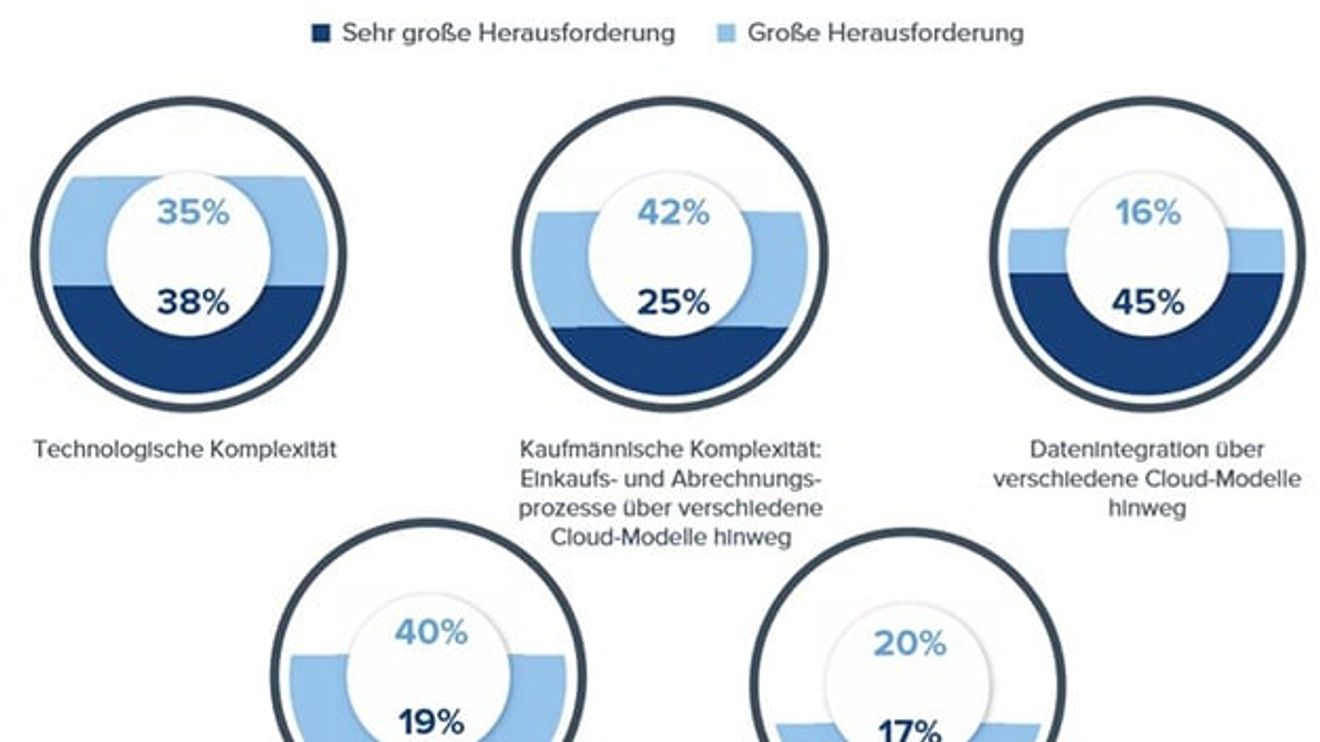
According to the survey, manufacturing companies often opt for the best cloud solution for the various applications, even if this may increase the management effort due to the different providers. Although they prefer the private cloud, public cloud offerings are also widely used. This can be seen in the various application areas. For example, a public cloud is mainly used for productivity tools such as collaboration or Office (32%), an internal private cloud for server and storage provision for in-house developments (40%), an external private cloud for systems for application development and testing (59%) and a hybrid cloud for setting up and operating new digital business areas (32%).

Relevance of requirements, approaches and aspects to an external service provider with regard to the implementation strategy and integration of various cloud solutions.
© PACAs a result, multi-cloud solutions will make up the majority of operating modes in the future. However, their use has its pitfalls. For example, 77% of respondents see major to very major challenges with multi-cloud due to technological complexity. Other critical points are commercial complexity (66%), data integration and end-to-end security (59% each). Due to these challenges, 45% of all respondents are using (45%), planning (37%) or discussing (18%) collaboration with external service providers. Industry knowledge (90%) and certifications (84%) of the provider as well as experienced employees in the area of production (62%) are considered very important here.
With their help, the industry would like to use cloud solutions above all to overcome the cost and efficiency pressure in IT operations (78%). However, tapping into new customer groups (74%) and regions (71%) are also important goals. The cloud also facilitates the expansion of the product and service portfolio (59%) and the development of new business partnerships (56%).
Technical expertise in demand
However, the decision to involve external experts is not always entirely voluntary. In fact, many companies start a cloud project on their own, but sooner or later realize that they do not have the necessary skills. For example, they are unable to ensure the necessary compliance and governance or adhere to security standards. Important organizational issues are overlooked: To what extent is your own company cloud-ready? Which cloud management approach should be used? Which departments should be involved? In addition, there is often a lack of technical expertise and a lack of market overview of the numerous cloud offerings.
Due to the shortage of specialists, these deficits cannot simply be remedied by hiring experts. Instead, manufacturers often have no choice but to rely on service providers in order to avoid flying blind. However, the cloud providers themselves rarely offer the necessary managed services. Although they provide the technology and usually help with the connection and operation of their services, they naturally offer no independent advice and usually have little industry expertise. Most companies appreciate the vendor-independent approach of a managed services provider, who ideally has already implemented corresponding projects in the manufacturing industry. Use cases, references and certifications provide a good overview when making a selection.
The optimal migration
A managed services provider helps customers to position themselves independently of the cloud in order to avoid vendor lock-in and to benefit from the best offers from the various cloud providers. It also helps to avoid common mistakes and reduce the complexity of multi-cloud management. The following steps must be implemented in order to benefit optimally from the offers:
- Formulate a multi-cloud strategy - Due to previous requirements or shadow IT, many companies already have several cloud solutions in place. To avoid uncontrolled growth and achieve controlled cloud usage, manufacturers should develop a multi-cloud strategy together with the managed services provider based on their business objectives.
- Create a multi-cloud foundation - The next step is to create the basis for the cloud. To do this, companies should check their entire IT landscape for cost-effectiveness. Outdated infrastructures need to be replaced. In addition, a cultural change is often necessary in order to introduce agile work processes. This must be accompanied by comprehensive change management.
- Have services professionally managed - The multi-cloud combines existing infrastructures, platforms and software with various cloud models. Managing them in a fail-safe and efficient manner is complex. A suitable service provider has experience with common cloud providers and industry expertise and provides a personal contact and round-the-clock service.
- Choosing the right migration strategy - The right migration strategy for each individual workload must then be determined together with the managed services provider. There are four options for this:
- Re-Host (Lift&Shift) is a simple move to the cloud without changing the existing application itself.
- Re-Platform (Lift&Re-Shape) often involves a considerable amount of work to make the application executable for the respective environment.
- Re-Architect (Re-Writing&Decoupling) is the supreme discipline, as the existing application is split into cloud-native microservices.
- Re-Purchase (Replace) means a new purchase if a self-developed application is now offered as a standard SaaS solution.
Author:
Andreas Bandel is Sales Director Automotive & Manufacturing at Rackspace.


You might also be interested in
The first steps towards digitization
Real-time transparency in the material flow: this was the goal set by Miba when it set out to digitalize its internal logistics processes. But how successful was the close link between ERP and MES in the end? - A field report.
 read more...
How will the IoT change companies in 2020?
How will network technology in companies change in 2020? Axel Simon, Chief Technologist at HPE Aruba, takes a look into the crystal ball
read more...Digital twin revolutionizes maintenance
As virtual representatives of real machines, digital twins open up new possibilities for maintaining and servicing complex industrial plants and systems. A project report.
read more...You can't do without Edge and Swarm
The IoT has changed the requirements for processing data provided by machine sensors and actuators. This needs to happen as quickly as possible - preferably where the data is generated. Edge nodes and swarm computing systems take on this task.
read more...Online machine data under control
Turning huge amounts of data into valuable information - how can this smart industry approach be implemented? Linking PC-based controllers with Matlab and a cloud-based IoT analytics service can be a viable approach.
read more...From modeling directly into the PLC
Despite digitalization and I4.0, the technical functions in a process plant do not become simpler if you break them down to the smallest detail. Nevertheless, the high level of difficulty can be overcome by combining the right tools in the right way.
read more...Where are the new business models?
The necessary new business models are repeatedly cited as the hallmark of an Industry 4.0 environment. But to date, very few companies have seen any of this. Schneider Electric now has a few models up and running.
read more...Why predictive maintenance?
Investments in predictive maintenance systems are worthwhile in order to proactively detect damage. Not only does this increase the service life of a machine, it also opens up new business models for machine manufacturers.
read more...First customer projects via BaSys 4.0
The BMBF project 'Basissystem Industrie 4.0' expired at the end of June 2019. Together with NetApp and Objective Partner, Fraunhofer IESE now offers Industry 4.0 solutions with support and adaptation to customer systems on the basis of this project....
read more...