
Pepperl+Fuchs
The digital process plant
The process industries are confronted with very specific situations, so Ethernet is only gradually becoming the basic technology for a digital future here too. Ethernet-APL is one approach to this.

The world of digital communication is an Ethernet world. Ethernet powers the internet, connects computers at home and has become the communication backbone of almost every organization. Cloud-based solutions are based on Ethernet. Manufacturing processes are automated with Ethernet. Even the Internet of Things uses the Ethernet protocol to connect to computers and systems. It is therefore not surprising that Industry 4.0 and similar initiatives rely on this ubiquitous communication standard that has conquered the world.
The situation is different in the process industries, however. Here, Ethernet is only gradually gaining the status of a basic technology for the digital future.
'Ethernet-APL' describes a new physical layer for Ethernet that is tailored to the requirements of process plants and integrates seamlessly into the ubiquitous Ethernet world. Ethernet-APL (Advanced Physical Layer) is a joint development and standardization project of the four major user groups in the process world: the FieldComm Group, the ODVA, the OPC Foundation and Profibus/Profinet International. Together with Pepperl+Fuchs, twelve PCS and hardware providers support Ethernet-APL.
What has made Ethernet so successful is above all its inherent simplicity - a device is connected and automatically recognized by the network. It only needs to be configured once and always works as intended. In process automation, such simplicity is still wishful thinking for many plant operators. Ethernet-APL is set to change that.
Adapted to the process world
The operators of process plants, on the other hand, had good reasons to stick with the tried-and-tested 2-wire cabling. This is because standard Ethernet communication has a number of serious disadvantages for the process industries - starting with the fact that the length of an Ethernet cable is limited to 100 meters. However, extensive process plants often have to bridge distances of up to 1000 m. There are also problems with supplying power to the devices via an Ethernet cable. In addition, many process plants require reliable protection in hazardous areas, in particular explosion protection through the intrinsic safety type of protection and a pronounced resistance to electromagnetic interference.
There were four main requirements on the way to adapting Ethernet to the process world:
- a reliable data path for fast communication
- the right power supply for field devices via the data lines
- efficient explosion protection
- significantly simplified installation and connection technology.
More data at higher speeds
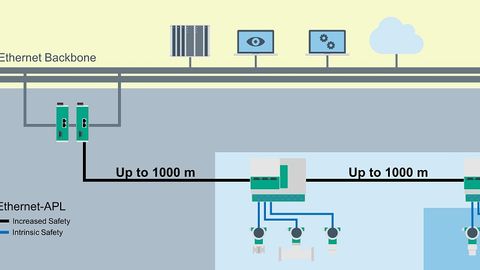
Topology for long cable runs: The trunk line feeds the field switch and the connected devices. Stub lines supply the field devices individually. This creates clarity during installation and maintenance work.
© Pepperl+FuchsFor Ethernet communication via two conductors, IEEE 802-3 distinguishes between different variants of the BASE-T1 cabling standard, which enable different speeds and cable lengths. For example, two wires will soon enable high-speed networking of computers within a high-performance data center. This allows speeds of up to 10 Gbit/s to be achieved over relatively short distances.
In contrast, 10BASE-T1L is the alternative for communication over long distances. Speeds of up to 10 Mbit/s are possible over shielded cables of up to 1000 m in length.
For process plants, this will be the new communication standard that requires 2-wire cabling for plants with a large area.
Ethernet-APL does not require special cabling, but uses standard type A cables that are well known in the process industry. The installation methods are therefore the same as those already established. Both clamp and screw connections are available as standard for the connections to field devices and switches. Standard M12 connectors can also be used. In other words, migrating to Ethernet-APL protects investments in the infrastructure of a process plant by allowing existing cables to continue to be used without restriction.
Another aspect of Ethernet-APL is the fact that, as a pure physical layer standard, it enables 2-wire Ethernet communication completely independently of the protocols used. This gives the system operator the freedom to always choose the communication protocol that is best suited to the application or system in question.
Simplified intrinsic safety
Potentially explosive atmospheres are a common feature of process plants. This aspect must be taken into account for every system - especially if it supplies power to field instruments. Ethernet-APL uses intrinsic safety in accordance with the new 2WISE standard (2-Wire Intrinsic Safety Ethernet), which is based on FISCO (Fieldbus Intrinsically Safe Concept). It is defined in IEC TS 60079-47 or is currently being developed and describes all the values and requirements that Ethernet APL-capable field devices must meet.
This device-based solution not only guarantees the interoperability of the devices. It also frees the system planner from having to perform complex calculations for each individual loop. This makes planning and verification of explosion protection safer, faster and easier than before. The procedure is carried out in three simple steps:
1. select the parameters for the classification of the hazardous area
2. select the appropriate cable
3. document
The necessary infrastructure
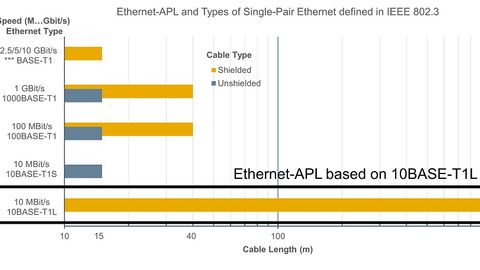
standards for communication via two-wire Ethernet. The Advanced Physical Layer uses 10BASE-T1L for cable lengths of up to 1000 m.
© Pepperl+FuchsEthernet-APL requires only two types of infrastructure components: Power Switches and Field Switches.
The 'APL Field Switch' for the direct Ethernet connection is suitable for smaller or geographically less extensive process plants, such as those typically found in the food and pharmaceutical industries. It is designed for top-hat rail mounting and is used both to supply power to the connected spurs and to exchange data between the devices and the control technology. It is designed for switch cabinet installation in Zone 2/Div 2 and offers intrinsic safety on the track for Ex ic IIC or Ex ia IIC. Ring redundancy is ensured via Ethernet. The switch can be connected to an external power supply.
The 'APL Power Switch' from Pepperl+ Fuchs feeds electrical energy into the trunk to supply the field devices with the required power. It is designed for switch cabinet installation in Zone 2/Div 2 and offers ring redundancy for connection to higher-level systems.
The 'APL Field Switch' for the trunk is a power supply and communication component that connects several spur lines to the trunk line. It is designed for field installation in Zone 1/Div 2 and serves devices in Zone 0/Div 1. This component, which is supplied via the trunk, provides an intrinsically safe power supply at all spurs up to Ex ia IIC.
In large process plants, Ethernet APL is usually used as a trunk-and-track topology over distances of up to 1000 m. For smaller process plants, star-shaped topologies are preferred. Both topologies are an unrestricted replacement for existing fieldbus infrastructures. As Ethernet-APL only defines point-to-point connections, making crosstalk between devices virtually impossible, communication is very robust. The top level of any Ethernet-APL-based process control system can consist of controllers as well as systems for process visualization, engineering and plant management. A completely new aspect for process automation is the barrier-free access to every system in the network and the possibility of including cloud-based systems. Such a structure not only enables access to practically all process data regardless of the user's location, but also allows, for example, long-term data storage independent of the process and the analysis of large volumes of data.
Migration made easy

An Ethernet APL communication infrastructure is very similar to current fieldbus-based solutions based on 'FieldConnex' power hubs, field barriers and segment protectors. This enables an easy migration path to a fully Ethernet-based process control system.
Over the last 20 years, many process plants have been equipped with digital communication to the field devices, for example via Profibus PA. For such plants, migration to Ethernet-APL is particularly easy, as only the existing field barriers or segment protectors need to be replaced by 'APL Field Switches'. These can automatically detect the fieldbus or Ethernet interface of the connected field device.
Ethernet-APL also opens up the possibility of fully integrating available safety concepts into a communication infrastructure. To this end, the safety data is transmitted via a 'black channel', which in principle piggybacks on one of the standard communication protocols.
Solutions of this type are already established in the manufacturing industry and
can sooner or later become part of every Ethernet APL-based system. Using this concept will not only greatly simplify the design and implementation of safety systems, but will also reduce costs while maintaining a high level of safety to protect both employees and the plant itself.


You might also be interested in
IO-Link and Single Pair Ethernet
Competition or cooperation?
Single Pair Ethernet enables the transmission of Ethernet data via just one pair of wires and therefore promises to connect sensors directly to Ethernet communication. In this respect, SPE is entering the traditional territory of the IO-Link...
 read more...
Kanban 4.0
With an intelligent combination of optical sensors, identification systems and modern, process-oriented cloud software, Kanban-controlled production and material flows are raised to a fully digital level.
read more...Use in hazardous areas
With the Tab-Ex Pro, the Pepperl+Fuchs brand Ecom Instruments is expanding the existing Tab-Ex series and thus the range of mobile devices for hazardous areas.
read more...No access! Please wait!
How can it be ensured that the number of people permitted in premises is not exceeded in light of the coronavirus pandemic? Two automation companies - Pepperl+Fuchs and Schmersal - present their technical solutions.
read more...Tablet for the Ex area
With the 'Pad-Ex 01 P12', Pepperl+Fuchs is launching a new tablet for professional use in potentially explosive atmospheres in Zone 2/22, Division 2.
read more...Flow of goods made transparent
With the 'IUR-F800-V1D-4A*', Pepperl+Fuchs is expanding its RFID portfolio with a UHF reader specifically for use in gate applications in logistics.
read more...HANNOVER MESSE DAILY Day 4
The top news from the fourth issue: Robert Habeck at the trade fair tour +++ Technological AI highlights from Beckhoff +++ Radar sensor technology in focus at Pepperl+Fuchs +++ ASi-5 counter module as an active distributor from Bihl+Wiedemann +++...
read more...followed up! - with Dr. Gunther Kegel
"Recognizably alien to the industry"
More and more regulations and bureaucracy are being imposed on companies. In an interview, ZVEI President Dr. Gunther Kegel criticizes politicians and calls for consistent action.
read more...Sensors plus evaluation unit for SIL 3 and PL e
To determine a safe absolute position, Pepperl+Fuchs relies on a combination of the 'PUS' evaluation unit with the 'safePXV' or 'WCS' sensors.
read more...