
Softing
Ready for take-off towards Industry 4.0
Industry 4.0 applications use a large number of OT components that provide data for IT applications. But how can the integration of automation and IT be designed efficiently?
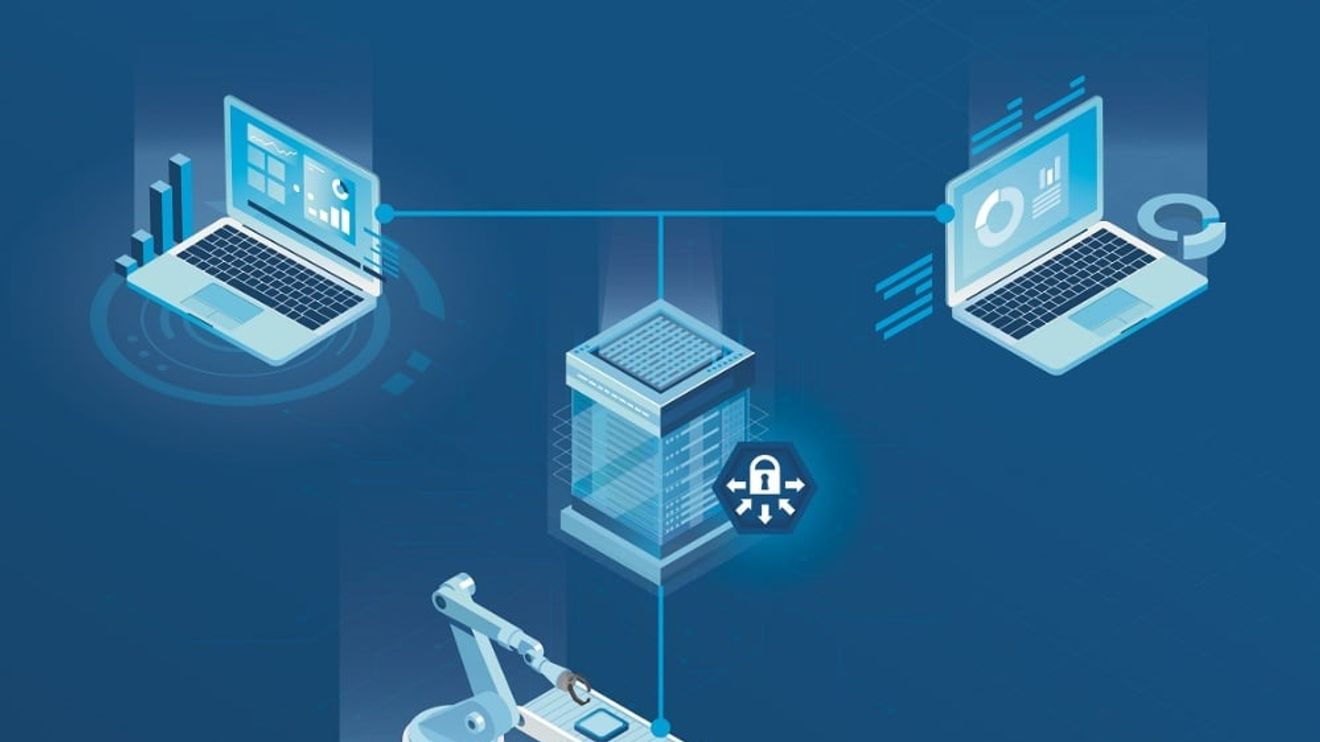
Industry 4.0 applications use a large number of OT components that exchange data with each other and provide data for various IT applications. This results in highly complex network structures that pose a challenge in terms of the amount of data required, secure data transmission and simple configuration. Short innovation cycles in IT also present users with the question of how they can reduce the costs of OT/IT integration over the lifetime of a system. Through the clever use of OPC UA functionality, a central middleware solution offers the user decisive advantages.
OPC UA: The standard for Industry 4.0
To implement Industry 4.0 applications, a large number of different individual components from various manufacturers must be integrated and closely interlinked at both production (Operational Technology, OT) and management (Information Technology, IT) level. Data exchange plays a key role here: it must be easy to implement and offer an end-to-end solution that also meets comprehensive security requirements. For this reason, OPC UA (Unified Architecture) is now established as the basic technology for data exchange in Industry 4.0 applications.
The OPC UA standard is based on modern data modeling technology and the use of a uniform information model for all applications. This means that OPC UA is not only suitable for communication tasks in production, but also allows IT systems, such as enterprise resource planning (ERP) and manufacturing execution system (MES) applications, to access data directly at field level.
Key component middleware
Within an overall Industry 4.0 application, the OT components take on the role of OPC UA servers and the IT components the role of OPC UA clients, which all have to exchange data with each other. The complexity of the network structures increases exponentially with the number of integrated OT and IT applications. The amount of data becomes correspondingly large, while the effort required for installation, configuration and maintenance increases at the same time. As the individual components can be located anywhere in the world, data security and protection against attacks are of crucial importance in addition to the organization of the actual data exchange. For this reason, committees such as the Industry 4.0 platform are looking at possible approaches for the optimal solution to these challenges. The use of an aggregating server architecture in accordance with the OPC UA standard offers particular advantages here.
The dataFEED Secure Integration Server from Softing Industrial Data Intelligence offers such middleware functionality with an abstract interface between the OT and IT worlds, which is based on address space modeling in accordance with the OPC UA standard and uses this in particular for interface abstraction and data aggregation. By supporting OPC UA publisher/subscriber technology, simple and small sensors and fieldbus devices can also be defined as data sources and leaner architectures can be implemented.
Interface abstraction between OT and IT
The aggregating server architecture supports changes or extensions within one level without the need for adjustments to the other level. This makes it easy for the user, for example, to integrate a new IT application into an OPC UA interface representing the OT side. Conversely, IT applications do not need to be touched when changes are made within the production world, as long as the OPC UA interface implemented in the middleware remains unchanged.

This allows a software supplier to easily integrate a standard interface for their application into customer-specific systems and environments. The user thus gains a considerable degree of freedom and can make full use of short innovation cycles in the IT world and freely select the IT applications and platforms used with reduced integration costs. In addition, they retain all options for making changes within the OT world without having to start the IT integration from scratch.
Data aggregation, data filtering and address space mapping
With data aggregation, data from different sources can be combined in one OPC UA server. Because the IT application now only has to access one server, the communication structure is simplified. This saves configuration effort, as a new configuration is not required for each individual OT data source and each individual IT application. Access to individual data points is controlled via access rights. Different applications can each work with their own certificates or access rights. Access can be further restricted using filters so that only the data points with the appropriate access type are available for individual OPC UA client applications, rather than the entire shared address space. To do this, the desired OPC UA service - read, write, browse or subscribe - is selected in the access configuration for individual data points.

The middleware combines the functionality for the central installation, configuration and maintenance of an Industry 4.0 application.
© SoftingBy loading an OPC UA Companion Specification with the information model it contains, which either covers the specific tasks of a particular industry or describes the object world used in a company and thus ensures compatibility at the semantic level, the user has access to the appropriate objects such as variables or alarms. After importing the corresponding Nodeset.XML file, the user can use the standardized data interface defined in this information model to access the various integrated OPC UA servers. For example, it describes the defined variables with their properties, such as the unit, the available methods and services. OPC UA Companion Specifications already exist for a number of different organizations such as Namur or the MES umbrella organization Mesa International and major manufacturers. In the future, OPC UA Companion Specifications will be available for all important use cases.
Built-in IT security

The middleware combines the functionality for the central installation, configuration and maintenance of an Industry 4.0 application.
© SoftingFinally, dataFEED Secure Integration Server also supports data security, which is based on the security functionality of the OPC UA standard. This makes it possible to manage, regulate and monitor individual application access rights centrally. For example, different access rights can be defined for different applications and users, access to individual data can be restricted to specific use cases, certificates for data access can be defined and white lists or black lists for data access from individual IP addresses can be set up. In addition, denial of service (DoS) attacks on OPC UA authentication can be detected.
Integration of existing systems
The ideal industrial world is only made up of new components that already support the OPC UA standard. In practice, however, there are also many existing systems with a more or less long remaining service life that also need to be integrated into a holistic Industry 4.0 application. A variety of hardware and software gateways are available on the market for connecting such machines, such as dataFEED OPC Suite. This software solution serves as a gateway between existing controllers with proprietary protocols and the OPC UA world.

The aggregation server abstracts device interfaces and provides a standardized interface for communication with a central platform.
© SoftingIn this way, even the integration of an old Siemens Simatic S5 controller is possible. Applications from different manufacturers and for specific use cases that have an OPC Classic Server interface can also be quickly and easily integrated into the Industry 4.0 application. It is recommended to first integrate the OPC UA components in dataFEED Secure Integration Server and then integrate the existing systems and machines in a second step.
Advantages for the user
With its comprehensive functionality, dataFEED Secure Integration Server already provides all the technological foundations for setting up a modern Industry 4.0 solution with centralized management of the application. In particular, the configuration and monitoring of all security features is possible at a single point: an extreme simplification and a major gain for the operator.

OPC UA servers and clients as well as the associated address spaces can be added and deleted dynamically and without restarting, and different data sources can be flexibly combined for access by individual OPC UA applications. The appropriate configuration of the OPC UA address space for a specific client interface enables the simple integration of standard applications. If changes need to be made in the OT world, the IT interface can remain unchanged. This reduces integration and operating costs. At the same time, decisions on changes and investments in the OT and IT worlds can be made largely independently of each other. This means that all the necessary components are already available from a technological perspective.
One final tip: when setting up an I4.0 application, it has proven advisable to first select the employees concerned and set up suitable training for them. Once the relevant know-how is available, the biggest hurdle for implementing the Industry 4.0 solution has already been overcome and implementation is possible without major delays.


You might also be interested in
Connecting Siemens controllers with IoT applications
With version v1.20 of the edgeConnector Siemens from Softing Industrial, Siemens controllers can be connected to industrial IoT applications.
 read more...
Merging the virtual and real worlds
At the beginning of March, Siemens held an online press conference to provide an outlook on the innovations for this year's Hannover Messe - at that time it was not yet clear that the trade fair would be canceled this year.
read more...Implementation is still stuttering
When it comes to implementing the digital transformation, companies are now focusing on their core business - the days of wild experimentation are over. But where exactly is it still stuck?
read more...S-DIAS series extended
Sigmatek has expanded its S-DIAS series with the CP313 CPU module for control, regulation and motion tasks and the EC121 interface module.
read more...Umati to become a global language
VDMA and VDW now want to promote the use and dissemination of OPC UA standards under the Umati brand for the entire mechanical engineering sector.
read more...IoT projects often fail because of data
The Industrial Internet of Things offers completely new opportunities for manufacturing companies in terms of automation and optimization. However, there are many reasons why new concepts do not deliver the desired success in practice.
read more...New functions and free of charge until the end of the year
The Codesys Group is now making its "Codesys Automation Server" available to Codesys users free of charge throughout the year due to the coronavirus crisis. In addition, the cloud-based Industry 4.0 platform for managing globally distributed control...
read more...The smartphone as a role model
Bosch Rexroth has designed a new automation platform and taken a lot of inspiration from smartphone technology. - But what is different about ctrlX Automation compared to conventional control systems?
read more...Processes monitored in real time
Digitalization requires the right information in the right place at the right time. Eckelmann has therefore introduced a 'Machine Management' system based on OPC UA and modern web technologies for the operational optimization of production processes.
read more...