
Bosch Rexroth
The smartphone as a role model
Bosch Rexroth has designed a new automation platform and taken a lot of inspiration from smartphone technology. - But what is different about ctrlX Automation compared to conventional control systems?
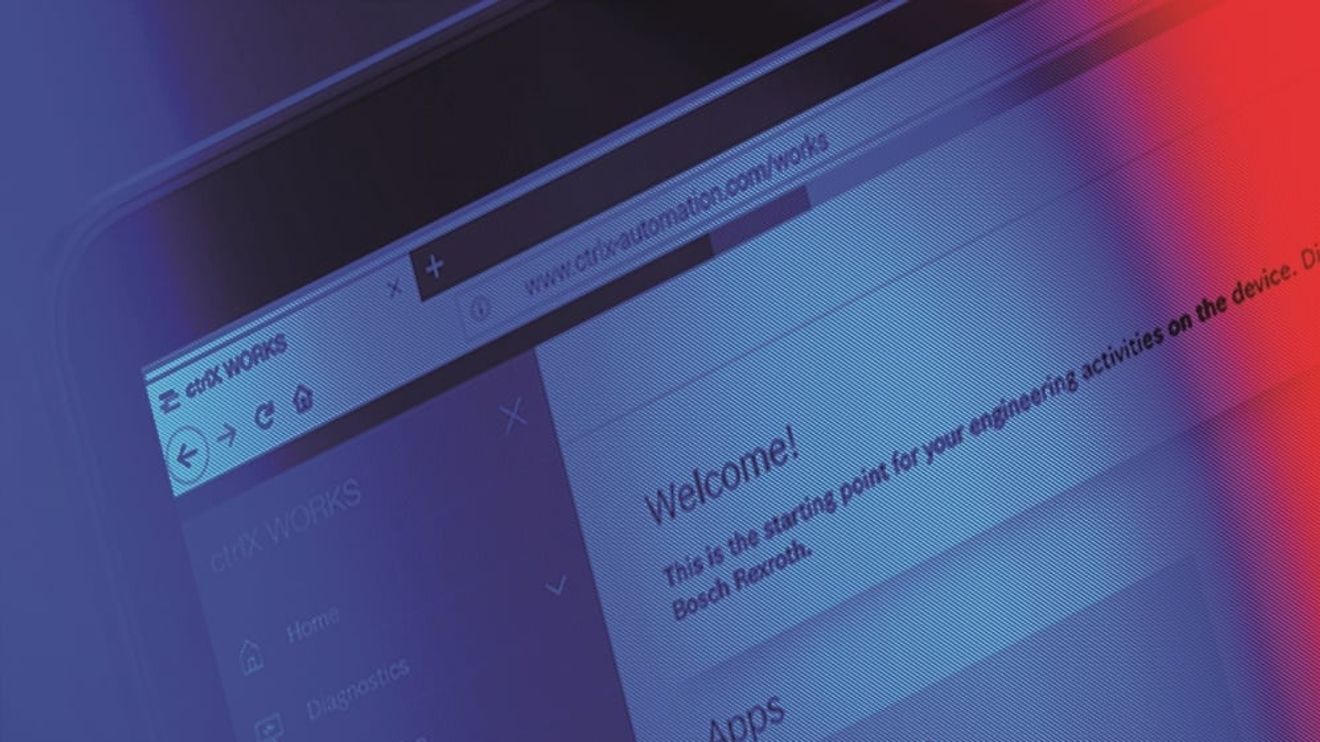
If automation technology were to be reinvented in Silicon Valley today, the smartphone would probably be the great role model. It combines an extremely high level of functional integration with intuitive operation. Users can choose from millions of apps and customize their devices. Bosch Rexroth has transferred this approach to automation and developed an open platform with ctrlX Automation.
"The paradigm shift is overdue," emphasizes Steffen Winkler, Sales Manager of the Automation & Electrification Solutions business unit at Bosch Rexroth. "With Industry 4.0 and the Industrial Internet of Things, IT and automation are growing ever closer together," says Winkler, describing the overarching trend. The logical consequence: automation technology must be integrated into the user's information technology with the least possible effort. This is much easier if it uses the same communication standards and programming environments as the IT world.

The new control platform is geared towards the consumer and working worlds, in which functions run as freely combinable apps on all device classes.
© Bosch RexrothThe intuitive usability of the technology plays a special role here. In the middle of this decade, generations Y and Z already make up 75% of the global workforce. They have grown up with the internet and smartphones, with graphical user interfaces, software wizards and intuitive operation.
They are only familiar with networked technologies and information is available to them at any time and from anywhere - and they expect the same at work. With the new platform, Bosch Rexroth is therefore merging automation, information technology and the Internet of Things into a consistent, open system. Traditional, often manufacturer-specific automation software is increasingly reaching its limits in terms of flexibility and software architectures. The integration of IT functions in suitable programming languages or updates of individual applications are often only possible on a separate industrial PC. Bosch Rexroth therefore relies on an open software architecture with flexible app technology and the ability to work in a wide range of IT programming languages.
Centralized access to real-time and non-real-time data
The new automation platform is based on the Linux real-time operating system, probably the most stable and secure of its kind. The operating system's container technology allows programmers to map all functions and applications with separate apps. "The ctrlX data layer is an important architectural element," emphasizes Steffen Winkler. It ensures central, authorized access to all real-time and non-real-time data of the installed apps. Data generated by an app can also be used by other apps, just as a QR code scanned with a smartphone camera automatically opens a website.

The ctrlX Drive with integrated control opens up new degrees of freedom for innovative solutions.
© Bosch RexrothAs a central nervous system, this data layer receives and distributes all data and values and gives them unique addresses. Measurements show that up to eight million accesses per second are possible. The automation platform also generates a real-time process image, creating the prerequisites for implementing machine learning applications, for example.
The new generation of controllers therefore differs fundamentally from previous industrial controllers. This is because users previously had no access to core functions and had to implement individual or subsequent applications on additional hardware. This increases the complexity of interfaces and data exchange and therefore significantly increases engineering costs.
Program your own functions with know-how protection
The app technology from ctrlX Works is different: it can reduce complexity and engineering effort by up to 50%. Standard functions such as a data gateway to production planning systems or the IT connection, firewall, VPN client and OPC UA are available as ready-made apps on the controller and do not need to be programmed. Developers can either select the required apps from the ctrlX Works modular software system or use any open source software. It is also possible to download apps from third parties, for example from the GitHub development platform, or to program applications in any language yourself.
Users can work as usual with the automation languages according to IEC 61131 or G-code to efficiently create process sequences according to PLCopen. However, as more and more younger specialists no longer come into contact with these languages during their training, Bosch Rexroth now offers the freedom to implement individual functions in widely used programming languages such as Java, JavaScript, Python Blockly, the C languages or the open source software Node-RED, protected by know-how. "With the new possibilities, users can reduce their engineering effort by up to 50% and differentiate themselves from the competition with self-developed functions," emphasizes Steffen Winkler.
Activate and update applications

The high-performance CPU ctrlX Core can be used throughout in the embedded controller, in industrial PCs or directly in the drive.
© Bosch RexrothUntil now, it has been common for machine software programmed by the manufacturer to run unchanged for many years. In times of ever-increasing networking and higher demands on flexibility, this is no longer appropriate. In the future, industrial applications will be measured much more than before in terms of their update capability. Here too, the new solution increases the design options. Adding or removing individual apps has no impact on the overall system. By selecting the apps, developers can adapt their applications individually to customer requirements and activate or add functions themselves as required. This reduces the complexity of updates and prepares the automation solution to meet future requirements in existing applications.
Open communication

As far as communication is concerned, "we rely on established standards for field communication," says Steffen Winkler. The controllers therefore primarily support Ethercat for the master interfaces, as well as Profinet, Ethernet/IP and Sercos on the slave side. The intelligent automation components and peripheral devices automatically identify themselves to the controller via digital type plates. This significantly reduces the commissioning effort.
Bosch Rexroth is a member of the cross-manufacturer working group of the OPC Foundation, which has taken on the definition of the OPC UA real-time extension Field Level Communication (FLC) including TSN. An OPC UA server and client are already integrated into the ctrlX Core controller, which will also support the new OPC UA PubSub specification. "As soon as OPC FLC real-time cross-communication is available, all you need to do is install the corresponding app to switch over to it," announces Winkler.
For communication with IT and the IoT, the new controllers also offer a large number of already installed protocols and standards. The platform supports more than 30 IT standards. This means they can be connected to numerous enterprise IT and cloud systems quickly and without programming effort. Users can also simply load future communication standards into the controller via apps and use them within minutes. The engineering is almost exclusively web-based and therefore does not require complex software installations.
One controller for all tasks

Steffen Winkler, Sales Director of the Automation & Electrification Solutions business unit, Bosch Rexroth: "The paradigm shift was overdue. We are now focusing on an open software architecture with flexible app technology!"
© Bosch RexrothWhen it comes to networking automation with IT, it is becoming increasingly clear that users will initially set up their cloud on local servers 'on the edge'. This provides them with sufficient bandwidth for data transmission and a protected infrastructure. The new controllers are also prepared for this trend, as the ctrlX Core controller can also be integrated into applications 'on the edge'. Whether as an embedded controller, an industrial PC or integrated in the drive; from the smallest PLC to high-end applications: The Core hardware is always identical, scaling is done via the software.
In 'on the edge' applications, the servers access the ctrlX data layer and thus all apps and data down to actuator/sensor level. This allows the software to monitor the status of a process during operation, for example, and directly influence productivity. Both online and offline, ctrlX IoT machine data can be transparently stored and displayed up to six months in the past. This data is also used to optimize the OEE of machines and systems.
The appeal of the new platform is that users can integrate, combine and update innovative functions in the form of apps on a modern software architecture as easily and securely as on a smartphone. This creates a new ecosystem for industrial applications, as millions of software developers can now develop industrial applications in all common programming languages and make them available to machine manufacturers.
The new ctrlX Automation platform at a glance
The solution is based on a universal hardware platform for all common automation topologies. In addition to the ctrlX Core control hardware, it includes expandable I/O modules (ctrlX I/O), a new generation of compact servo drives (ctrlX Drive), a range of operating devices (ctrlX HMI) and IPCs (ctrlX IPC) for PC-based automation or edge solutions. The web-based engineering environment ctrlX Works accelerates the development of machine software and the commissioning of new concepts. Overall, ctrlX Automation saves up to 50% in both installation space and engineering effort.


You might also be interested in
Automation trends from Bosch Rexroth
Platform economy is the top trend in 2021
Bosch Rexroth has defined the automation trends for 2021. Openness, simplicity and flexibility are in demand. The demand for needs-based solutions for high added value is growing.
 read more...
Opening for partners
ctrlX Automation from Bosch Rexroth is an open ecosystem with applications for any automation task. Users can use apps from Bosch Rexroth, third-party applications or apps they have created themselves.
read more...One year of the ctrlX platform - what now?
A year ago, Bosch Rexroth launched the ctrlX automation platform on the market. What has happened since then? What are the next steps?
read more...SPS Connect 24.11. - 10:45 - 11:15 a.m.
Effects of the coronavirus pandemic and the digital transformation
The coronavirus pandemic is clearly having a massive impact on us all. Distancing rules, masks, restricted access, local quarantine measures and partial lockdowns through to a complete lockdown.
read more...Focus on energy efficiency
With the ServoOne CM, Keba has a servo drive system in its range that offers machine manufacturers many options for increasing the energy efficiency of their machines.
read more...Economical thanks to automatic holding current reduction
With the EM_S, Koco Motion is launching the next generation of stepper motor drivers that are controlled via the clock-direction interface.
read more...Steer conveyed goods in any direction
The celluveyor conveyor and positioning system from Cellumation consists of small conveyor cells with omnidirectional drive wheels and offers conveyor technology new design and application options for the realization of complex material flows in...
read more...Control systems: Communication in real time
Zander has added four new features to the ZX09 family of FPGA-based compact industrial controllers.
read more...Draw circuit diagrams instead of writing C code
According to the manufacturer Prahm, the PMS Function Block Editor FB2 makes it easier and more intuitive to develop real-time software. The function block language is the ideal high-level language for C, as it is the direct graphical representation...
read more...