
Functional safety
Gateway solution for secure cross-communication
AS-i Safety has long demonstrated its strengths in systems with strictly hierarchical safety technology. New gateway solutions for safe cross-communication ensure that decentralized structures also benefit even more from the advantages of safe networking.

It's almost like a question of faith among those responsible for plant safety: some swear by centralized concepts, others by decentralized solutions. And although the world of technology is considered to be thoroughly rational, it is usually not only the head but also the gut that plays a decisive role in shaping such preferences. And so it happens that one and the same fact is seen by both 'camps' as an argument for the correctness of their respective convictions.
If the system is set up centrally, a large fail-safe control unit controls the entire safety technology of the system. The entire safety program is therefore located at a single point and can be monitored by one person at all times. The advocates of such a strategy see a clear advantage in this strictly hierarchical structure: they believe that a security system could not be set up more clearly, clearly and stringently.
The proponents of decentralized solutions are of a completely different opinion: They see a risk in the same approach: the total dependence of all security components on one instance is not an advantage, but the decisive weak point of the centralized structure. This is because if the connection to the fail-safe control system is interrupted, the entire system usually comes to an immediate standstill. In this case, none of the units can continue to work independently. This means that, in the event of a malfunction, considerably more valuable production output is lost than is absolutely necessary.
Both justifications not only sound absolutely conclusive - they are. In fact, there is no universally valid answer to the question of the 'right' concept. But there is one decisive criterion for the choice of the structure to be favored: the size of the system. For smaller applications, consisting of one or two machines or system parts, which are the most common in practice, the centralized variant is recommended. However, as the complexity of the application increases, the advantages of the decentralized strategy become more important. In addition to higher availability, these include cost aspects and superior flexibility. In addition, the argument of clarity is largely reversed: This is because concentrating the entire logic in a single program can make security management significantly more difficult. With a decentralized structure, on the other hand, everything can be divided into several easy-to-manage programs.
Not competitors, but partners
The desire of users to combine the advantages of the simple safety technology of AS-i Safety and the globally recognized drive technology of Profisafe in the most cost-effective way possible underlines the fact that AS-Interface is by no means a competitor, but rather a strong partner of fail-safe control systems.
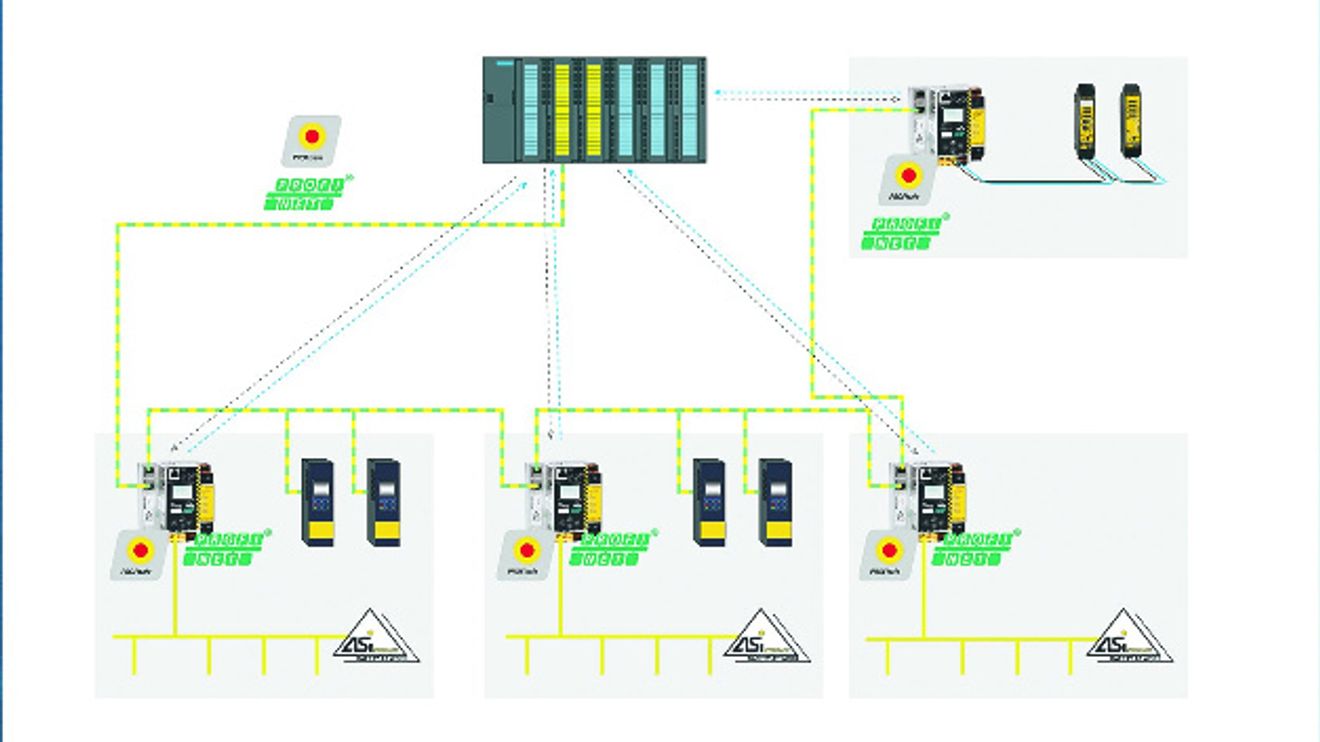
Central concept: A large fail-safe control unit controls the entire safety technology of the system.
© Bihl+WiedemannA simple calculation shows that this combination also offers enormous savings potential: to collect the data from 31 safety sensors, for example (maximum number of safe inputs on an AS-i circuit), the conventional peripherals of a fail-safe control system would require at least four times as many wires - i.e. 124 - from the switchgear to the field. With AS-i Safety at Work, the typical yellow cable alone is sufficient for the same application. For the implementation of such solutions in centrally organized safety concepts with different fail-safe control systems, appropriate products have been available for many years, such as the AS-i Safety Gateways to Profisafe via Profinet or Profibus from Bihl+Wiedemann. These devices can be integrated into the higher-level network as easily as a 'normal' slave and provide extensive diagnostic and status information to the fail-safe control system, in the case of Profisafe, for example, to the F-CPU from Siemens. This means that all relevant data reflecting the current status of the entire system is available in the safe command center at all times.
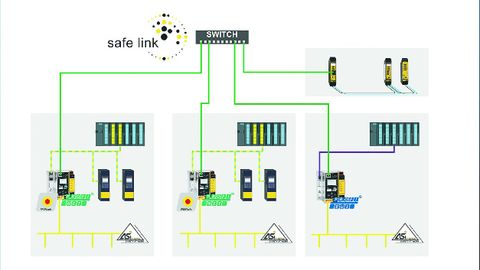
Decentralized concept: Safe Link in conjunction with the new 'AS-i Safety Profisafe Gateways' now also enables the decentralized networking of systems with safe drives and F-CPUs and those without safe drives and F-CPUs.
© Bihl+WiedemannWith the 'AS-i Safety Gateways' commonly used to date, it is possible to connect up to two AS-i circuits per gateway to the fail-safe control system. However, Bihl+Wiedemann felt that this was not enough with a view to the future. "As we know from many discussions with users, the trend is clearly moving towards increasingly complex and branched systems," says company boss Jochen Bihl. "We have derived a clear development mandate from this: We need an 'AS-i Safety Gateway' that is capable of linking the safety technology of as many system parts as possible - even if different fieldbuses are used in these segments."
The Mannheim-based company already had the technology for this: Safe Link was developed a few years ago precisely for this purpose: to efficiently connect several safe AS-i networks and integrate them into complex applications in which different fieldbuses can be used.
Safe Link allows up to 31 gateways with integrated safety monitors and basic safety monitors with Ethernet interfaces to be linked together. Communication is based on so-called multicasts. This means that one safety monitor 'speaks' and everyone 'listens'. Up to 1922 slaves can thus communicate directly with each other across all connected AS-i networks, completely independently of the overall technological concept of the system. You have direct access to the input and output data of all the machines involved.
AS-i gateway to the F-CPU with Safe Link
If Profisafe is used in all parts of the system, the safe connection could in principle also be established via the F-CPU; however, Safe Link is the far simpler alternative for several reasons. For example, project planning is carried out with just a few mouse clicks. And thanks to the "everyone hears everyone" principle, the output data of a subscriber with Safe Link only needs to be created once and can then be used directly by all other connected subscribers.

The new AS-i Safety Gateway Profisafe via Profinet with Safe Link (BWU3367): It can be used to implement applications up to SIL3, PLe.
© Bihl+WiedemannWith this in mind, it made sense for the developers to integrate the existing technology into the AS-i Safety Gateways for fail-safe control systems. "It doesn't sound that complicated at first," says Jochen Bihl. "In reality, however, it was a lot of hard work to pack both - i.e. the requirements for perfect interaction with the F-CPU and the capabilities for safe coupling with other AS-i networks - into one and the same device." In concrete terms, this means that not two, but three safety protocols had to be integrated into one gateway: AS-i Safety, Safe Link and Profisafe.
Such a solution was implemented for the first time with the AS-i Safety Gateway to CIP Safety via Sercos, which was presented last fall. The device itself combines two AS-i masters for two AS-i circuits and can be expanded by almost 2000 inputs and outputs via Safe Link. It also enters completely new spheres for AS-Interface: With its help, drives can be safely controlled and monitored via CIP Safety - directly and without an additional safety PLC.
Now comes the next development step: the new AS-i Safety Gateway for Profisafe via Profinet with Safe Link (BWU3367). It has two AS-i masters, three two-channel safe inputs and six independent safe outputs and can also be extended by almost 2000 safe inputs and outputs via Safe Link. With this solution, systems with safe drives can now also be flexibly networked with Profisafe and operated with a decentralized concept. This means that each part of the system has its own small or medium-sized controller, and in many cases the safety program is processed completely in the AS-i gateway. The individual segments are coupled very simply via Safe Link.
Author: Thomas Rönitzsch is responsible for corporate communications at Bihl+Wiedemann.


You might also be interested in
Trumpf collaborates with the IPAI AI Network
Trumpf is a new partner of the IPAI AI network in Heilbronn. Together, the two parties plan to develop and test artificial intelligence applications for industry.
 read more...
TSN as the Foundation of the Digital Industry
TSN/A Conference 2026 – Get your Early Bird Ticket now!
With a top-notch program and leading experts from industry, research, and standardization, the 11th TSN/A Conference 2026 will once again bring together the international TSN community under the theme “Multi-Industry Adoption of TSN.”
read more...Kontron Begins Production of 5G Modules in Düsseldorf
Kontron has launched mass production of 5G communication modules in Düsseldorf. The modules, which were developed in Berlin, are used in a variety of sectors, including industry, transportation, and critical infrastructure.
read more...Interview with Mike Slater, DigiKey
The Benefits of Data-Driven Distribution
With a single global distribution center, data-driven demand forecasting and comprehensive digital services, DigiKey aims to serve industrial customers worldwide. In this interview, Mike Slater explains the role Europe plays in the company's...
read more...AS-i Master for IIoT Platform
With ifm's "Moneo"-compatible AS-i master, sensors with AS-Interface can now also take advantage of the functionality of the "Moneo" IIoT platform.
read more...New Generation of Industrial Routers
Insys icom isexpanding its product portfolio with Moros.neo,a new generation of routers designed for use in critical infrastructure and industrial environments.
read more...Industrial-Grade DECT NR+ Gateway
With the "DECT NR+ Gateway," Stratum 9 is introducing what it claims is the first industrially viable gateway for real-time mobile applications.
read more...Connecting Wireless Sensors and Analog Control Systems
Hottinger Brüel & Kjær (HBK) has reintroduced the "WSDA-101" wireless gateway to the market. The wireless gateway is particularly well-suited for applications that require predictable analog signals with low latency.
read more...Federation Architecture | Part 3
Toward an Industrial-Grade AI for OT
Operational Technology (OT) controls physical processes and therefore operates under preventive and deterministic constraints. Modern AI, by contrast, is probabilistic and improves through iterative learning. Reconciling these paradigms remains a...
read more...