
VDMA on Corona
A small sigh of relief in mechanical engineering
An optimistic report comes from the VDMA: the downturn in the German mechanical and plant engineering sector slowed in June. Job losses also remain moderate.
Mechanical engineering has been hit hard by the coronavirus pandemic
© Pixabay/CC0The VDMA reports that machinery exports were also hit hard by the coronavirus pandemic in the second quarter. Between April and June 2020, they fell by 22.9% to €35.2 billion compared to the previous year; in Q1/2020, exports were still 5% below the previous year's figure, resulting in a cumulative decline in exports of 14.1% for the first six months.
April and May proved to be particularly weak months due to the global travel and transport restrictions: Exports fell short of the previous year's figure by around 28% in each case. At 12% year-on-year, machinery exports from Germany fell less drastically in June than in the two previous months of April and May due to the easing of restrictions. There is also likely to have been a catch-up effect due to the easing of supply chains.
The 2008/2009 financial and economic crisis was worse
"Companies have recently been able to breathe a little easier in the export business. But it will still be a bumpy road back to normality. This is because in order for export business to normalize, many mechanical engineering customer countries must first get a better grip on the consequences of the pandemic and develop more confidence for new investments," says VDMA Chief Economist Dr. Ralph Wiechers. Nevertheless, a comparison of the export figures from the corona crisis with the figures from the 2008/2009 financial and economic crisis shows that the decline was not more drastic, at least in the first half of the year. "In the first six months of 2009, machinery exports from Germany fell by just under 23%," explains Wiechers.
Russia strong, Great Britain weak
In the second quarter of this year, machinery exports from Germany to the EU-27 were 27.7% below the previous year's level. As expected, the export business with countries severely affected by the coronavirus, such as France (-28.2%), Italy (-31%), Spain (-32.1%) and the UK (-36.4%), was particularly poor during this period. Cumulatively, exports to the EU-27 partner countries fell by 17.3% in the first six months of 2020.
In the same period, 11.3% fewer machines were delivered to the rest of Europe. Russia stands out in particular, as it was the only top customer country to record an increase in exports of 4.5% in the first half of the year. "The increase is largely due to major orders for the Russian process industry, which were realized in June," explains Wiechers. "This recent growth trend in machinery exports from Germany to Russia is unlikely to continue."
Nevertheless, Russia has now moved back up to ninth place among the most important customer countries for machinery exporters from Germany, displacing Switzerland to tenth place.
China outstrips the USA
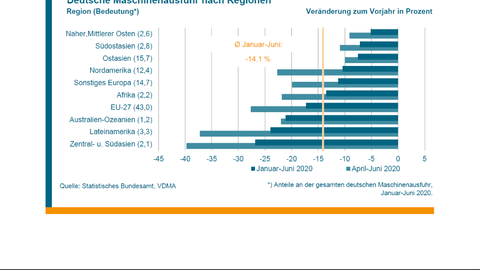
German machinery exports in the 2nd quarter and 1st half of 2020 compared to the same period of the previous year.
© VDMAExport trends to the two most important individual markets, the USA and China, differ significantly: 23% fewer machines were delivered to the USA in the second quarter than in the previous year. Although business in China declined between April and June, this was only by 7.9%. According to the VDMA, China is therefore on its way to catching up with the USA in the ranking of the most important individual markets. "In the People's Republic, we are observing an extremely robust economic recovery, especially in industry. This in turn is benefiting a number of mechanical engineering sectors, which are recording significant growth in exports to the People's Republic. These include machine and component manufacturers for the construction and infrastructure industries as well as the electronics sector," Wiechers analyzes.
Labor market situation: Moderate job cuts and short-time work
The number of employees thus amounted to around 1.03 million at the end of June. "In view of the immense pressures facing our industry, this remains a moderate reduction," Wiechers comments on the figure.
The reduced labor market momentum was already apparent in the results of the regular Corona flash surveys conducted by the VDMA. 17% of the companies last surveyed at the beginning of July stated that they were adjusting their underutilized production capacities by reducing permanent staff. Significantly more (68% of companies) are using short-time work. "As in 2009, short-time work secures numerous jobs and is proving to be a reliable, job-securing instrument in this crisis too," explains the VDMA Chief Economist. "For this reason, Federal Finance Minister Olaf Scholz is on the right track when he wants to extend the duration of the short-time working allowance to 24 months."
Plea for extended short-time work
In July, a good third of employees in the mechanical engineering sector were on short-time work. However, the increase from an estimated 354,000 short-time workers in June to 378,000 in July was significantly lower than in previous months.
Many mechanical engineering companies are currently having to walk a tightrope between hiring freezes and the search for skilled workers for the tasks ahead, particularly in the area of digitalization. Caution currently prevails: "The number of registered jobs in mechanical engineering has almost halved compared to the previous year," Wiechers classifies. Demand for engineering staff fell by 14.5% in the first quarter and by 23.7% in the second quarter.


You might also be interested in
Taking responsibility - Sylke Schulz-Metzner in conversation
The development of the corona pandemic means that the SPS in Nuremberg cannot take place. We spoke to Sylke Schulz-Metzner, Vice President Mesago Messe Frankfurt, about the concerns that ultimately led to the physical event being canceled.
 read more...
Mechanical engineers against the general obligation to wear masks at work
The mechanical engineering association VDMA has spoken out against a general obligation to wear masks in the workplace.
read more...German economy sounds the alarm over travel restrictions
Travel warnings and quarantine regulations during the coronavirus pandemic are making life difficult for the economy. This also applies to trade fairs.
read more...Industry recovers only slightly from coronavirus slump
A rapid economic recovery after the lockdown is not a foregone conclusion. Industry, construction and energy suppliers once again produced more in July than in the previous month. But economists had expected more.
read more...Sharp drop in production in NRW industry
Industry in North Rhine-Westphalia had to cope with a sharp drop in production in the first half of this year.
read more...electronica 2020 canceled
Due to the latest developments in the coronavirus pandemic, electronica will not be held as an in-person trade fair this year and will instead switch to a purely digital format.
read more...Ralf Winkelmann appointed to the Management Board
Ralf Winkelmann is a new member of the board of the VDMA Robotics + Automation Association. The Managing Director of Fanuc Germany succeeds Helmut Schmid, formerly of Universal Robots.
read more...VDMA joins European Clean Hydrogen Alliance
The VDMA is a member of the European Clean Hydrogen Alliance. Its aim is to promote climate-neutral hydrogen in Europe.
read more...Drive technology in growth
Reducing costs and thus increasing resilience was ABB's declared aim. These efforts led to a better quarterly result than expected.
read more...