
Hy-Line
UPS for the DIN rail
An uninterruptible power supply, or UPS for short, is useful for the stability of a system. If no long bridging times are required, it can even be integrated on the top-hat rail.

Even the shortest power failure in production can result in long downtimes and therefore high costs. If, for example, a plastic injection molding machine has come to a standstill, any unmelted granulate and plastic mass that has already melted and cooled down in the machine must first be completely removed before production can be restarted. It therefore makes sense to have a powerful system that can take over in the event of a power failure. With regard to the control system of a machine, a mains voltage fluctuation of just a few milliseconds can lead to problems and failure of the PLC and therefore the machine. It is therefore important to keep the control system stable and functional.
DC UPS instead of classic AC UPS
Industrial plant control systems usually run on a 24 V DC bus. It is therefore much more efficient to start here than on the AC side. AC UPS are complex systems and sometimes involve considerable additional losses due to the continuous conversion from alternating voltage (AC) to direct voltage (DC). If, on the other hand, buffering is only carried out on the DC side, there are only minor additional losses to keep the energy storage device charged with a regular mains supply: It is only converted from AC to DC once in the power supply unit and, in the event of a mains failure, the energy storage unit can supply the bus directly or via a simple DC/DC converter.
But which energy storage system is suitable for this type of DC UPS? First of all, classic rechargeable batteries, whether in lead, nickel metal hydride (NiMH) or lithium technology. Some of these can be coupled to the bus via diodes or ORing assemblies to compensate for voltage failures in the grid, as they only supply a slightly decreasing voltage from full charge to almost complete discharge. They can also bridge longer failures, but also take longer to reach full capacity again after a failure. They are ideal for shutting down the system in a controlled manner if the mains supply fails.
If, on the other hand, it is primarily a matter of intercepting brownouts or short blackouts, for example until another system steps in or the control system can quickly save its data, capacitors make more sense as energy storage devices. This is because they are all low-wear, deliver high power in the short term and can be fully recharged much faster than batteries. However, a DC/DC converter is required if a constant output voltage is needed, as the voltage of capacitors drops significantly as they discharge.
There are different UPS systems for these requirements, but both are suitable for snapping directly onto the top-hat rail in the control cabinet - including energy storage. A variant for direct installation in your own devices is also available. However, other individual solutions are also possible, including buffering large power supplies and local networks with a wide variety of energy storage systems.
DC UPS - all-in-one solution with accumulators
The 'DC-UPS' system from Adelsystem is a compact solution for 12, 24 and 48 V DIN rail systems with a current requirement of 3 to 35 A with a peak load capacity of up to three times the rated current. In addition to the actual UPS logic, these "all-in-one" solutions also contain a power supply unit and a battery charger. Back-up batteries with up to 7.2 Ah each can also be mounted on the top-hat rail. In this way, a completely fail-safe DIN rail power supply can be implemented in the same place instead of just a classic DIN rail power supply unit.
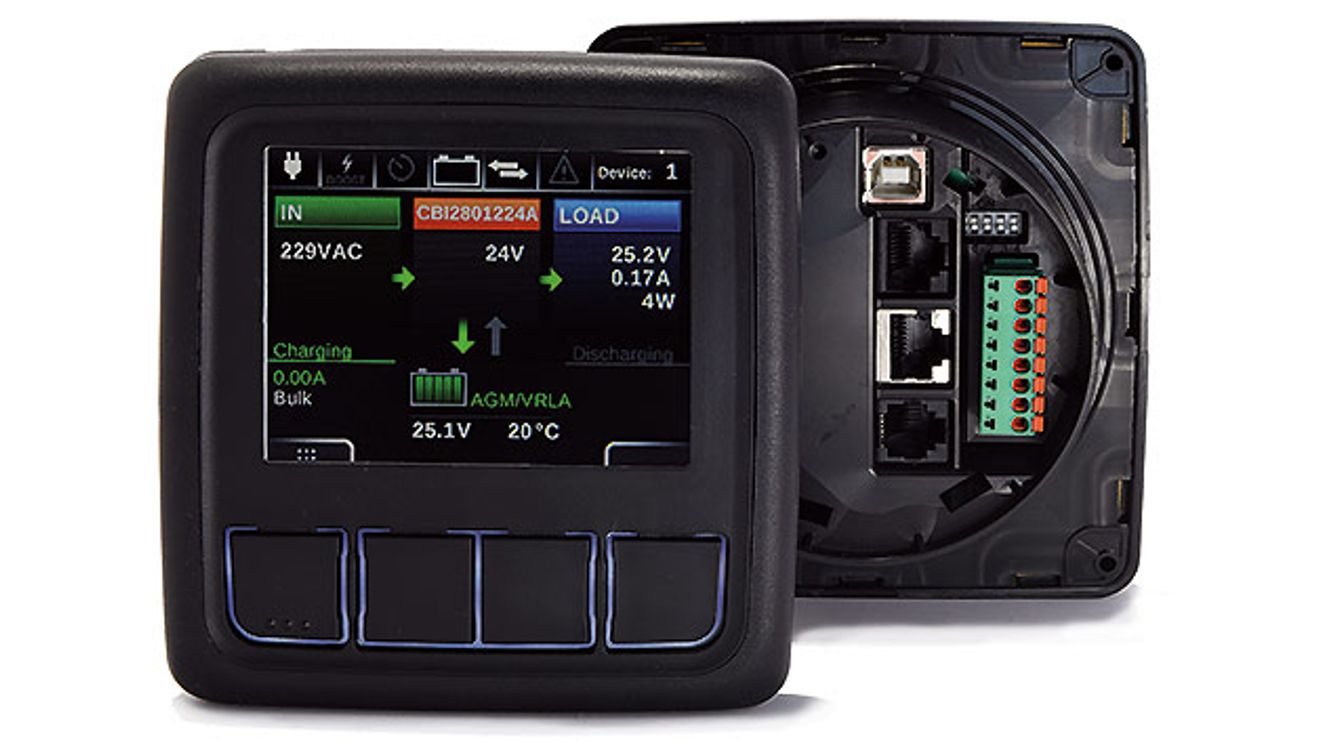
These all-in-one UPS are not intended to supply a complete production plant, but to keep individual control subsystems in operation even in the event of grid instability or failure. This eliminates the unnecessary detours of conventional UPSs, which first generate AC mains voltage from DC voltage. Another advantage: although a fault in the battery affects the UPS function, it does not lead to the output voltage being switched off if the input voltage is present, as is the case with an AC online UPS, for example. Finally, the charging current is dynamically controlled depending on the power requirement of the consumer: if the power drawn from the consumer is low, more is diverted to charge the battery.
The system is flexible and can work with lead and nickel-metal hydride batteries as well as lithium-ion batteries, charging, managing and controlling them. Deep discharge is prevented and charging is adapted to the current ambient and cell temperature. Reverse polarity, cell short circuits and increased internal resistance are also detected. Special battery care functions such as diagnostics and charging adapted to the temperature and internal resistance extend the life of the battery.
Fully equipped Adelsystem 'DC-UPS' with Modbus RTU can also be coupled with a control panel and web server for remote monitoring communication. This provides log functions, monitoring, alarm notification and numerous configuration options via RS485, SNMP and Ethernet TCP/IP. The wide-range input covers 115 and 230 VAC, and a three-phase version is already being planned.
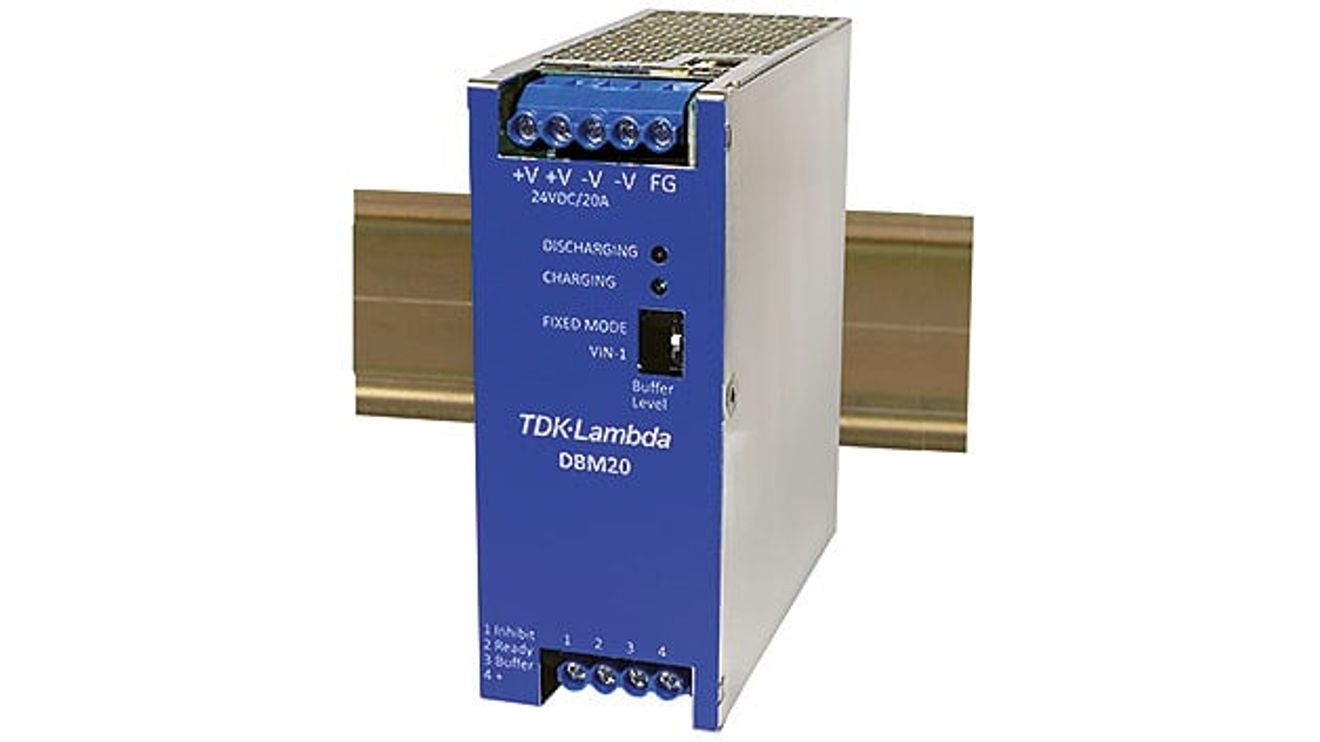
Figure 2: The 24 V capacitor buffer module DBM20 for the top-hat rail. TDK-Lambda offers different versions of the buffer module.
© TDK LambdaUPS DC buffer modules with capacitors
The DBM20 and ZBM20 buffer modules from TDK-Lambda do not work with batteries, but with de facto maintenance-free capacitors. DBM20 modules are also DIN rail mountable, while the ZBM20 variant is realized as an open-frame installation module. The buffer modules can be easily combined with the open-frame power supplies of the CUS series or the DIN rail power supplies of the DRx series or products from other manufacturers.
At maximum load, the buffer modules can bridge at least 250 or 380 ms of input voltage failure of a 24 V DC power supply unit in a DIN rail (49 mm wide) or open-frame housing (175 mm × 85 mm × 57 mm). They are therefore suitable as a buffer for short-term mains instabilities or for peak load requirements of loads that are connected to an AC/DC power supply unit. Additional bridging times of 250 ms at 448 W output power are possible.

These are extended, for example, to 2000 ms with a 2.5 or 4 A load or 14 s with 0.25 A. The extended bridging time enables a safe shutdown of the devices and prevents data loss in the event of interruptions to the AC power supply. Possible applications include industrial automation, robotics and semiconductor manufacturing. To prevent unintentional discharge of the stored energy, the output can be disabled using a remote on/off function. Both a DC-OK relay and optocoupler outputs for status monitoring are available for remote monitoring. Several modules can be connected in parallel for even longer buffer times.
Electrolytic capacitors are used for energy storage. This eliminates the need for regular maintenance intervals for battery replacement and significantly increases reliability. DC/DC converters are used to increase the storage capacity and keep the output voltage constant. An inrush current limiter and internal fuses are also provided. The safety approval includes IEC/UL/CSA/EN 62368-1 with CE marking in accordance with the Low Voltage, EMC and RoHS directives.
On the model with 24 V output, a switch can be used to select between two operating modes. In 'fixed mode', the module supplies energy as soon as the input voltage drops to a fixed threshold of 22.4 V. In 'variable mode', the module supplies energy as soon as the input voltage drops by 1 V. In total, input voltages of 23 to 30 VDC are permissible here, and the permissible operating temperature range is from -20 to +70 °C without any reduction in performance. The internal storage voltage in these modules is up to 220 VDC in order to make optimum use of the electrolytic capacitors and achieve high efficiency levels.

It can also be bigger...
There are also DC UPS solutions with even higher storage voltages of 500 to 1,000 V for direct connection to intermediate circuits. This means that even larger systems and entire grid power supplies can be reliably and almost maintenance-free protected against power failures or peak loads using capacitors instead of batteries, but then no longer as a DIN rail solution. One example is the port facility in Genoa, where the transformer station is unable to supply peak loads if several consumers draw power at the same time. Which designs and energy storage technologies are the right ones can be decided and implemented on an individual basis.


You might also be interested in
Power supply units with AC three-phase input
The TPS series from TDK-Lambda - available from Hy-Line Power Components - can be operated on all 3-phase supplies with 400, 440 and 480 V(AC) and delivers 24 or 48 V(DC) output voltage, adjustable to 19.2 to 28.5 or 38.4 to 58 V respectively.
 read more...
DIN rail power supply units with three-phase input
Newly available from Hy-Line Power Components is a compact series of TDK Lambda DIN rail power supplies that can be fed from a three-phase network.
read more...DIN rail power supply units with three-phase input
The 3-phase power supply units in the DRB series from TDK-Lambda, which are available from Hy-Line Power Components, are designed for continuous operation with 120 and 240 W at 12, 24 and 48 V and can deliver a peak power of 144 or 288 W for 2...
read more...For top hat rail mounting
With the DC-UPS system, Hy-Line Power Components offers a solution for 12, 24 and 48 V DIN rail systems from 3 A to 35 A with a peak load capacity of up to three times the rated current.
read more...Increased voltage and temperature range
The latest model in Hy-Line's range of bidirectional DC/DC converters from TDK Lambda, the EZA2500, allows a bus voltage in the range of 260 to 400 V(DC) and a battery voltage of 36 to 65 V(DC).
read more...Rack power supply for up to 15 kW
The Genesys+ programmable power supply for rack mounting from TDK-Lambda has been extended to include models with output powers of up to 15 kW.
read more...Power supply units: Also approved for medical devices
With the DTM65-D and DTM65-C8 power supply series from TDK-Lambda, Hy-Line Power Components offers external AC/DC adapters with mains plug/cold appliance connection.
read more...Distributors expand product range
Power supplies have become an integral part of many distributors' product ranges. Hy-Line, Rutronik and Farnell have new products in their portfolios.
read more...Are touchscreens still fit for the future?
Looking at the innovations and therefore the future of the Human Machine Interface, it is easy to wonder whether touchscreens are still necessary at all, or for how long. What is the state of the art in HMI?
read more...