
Power supplies
Electronic fuse replaces automatic circuit breaker
As a result of the use of switched-mode power supplies, electronic fuses are increasingly replacing conventional circuit breakers. What are the advantages?


Overload behavior and switching power lines: Linear control of current limiting (top) and hicc-up mode to protect the power supply unit (bottom).
© Friedrich LützeConventional circuit breakers are designed to trip when a considerable current flows. Ideally, this requires an infinitely large current source and the possibility of earthing, because while the current is being detected, the entire system must carry the excessive current for a short time. For this reason, modern switched-mode power supplies offer self-protection against thermal destruction; when circuit breakers are used, on the other hand, the power supply must be oversized to ensure tripping. If electronic fuses are used (such as the 'Locc-Box' or the 'LCOS CC' family from Lütze), such overdimensioning is not necessary as the protection mechanisms are based on the real application conditions. This enables users to use smaller power supplies in smaller housings and thus save space in control cabinets.
The moment an application is switched on can also be critical, as the increased power requirement of the power supply can lead to various types of malfunction. If, for example, a short circuit occurs, the power supply cannot provide enough current to trigger the circuit breaker. This only detects an overcurrent and switches with a very long delay - if at all. This dead time of at least a few seconds can lead to considerable damage to the system.
Power Boost as a solution?
Power Boost is a good option for supplying the required higher current at the moment of switch-on or in the event of a temporary overcurrent. However, the power boost is not suitable for supplying the additional current at nominal operation to trip the circuit breaker. Another moment when switching off is undesirable is a brief high inrush current, especially with capacitive or inductive loads. An automatic circuit breaker is not able to detect the load, resulting in false tripping.
Electronic fuses, on the other hand, are designed in such a way that they automatically detect such loads and do not switch off accordingly, but rather only switch off before the connected power supply goes into self-protection. Different characteristics can be set on Lütze devices in order to cover the various switch-on behaviors up to heavy load starting.
NEC Class 2 and electronic fuses
In the North American NEC (National Electric Code), circuits are divided into different classes. NEC Class 2 circuits, for example, may only be supplied by a power source with a maximum of 100 VA/8 A. The structure must either comply with the UL1310 guidelines or be classified or listed as a limited power source in accordance with UL 60950-1. In general, NEC Class 2 circuits are not considered dangerous in terms of fire hazard and electric shock.
Protection of a conventional power supply to a power-limited circuit by fuses or circuit breakers is only permitted with an NEC Class 2 approved electronic fuse. In the event of an overload, the maximum current is limited and switched off after the defined time in accordance with the preset characteristic. All fuses operate independently so that, unlike other systems, not all fuse modules are switched off. Even in the event of a device fault, the internal, redundant design prevents the occurrence of a dangerous state.
Not just line protection
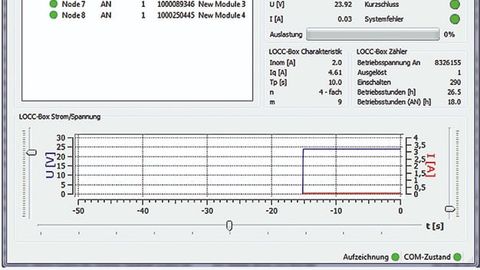
Free 'LOCC-Pads' software: evaluation of relevant system data such as status, parameterization and live data.
© Friedrich LützeHowever, electronic fuses such as the 'Locc-Box Net' or the 'LCOS CCi' family are not just pure protection elements, but can already cover Industry 4.0 requirements today: Both systems continuously record all relevant energy and system data via bus couplers. This includes parameters such as current operating voltage and current, set rated current and characteristics, operating hours of the system and device, overload status or even short circuit and undervoltage. The data can be displayed in the Profinet, Ethercat, Profibus DP, CANopen and Ethernet IP communication systems via bus couplers. The data is evaluated in a control system or a higher-level energy management system, which can then lead to one or all devices connected to the bus coupler being switched off. This makes it easy to switch off consumers that are not required or entire parts of the system. In addition, it is up to the user to decide whether to carry out switching via the standard remote control channel or directly via the communication system. All functions can be graphically visualized and executed via freely usable software or an HMI.
Another important aspect is troubleshooting. Particularly in the case of sporadic overflows, the recording of all relevant data can be displayed in the software via event data logging or sent to the control system including a time stamp.
Author:
Dimitrios Koutrouvis is Head of R&D at Friedrich Lütze in Weinstadt.


You might also be interested in
Heat forecasts thanks to temperature simulation
With 'Airtemp 2.0', practical heat forecasts can be created for control cabinets equipped with the 'Airstream' wiring systems from Lütze.
 read more...
Cooling switch cabinets as required
What to do when production facilities are 'getting on in years' and their retrofitting needs to meet both digitalization and sustainability requirements? A long-term project for temperature monitoring of control cabinets helped an automotive...
read more...The e-paper of issue 07/2024
Read in the current issue of Computer&Automation how ChatGPT can provide support in the conception phase, how LLMs are used in code analysis and whether TSN can be considered as a backbone for virtualized control systems.
read more...Power monitoring system expanded
Lütze is expanding the intelligent current monitoring system 'LOCC-Box' with an IO-Link gateway for coupling up to 15 LOCC-Box Net modules.
read more...IO-Link gateway expands power monitoring system
Lütze is expanding the intelligent current monitoring system 'LOCC-Box' with an IO-Link gateway for coupling up to 15 LOCC-Box Net modules.
read more...The e-paper special: looking for products of the year 2024
They've earned it: all 96 nominated products from 12 categories in their own e-paper. Browse through the individual areas and make your personal selection. You can also find out more about the companies and their solutions in the accompanying video...
read more...Enclosure ventilation in the smallest of spaces
The latest member of the Lütze 'Airstream' product family is the 'Airblower Compact', with which the flow and heat dissipation properties of the Airstream wiring system can also be used in small control cabinets and switch boxes.
read more...Control cabinet ventilation with minimum space requirements
The latest member of the Lütze 'Airstream' product family is the 'Airblower Compact', which allows the flow and heat dissipation properties of the Airstream wiring system to be used in small control cabinets and switch boxes.
read more...Universal load monitoring up to 8 A
Lütze has added the compact, single-channel Locc-Box-M, which can be used as a stand-alone version, to the proven Locc-Box family of electronic load monitors.
read more...