
Enclosure cooling
The possibilities of passive cooling methods
In the age of digitalization, more and more electronic components are moving into the enclosure - which can become a problem in terms of heat development. Accordingly, the issue of air routing in the enclosure needs to be addressed 'intelligently' as early as the planning phase.

Components and electronics in the switch cabinet are becoming increasingly compact while retaining the same switching function. However, this does not lead to a reduction in heat loss and cannot prevent the build-up of heat in the enclosure. On the contrary: heat-producing components add up and the heat increases continuously. The result: 'hot spots' are created. The service life of the components positioned in these hot spots is likely to decrease. In other words, a creeping heat death is pre-programmed. Ultimately, the components no longer deliver the desired performance, fail and cause the system or machine to come to a standstill. In short: Innovative components in the control cabinet usually have the negative consequence that cooling is increasingly required.
Is the use of a conventional cooling unit the solution? Up to now, cooling units have been dimensioned for an internal temperature in the enclosure of around 25 to 30 °C at the highest possible ambient temperature for the theoretically maximum required cooling capacity. This means that oversized cooling capacities are installed, but are usually not immediately required. The problem is exacerbated by global warming with its temperature peaks - even in temperate zones such as Germany.

Figure 1: Rear view of an Airstream frame with Airblade for targeted cooling air flow (bottom left) and Airblower for homogenizing the enclosure climate (top).
© SagittariusThe solution to the problem is therefore not the use of an oversized cooling unit, but rather the development of an intelligent cooling air routing system in the enclosure (Figure 1). What such a solution concept can look like is illustrated below using the example of the so-called AirStream concept from Lütze. In addition to the wiring system, which is compatible with all standard enclosures, this concept includes an online configurator and an online tool for calculating the thermal performance and optimizing existing and newly planned enclosures.
Before the wiring frame is planned with the help of the online configurator, background information for the geometry and definition, such as the height, width or depth of the enclosure, must be collected. The wiring frame is individually adapted to the components. The frame itself consists of aluminum modules in which an additional level in the depth of the enclosure behind the components is used for the wiring. This means that there are no more unfavorable cable ducts in terms of ventilation. The frame can then be optimally adapted and can be planned online in just a few steps. The result of this planning is output in a file that can be imported into any CAD program. With the integration of the wiring system in the Eplan portal, designers also benefit from engineering tools such as project planning, 3D layout, production and assembly.
The web-based AirTemp application has recently been introduced to provide additional assistance in planning the wiring system. The thermal analysis tool enables quick and spontaneous analyses of different types of wiring and cooling systems and provides well-founded results on heat development and distribution in the enclosure. In other words, the heat simulator offers the possibility of a heat forecast that goes beyond a simple description of the current status and therefore allows the heat development in the enclosure to be determined as early as the design phase.
Among other things, the different temperature layers in the enclosure - whether with mounting plate or wiring system - can be precisely determined in this way. For this purpose, the enclosure is divided into three zones (top, middle, bottom). The temperature can be precisely defined in the zones. The user must first determine the key data. For example, whether the control cabinet is free-standing or mounted on a wall. Then all that needs to be entered is the power loss of the installed components. Based on this, the tool then provides data and information on, for example, how the arrangement of the components in the enclosure can be improved from a thermal point of view or how cooling options within the enclosure affect the enclosure. Ultimately, the aim must be to optimally position the components during the planning phase of the enclosure and thus increase efficiency.
Guide air flows precisely
A very efficient way to homogenize the climate in the enclosure or to ventilate heat pockets directly is to guide the air flows precisely via air baffles (AirBlades) in combination with corresponding fans (AirBlower). This significantly improves the heat dissipation performance of the enclosure. Practical experience shows that the temperature level in the enclosure can be equalized and reduced by up to 10 Kelvin within a few minutes.

Figure 2: Normal heat distribution in the control cabinet shortly after commissioning the machine.
© SagittariusThermal imaging can be used to illustrate the positive effect of optimized air circulation and the associated chimney effect in the enclosure. Although power components with correspondingly high heat development are installed in the control cabinet, active cooling is not used in the test setup shown in Figures 2 and 3.
Figure 2 shows the average heat level in the control cabinet shortly after commissioning the machine or system. The warm areas are shown around the power components. The colors yellow and white represent the areas with the highest temperature. It can be seen that power components with a high heat output are present in the lower middle area of the image. The cooler zones are shown in the blue and violet areas. Overall, the temperature in the control cabinet is still at an acceptable level.

Figure 3: Existence-threatening hot spots emerged around the power components 80 minutes later.
© SagittariusAbout 80 minutes later, the picture has changed dramatically. The control cabinet is at operating temperature and the components are behaving like heating elements. The resulting heat pockets endanger heat-sensitive components. As can be seen in Figure 3, the heat level in the entire enclosure has increased significantly and is a threat to all components. A hotspot has formed around the power components. Sooner or later, damage to the electronics is to be expected. In this phase, the aforementioned air blower is used in the enclosure.
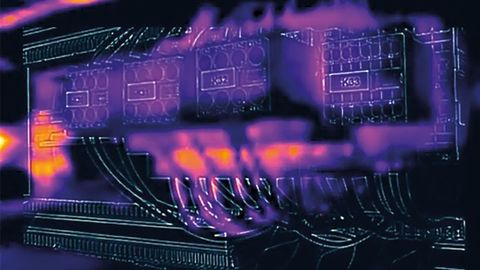
Figure 4: Another eight minutes later: air baffles and fans have homogenized the heat distribution in the enclosure.
© SagittariusPicture 4 was taken eight minutes later. Just a few minutes were enough to completely eliminate the hotspots around the power components and reduce the average heat level in the enclosure to a tolerable level. It should also be noted that the operation of the air blower requires significantly less energy than an active cooling unit and does not have to be used in continuous operation.
The 24-volt fan modules can be installed with little effort. The fans are mounted on bar modules with a choice of 700, 900 or 1100 mm bar length. A hook-in version is also available for retrofitting. This can also be used with 500 mm wide cabinets. The modules are controlled via a control unit that enables freely parameterizable fan operation.
What remains to be said: Practical experience with specific industrial applications and empirical studies show energy savings of up to 23%, even without an external cooling unit. In addition to the cost savings, this has a positive effect on the carbon footprint. To illustrate this: in 2011, around 3.5 million active enclosures with around 900,000 installed cooling units could already be assumed in Germany. This corresponds to a connected load of around 600 MW. To cover this energy requirement, around 300 wind turbines would have to be turning or a conventional coal-fired power plant would have to be operating.
Author:
Michael Bautz is Product Manager at Lütze.


You might also be interested in
Heat forecasts thanks to temperature simulation
With 'Airtemp 2.0', practical heat forecasts can be created for control cabinets equipped with the 'Airstream' wiring systems from Lütze.
 read more...
Cooling switch cabinets as required
What to do when production facilities are 'getting on in years' and their retrofitting needs to meet both digitalization and sustainability requirements? A long-term project for temperature monitoring of control cabinets helped an automotive...
read more...The e-paper of issue 07/2024
Read in the current issue of Computer&Automation how ChatGPT can provide support in the conception phase, how LLMs are used in code analysis and whether TSN can be considered as a backbone for virtualized control systems.
read more...Power monitoring system expanded
Lütze is expanding the intelligent current monitoring system 'LOCC-Box' with an IO-Link gateway for coupling up to 15 LOCC-Box Net modules.
read more...IO-Link gateway expands power monitoring system
Lütze is expanding the intelligent current monitoring system 'LOCC-Box' with an IO-Link gateway for coupling up to 15 LOCC-Box Net modules.
read more...The e-paper special: looking for products of the year 2024
They've earned it: all 96 nominated products from 12 categories in their own e-paper. Browse through the individual areas and make your personal selection. You can also find out more about the companies and their solutions in the accompanying video...
read more...Enclosure ventilation in the smallest of spaces
The latest member of the Lütze 'Airstream' product family is the 'Airblower Compact', with which the flow and heat dissipation properties of the Airstream wiring system can also be used in small control cabinets and switch boxes.
read more...Control cabinet ventilation with minimum space requirements
The latest member of the Lütze 'Airstream' product family is the 'Airblower Compact', which allows the flow and heat dissipation properties of the Airstream wiring system to be used in small control cabinets and switch boxes.
read more...Universal load monitoring up to 8 A
Lütze has added the compact, single-channel Locc-Box-M, which can be used as a stand-alone version, to the proven Locc-Box family of electronic load monitors.
read more...