
Weidmüller
Simply monitored
Basic knowledge of industrial IoT applications is available in many companies today - but they often lack the know-how to implement them independently. A solution that can be integrated quickly should help to easily monitor the status of decentralized machines and systems.
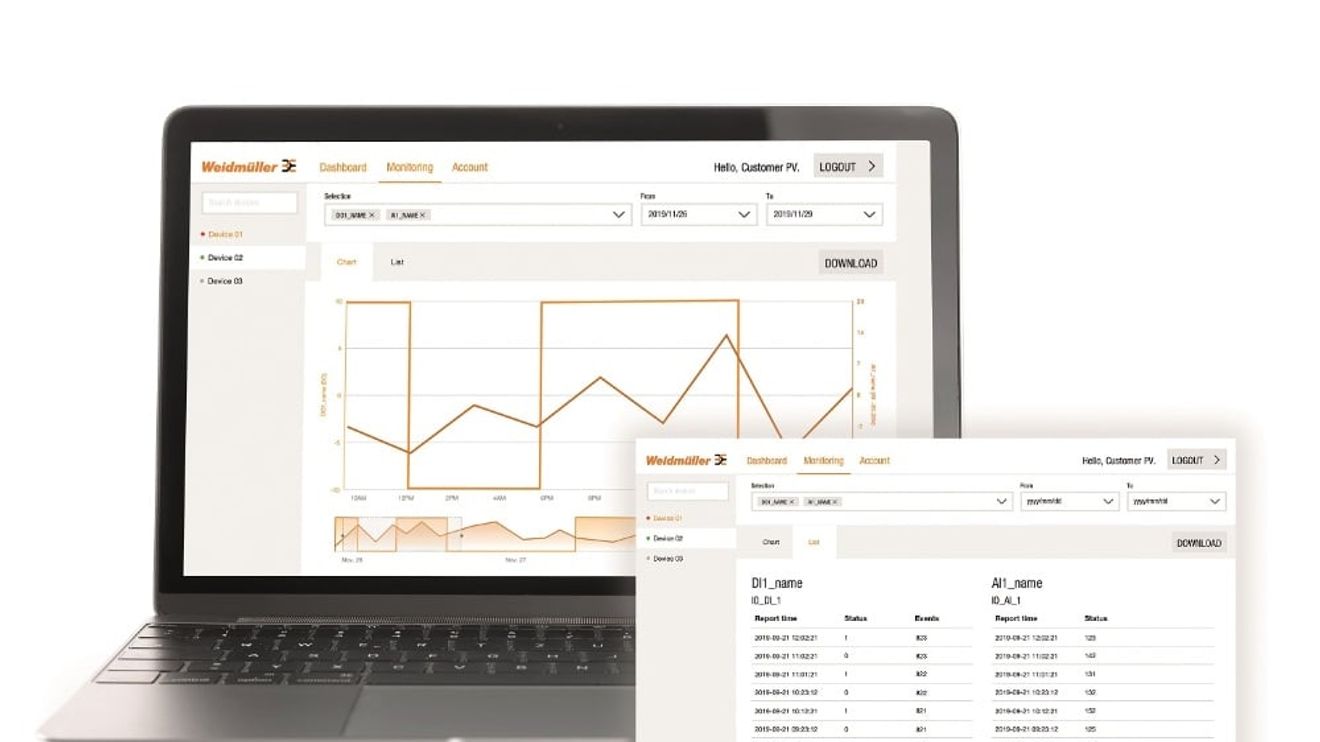
Simply monitored
© WeidmüllerMany companies collect and store data as a first step, but often do not use it in a targeted manner. However, the collected information only achieves a concrete, measurable benefit through logical linking and evaluation. However, this requires identifying individual potential for industrial IoT applications, developing needs-based solutions and integrating them into existing structures - for example, for location-independent machine commissioning, improving overall equipment effectiveness (OEE) or generating automated reports on energy consumption.
Foundation stone for IIoT portfolio
With the 'IoT terminal', Weidmüller offers an open, quickly integrated solution for the Industrial IoT that collects data, transmits it to cloud services and also enables active data-driven interactions. This means that decentralized and centralized systems can be configured in equal measure and their signals can be processed and monitored. The solution is particularly suitable for detecting errors and transmitting configured error messages to a cloud service.

Several digital and analog input and output ports are available. The input ports allow four digital signals to be monitored simultaneously. In addition, two voltage or current measurements and up to four temperature measurements can be carried out. Two galvanically isolated ports enable AC voltage applications.
During commissioning, the IoT terminal automatically registers in the cloud and is ready to transmit data. It is commissioned and configured via an app using the device's BLE (Bluetooth Low Energy) interface. The intuitive smartphone app supports the user throughout the entire set-up and maintenance process. After starting the app, the user logs in with their username and password. The IoT terminal can then be selected from the list of scanned BLE devices. As soon as it is registered as a 'device', data from the input and output ports can be called up.
Communication via Narrow-Band IoT and LTE-M
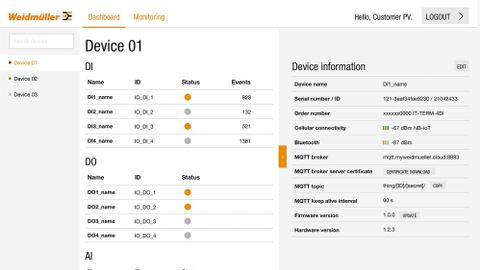
The data from the 'IoT terminal' is available as standardized protocols that can be easily integrated into existing engineering systems.
© WeidmüllerAfter logging into the cloud, configuration can also be carried out via the cloud. A configuration can be, for example, the determination of limit values with the corresponding reaction to them: If the defined limit value is exceeded, the user is notified directly. Such active, data-driven interactions make a wide range of industrial applications feasible - for example in solar parks for power monitoring, in hydroelectric power plants or for monitoring electric vehicle charging stations.
It is also possible to transfer data to the cloud at regular intervals. All transfers are logged in the cloud and are available later as a history. By using the MQTT/COPA web transfer protocol , users have access to the data as standardized protocols that can be easily integrated into existing engineering systems. The MQTT protocol manages and administers all data traffic via the so-called MQTT Broker - messages are received and distributed directly.
For IoT applications, however, it is not only the standardized provision of data in the cloud that is necessary: data monitoring via cloud services, which should be as simple and cost-effective as possible, is also an important factor. To transmit data to the cloud, Weidmüller relies on communication via narrow-band IoT and LTE-M cat.1, among other things. These mobile radio standards are intended for low-power and low-cost IoT services. The special narrow-band modulations of Narrow-Band IoT and LTE-M increase radio signal penetration for long distances of up to 10 km in rural areas and overcome the attenuation caused by walls, machines and environmental obstacles.
Simple retrofitting

IoT-terminal also has Bluetooth Low Energy and ModBus. This transmission standard is particularly suitable for transmitting status data at regular intervals in decentralized applications, as it consumes little energy.
One possible application for the IoT terminal is retrofitting existing machines and industrial systems for energy recording. In this case, the basis can be an energy meter with just one Modbus RTU interface. The IoT terminal acts as a Modbus RTU master with the addition of the IoT function. All components are accommodated in a separate housing - the so-called Energy PnP Box - and are therefore ready for retrofitting. Additional external sensors such as flow switches or temperature measurement can also be connected via digital/analog input. All values are available directly in the cloud.
The IoT terminal was developed together with the Taiwanese family-owned company ORing Industrial Networking, in which Weidmüller acquired a stake in the summer of 2019. This IIoT solution is the first result of the cooperation, with which Weidmüller aims to drive forward the vertical integration of the IIoT.


You might also be interested in
Democratization of machine learning
The 'Industrial AutoML' software enables companies to implement machine learning models independently - without a data scientist. The application engineer contributes their domain knowledge and the software automatically creates the ML model.
 read more...
SPS Connect 25.11. - 16:15 - 16:35
Single Pair Ethernet
Intelligent connection technology & infrastructure in the networked world: The increasing degree of digitization of industrial systems requires the further development of existing Ethernet cabling.
read more...Digital components integrated into the IP network
With the Smart I/O Controller with digital inputs and outputs from Microsens, users can easily integrate devices at the sensor-actuator level into the IP network.
read more...Initiative for switch cabinet construction
Weidmüller, Komax, Zuken and Armbruster Engineering have founded the 'Smart Cabinet Building' initiative for new solutions in control cabinet construction.
read more...CAD software: Models available remotely via browser
With the release of IndustrialPhysics 3.0, the machine engineering team has integrated new features into the software. For example, synchronized mechatronic engineering is now possible via the so-called CAD offline buffer with workflow control.
read more...AI on the machine tool
Siemens is expanding its Industrial Edge offering for the machine tool-related 'Sinumerik Edge' with additional applications. The Edge application 'Analyze MyWorkpiece/Vision' is based on artificial intelligence.
read more...Between analog and digital
When measuring with piezoelectric sensors, the charge amplifier is an indispensable link in the measuring chain. As automation progresses, this component undergoes its own evolution from analog to digital.
read more...You can't do without IoT platforms!
IoT platforms are already available today in very usable versions. But what building blocks do the platforms actually consist of and what should you look out for if you want to use a platform?
read more...Simple implementation of IO-Link devices
How can the integration of IO-Link devices into control systems be simplified? An open software-based service for all IO-Link device manufacturers automatically creates function blocks and thus significantly reduces the implementation effort.
read more...