
Switch cabinet construction
Industry 4.0 starts with engineering
Using the data generated in engineering for all other processes in the company - the example of a medium-sized machine and control cabinet manufacturer shows how this works.
When Hartmuth Bauer changed his company's name to Bauer Steuerungsbau in 2004 and focused entirely on control and switchgear construction, he ordered a CNC machining center for machining control cabinet parts at the Hanover Trade Fair that same year - even though he had just three employees in the workshop at the time. "If we want to be a serious supplier on the market, we need a machining center like this," says the Managing Director, explaining his conviction that prompted him to make this investment. Founded in 1999, the company originally developed handling systems and control systems for the timber industry as a mechanical engineering company. As more and more customers were added over time, for whom control cabinets with control technology were supplied, the company was renamed and realigned. Today, around 30 employees work for the medium-sized company, which now operates under the name Bauer Systeme.
'Everything from a single source' is the concept of the company, whose range of services starts with concept development. "Where possible, we handle projects from electrical and 3D layout planning to production in our workshop and commissioning," says René Alldinger, also a member of the management team. PLC programming and the creation of visualizations are also part of the portfolio.
An important prerequisite for being able to implement such complex projects is consistent digitalization along the value chain. As all processes are automated, even larger orders can be processed with the short delivery times that are often required. This is because the prevailing shortage of skilled workers means that it is virtually impossible to increase the workforce at short notice.
Engineering as a basis

The data is also used to control the 'Perforex' machining center - the employee starts machining the mounting plate with just a few mouse clicks.
© Rittal"We lay the foundations for automation right from the engineering stage," explains Oliver Martin, Head of Electrical Design at Bauer Systeme. All other processes are based on the data generated here - not only the workshop, but also purchasing, costing, merchandise management, logistics and work preparation access the same data. The 'Eplan' database is the key to the engineering process. Examples are the correctly determined wire lengths or the drilling information for the 'Perforex' machining center. However, the quality of the data differs from component supplier to component supplier. For example, a modern inverter usually also has PLC functionalities and is often equipped with bus interfaces. However, the data provided often only contains the terminals for the power connections. In such a case, the line routing in 'Eplan Pro Panel' does not work for the bus line.
Prevent subsequent errors

Behind all planning is the 'Eplan' database. It acts as a kind of key in the engineering process and is carefully maintained accordingly.
© RittalThe database is very detailed. A separate style guide defines how the data is stored. It is important that the data is always complete: In addition to the electrical data, the connections and routing information as well as the mechanical data including the drilling information for the mounting are stored. There is also a picture of the component and the data sheet. "Depending on the quality of the data provided by the manufacturer," says Martin, "we have to edit the data again." If necessary, Martin recreates the 2D drawings and 3D models to ensure the quality is right. This is because incorrect or incomplete data can lead to subsequent errors during planning. The data that Rittal provides in the 'Eplan Data Portal' is of high quality, which makes design much easier, especially in three-dimensional applications. In the 'VX25' enclosure, for example, even the mounting points for baying connectors are created in such a way that the components automatically snap into the correct position when they are placed.
The virtual prototype
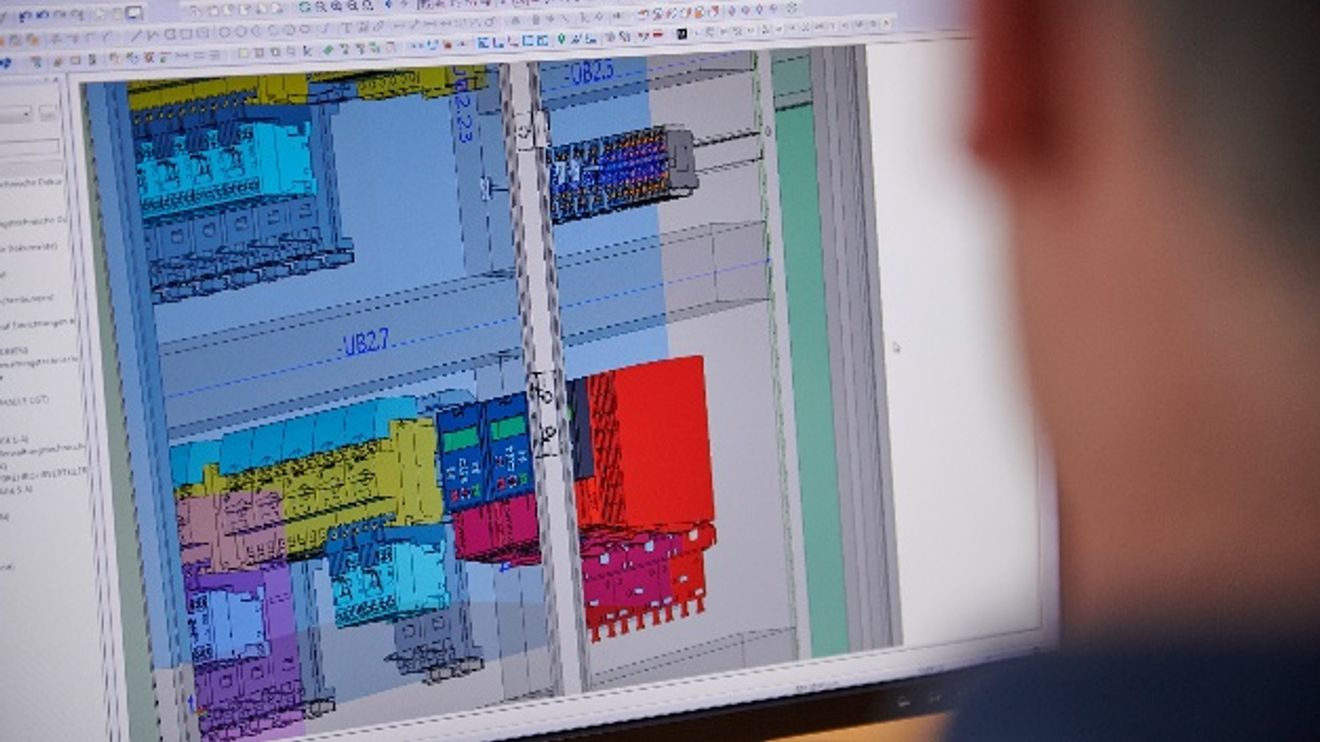
Bauer Systeme uses 'Eplan Electric P8' for electrical planning. This is followed by 3D layout planning in 'Eplan Pro Panel', which generates a virtual prototype. Both the electrical plans and the virtual prototypes have a high level of detail and are correspondingly extensive. The circuit diagram and virtual prototype form the basis for all subsequent work steps. The more detailed the planning, the more efficiently production can work. The effort required in the planning office is therefore somewhat higher, but this pays off in subsequent production. Digitalization means that some of the work is shifted from the workshop to the planning office. Overall, this means that projects can be realized with less manpower. As the data for the 'Perforex' machining center comes directly from the body planning department, machining in the workshop can then be started with just a few mouse clicks.
Working without printed plans
Thanks to its origins as a mechanical engineering company, the company has expertise in mechanical design as well as in control and switchgear construction. Integrated solutions can therefore also be offered. Here, too, the focus is on consistent data management: 3D models from the mechanical design are imported directly into 'Eplan' and can be seamlessly reused there.
Bauer Systeme is constantly working on further optimizing all processes and advancing automation. This affects all areas - in addition to electrical planning and production, mechanical design and the connection to the ERP system. The extent to which this strategy is being adhered to can be seen in the workshops: all employees in both the mechanical engineering workshop and the electrical workshop work without printed plans.
Authors: Hans-Robert Koch is Group Manager Product Communication at Rittal in Herborn and Dr. Jörg Lantzsch is a trade journalist from Wiesbaden.
Automated flat part machining
In practically all cases, control cabinets for control and switchgear construction have to be machined before assembly and wiring can begin. Holes and cut-outs are required in the doors and side panels for operating components, displays or air conditioning units. Mounting plates must be provided with holes and threads for the installation of mounting rails and electrical components. CNC machining centers such as those from the 'Perforex' series from Rittal are specially equipped for these tasks in switchgear construction. They can drill, mill and cut threads. With an automatic tool changer and a tool magazine that can hold up to 20 tools, all work can be completed in a single pass without operator intervention.
The processing machine is suitable for all materials commonly used in switchgear construction, such as steel, aluminum, copper and plastic. In addition to mounting plates, doors and complete enclosures can be machined quickly and accurately.


You might also be interested in
The first steps towards digitization
Real-time transparency in the material flow: this was the goal set by Miba when it set out to digitalize its internal logistics processes. But how successful was the close link between ERP and MES in the end? - A field report.
 read more...
How will the IoT change companies in 2020?
How will network technology in companies change in 2020? Axel Simon, Chief Technologist at HPE Aruba, takes a look into the crystal ball
read more...Digital twin revolutionizes maintenance
As virtual representatives of real machines, digital twins open up new possibilities for maintaining and servicing complex industrial plants and systems. A project report.
read more...You can't do without Edge and Swarm
The IoT has changed the requirements for processing data provided by machine sensors and actuators. This needs to happen as quickly as possible - preferably where the data is generated. Edge nodes and swarm computing systems take on this task.
read more...Online machine data under control
Turning huge amounts of data into valuable information - how can this smart industry approach be implemented? Linking PC-based controllers with Matlab and a cloud-based IoT analytics service can be a viable approach.
read more...From modeling directly into the PLC
Despite digitalization and I4.0, the technical functions in a process plant do not become simpler if you break them down to the smallest detail. Nevertheless, the high level of difficulty can be overcome by combining the right tools in the right way.
read more...Where are the new business models?
The necessary new business models are repeatedly cited as the hallmark of an Industry 4.0 environment. But to date, very few companies have seen any of this. Schneider Electric now has a few models up and running.
read more...Why predictive maintenance?
Investments in predictive maintenance systems are worthwhile in order to proactively detect damage. Not only does this increase the service life of a machine, it also opens up new business models for machine manufacturers.
read more...First customer projects via BaSys 4.0
The BMBF project 'Basissystem Industrie 4.0' expired at the end of June 2019. Together with NetApp and Objective Partner, Fraunhofer IESE now offers Industry 4.0 solutions with support and adaptation to customer systems on the basis of this project....
read more...