

Sagittarius
Cooling switch cabinets as required
What to do when production facilities are 'getting on in years' and their retrofitting needs to meet both digitalization and sustainability requirements? A long-term project for temperature monitoring of control cabinets helped an automotive manufacturer with this.

The car manufacturer's ageing production plant was to be replaced with solutions that not only increase efficiency, but also contribute to sustainable climate management. A key aspect of this was the switch from the mounting plate to the 'Airstream' wiring system from Lütze. This was not only about mechanical advantages, but also about thermal advantages. The Eplan planning system was used to integrate the wiring system and the 'Airblower' fan in combination with a cooling unit into the system right from the start of the project. The aim was to create a needs-based cooling concept for the control cabinet combination under investigation. To this end, the temperature calculation tool 'Airtemp' carried out a series of simulations for future operating conditions. During series operation, the actual temperature situation was recorded and evaluated using measurements.
In accordance with the customer's wishes, the focus was on operational reliability; it should also be possible to make subsequent optimizations if anomalies were detected during the measurements. Lütze was supported by the University of Stuttgart, which has been conducting research into the thermal optimization of control cabinets for many years.
Planning and design of the system
The cabinets were designed in 3D and included all relevant components, whereby a theoretical analysis was carried out using the 'Airtemp' simulator. The input of various parameters such as installation location, ambient temperatures and power consumption of all components made it possible to calculate the thermal properties of the enclosures. As these were arranged openly, particular attention was paid to their behavior in relation to each other: The calculations showed that a simple summation of the enclosures was not sufficient, as air exchange and power distribution are not uniform.
Calculation of temperatures in the 3-zone model

Figure 1: Extract from Airtemp calculation of the individual cabinets. Supply cabinet without and with fan, drive cabinet without and with fan, and Airblower fan with air conditioner, control cabinet without and with fan (each from top to bottom).
© SagittariusTheoretical calculations were carried out for all enclosures using 'Airtemp' - in the first step with free cooling. The results(Fig. 1) show that with a simultaneity factor of 0.7 (i.e. all components are active 70% of the time and call up this power accordingly), a temperature of +40 °C was exceeded in at least one of the three zones in the enclosure. Although the results for two enclosures could be reduced to almost 40 °C by using the air blower, it was found that the enclosure with inverters still reached over +57 °C even with the air blower. An additional active cooling unit with a cooling capacity of around 550 W was therefore required to reduce the temperature to below the prescribed +40 °C. The selected cooling unit with a cooling capacity of 750 W is not operated at full load, which provides a sufficient buffer.
The calculations show that the fan has homogenized the temperatures. It remains to be seen what the actual distribution of temperatures under the cabinets will look like in reality. The calculations were deliberately carried out with tight limit values and a small buffer so that the results can be evaluated later.
The cooling concept
Taking into account analyses and experience from other measurements and projects, it was decided together with the customer to implement the row combination as follows: All Airstream frames were equipped with an air blower. The control cabinet containing the inverters was also to be equipped with a front cooling unit. The aim was to actively support the cabinet with the highest power loss with cold air when it was needed. The air blower should ensure that the air circulates around the frames and thus create a homogeneous climate. If the maximum acceptable internal temperature is exceeded, the cooling unit should be switched on to further reduce the average temperature level in the enclosure combination.
After one year of continuous operation of the system, the practical measurement project was launched. Two data loggers, each with nine temperature sensors and one humidity sensor, were integrated into the four control cabinet panels. At the same time, a measuring capsule was placed outside the control cabinet to record the ambient temperature and humidity. The measurements lasted a total of 18 months with regular monitoring. Targeted daily measurements were carried out on site for more in-depth analyses.
In the plant, which operates in three shifts, the measuring points were positioned in the open space (centrally in the front area, between the components and the enclosure door) at the bottom, in the middle and at the top in order to monitor the three zones. In addition, sensors were placed between and above the components that generate a lot of heat. In this way, all cabinets could be monitored.
The measurement results of the long-term measurement

Figure 2: Flow pattern with cooling unit, distribution in the cabinets. The integration of the fans in all cabinets is intended to move the air around the Airstream frames in a targeted manner, as the cold air from the cooling unit does not reach all areas. The optimization offered by the fan in combination with the cooling unit makes it possible to create a homogeneous climate.
© SagittariusDaily measurements were carried out under comparable operating conditions, with a constant ambient temperature and constant cycle behavior of the system. The focus was on the enclosures with the highest power consumption and on the distribution of air from the active cooling medium to the other enclosures, as provided for in the calculation with Airtemp. The drive enclosure equipped with an active cooling unit was located in the middle of the row combinations. A flow simulation using an active cooling medium was used to illustrate the flow behavior. This theoretical simulation was intended to provide information on how the air behaves in a row combination without a fan. The flow diagram(Fig. 2) shows the air velocity using a color scale. Enclosures 1 and 3 are partially flowed through, but not evenly. Blocking of components or cable ducts on a mounting plate can even create flow dead zones. These could cause hot spots and lead to failures.
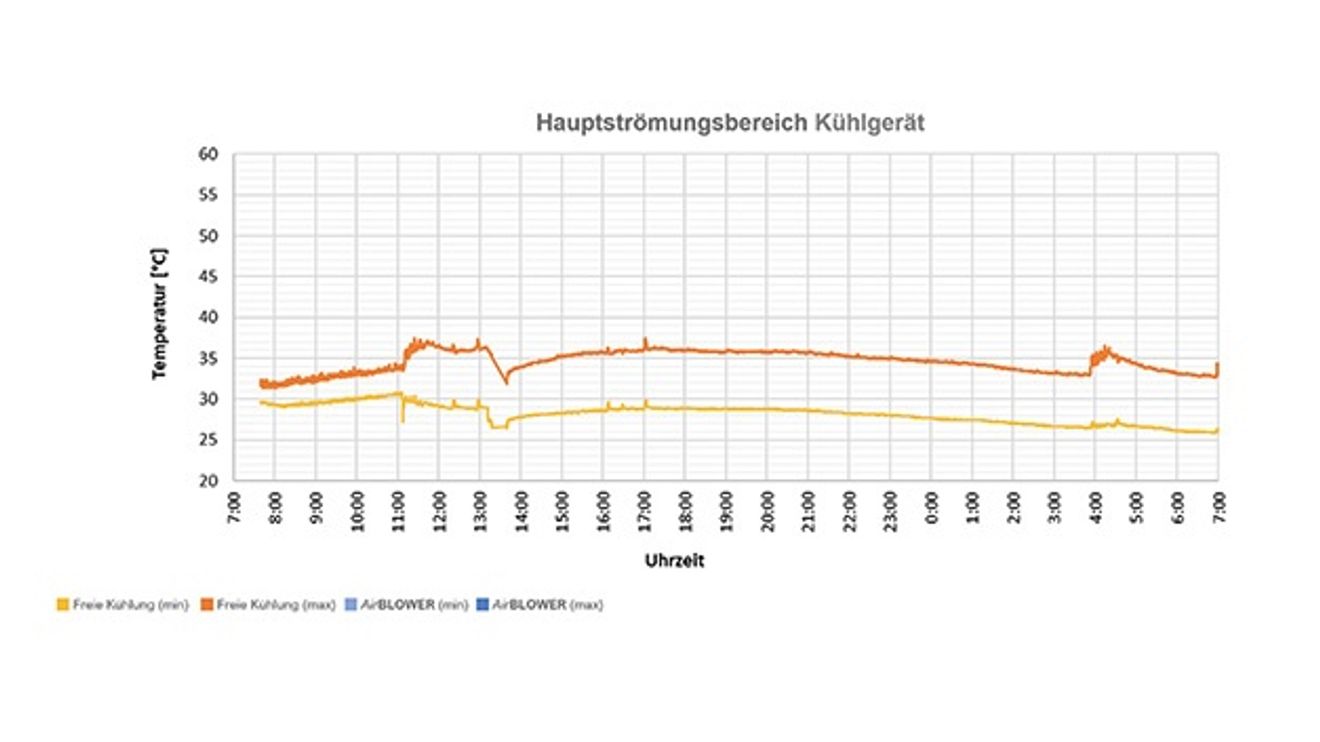
The project revealed that the main flow area is in the drive cabinet, which is operated with a fan and active cooling unit. The secondary flow area was concentrated in the control cabinet, which is only equipped with a fan. By reducing the number of sensors, only the minimum and maximum values were displayed in the control cabinet. The measurements were carried out on two consecutive days - the first day without and the second day with the air blower - in order to find out how switching on the fan affects the overall system, whether flow dead zones are resolved and whether the combination with the active cooling medium is efficient in practice.

Figure 4: Main flow area temperature curve min and max with fan and cooling unit in combination.
© SagittariusStarting with the characteristic curves from the main flow area on the first day(Fig. 3), cold air was only supplied with the active cooling unit. The characteristic curves (air stratification) are about 6 Kelvin apart, whereby the temperature range is below 40 °C. On the second day, after the fan was switched on(Fig. 4, blue lines), the stratification is only about 2 Kelvin, but the temperature at the bottom rises slightly, which is due to the effect of the air circulating around the Airstream frame. The upper temperature becomes more linear as the cold air is immediately introduced into the air circuit, depending on its intensity.

Figure 5: Minimum and maximum temperature profile in the bypass flow area due to free cooling without passive/active ventilation.
© SagittariusThe secondary flow area(Fig. 5) shows significantly higher temperature stratification on the first day of the measurement - without a fan. A difference of around 23 Kelvin can be seen here, as well as the specified 40 °C internal temperature being exceeded. Power supply units located in the upper area, close to the measuring point, would be exposed to excessively high temperatures here with 'free cooling' and despite the air conditioning unit actively operating in the adjacent cabinet. Here too, the fan was switched on the following day(Fig. 6). The blue line again shows the homogenization caused by the fan. The maximum temperature (upper enclosure area under the roof) is reduced to around 36 °C and the hot spot area on the power supply unit is resolved.

By circulating the air through the air blower, the air layers are broken up and moved around the wiring frame in a targeted manner. The cold air that is brought into the middle enclosure by the cooling unit can be better distributed to the other bays as the enclosures are open to each other. The cycle behavior of the air conditioning unit is adapted as required and intelligently controlled if passive cooling is no longer sufficient.


You might also be interested in
Power monitoring system expanded
Lütze is expanding the intelligent current monitoring system 'LOCC-Box' with an IO-Link gateway for coupling up to 15 LOCC-Box Net modules.
 read more...
Enclosure ventilation in the smallest of spaces
The latest member of the Lütze 'Airstream' product family is the 'Airblower Compact', with which the flow and heat dissipation properties of the Airstream wiring system can also be used in small control cabinets and switch boxes.
read more...Heat forecasts thanks to temperature simulation
With 'Airtemp 2.0', practical heat forecasts can be created for control cabinets equipped with the 'Airstream' wiring systems from Lütze.
read more...The e-paper of issue 07/2024
Read in the current issue of Computer&Automation how ChatGPT can provide support in the conception phase, how LLMs are used in code analysis and whether TSN can be considered as a backbone for virtualized control systems.
read more...Power monitoring system expanded
Lütze is expanding the intelligent current monitoring system 'LOCC-Box' with an IO-Link gateway for coupling up to 15 LOCC-Box Net modules.
read more...IO-Link gateway expands power monitoring system
Lütze is expanding the intelligent current monitoring system 'LOCC-Box' with an IO-Link gateway for coupling up to 15 LOCC-Box Net modules.
read more...The e-paper special: looking for products of the year 2024
They've earned it: all 96 nominated products from 12 categories in their own e-paper. Browse through the individual areas and make your personal selection. You can also find out more about the companies and their solutions in the accompanying video...
read more...Enclosure ventilation in the smallest of spaces
The latest member of the Lütze 'Airstream' product family is the 'Airblower Compact', with which the flow and heat dissipation properties of the Airstream wiring system can also be used in small control cabinets and switch boxes.
read more...Control cabinet ventilation with minimum space requirements
The latest member of the Lütze 'Airstream' product family is the 'Airblower Compact', which allows the flow and heat dissipation properties of the Airstream wiring system to be used in small control cabinets and switch boxes.
read more...