
Tips from the coach
How can my team become more willing to take risks?
Success is also linked to the willingness to take risks. But how can my team become more willing to take risks? Coach Bernhard Broekmann gives some tips.

How can my team become more willing to take risks? - Like most things in life, this question also depends on the context in which the question is answered. If we are working in the context of a traditionally grown organization, which was often founded 80 or more years ago, there are usually clearly standardized procedures with proven processes and task assignments. Today, we are talking about the waterfall organization: instructions and responsibilities come from 'above', i.e. from management, and are broken down and applied 'below' in the organization for value creation. Changes should not take place, especially not initiated from below. This has many advantages, but there is no mentality that encourages experimentation. This means that employees hand over their creativity to the reception desk, risk-taking is neither desired nor present. In the last three decades, the principle of continuous improvement processes (CIP) - often rewarded with bonuses - has at least become established, allowing employees to take on more responsibility.
However, if we answer the question from the perspective of an agile start-up, as there are now thousands of them in the DACH region - admittedly usually with a smaller workforce - the answer is different. Here, there are usually smaller teams with a flat hierarchy and a high degree of personal responsibility to improve their own processes and products or develop new ones with a high degree of authorization and a keen ear for customer needs. Then we move into an agile environment, where everyone is expected to think for themselves, contribute their expertise and ideas as well as their concerns and show a certain willingness to take risks.
Standard or agile? - The task decides
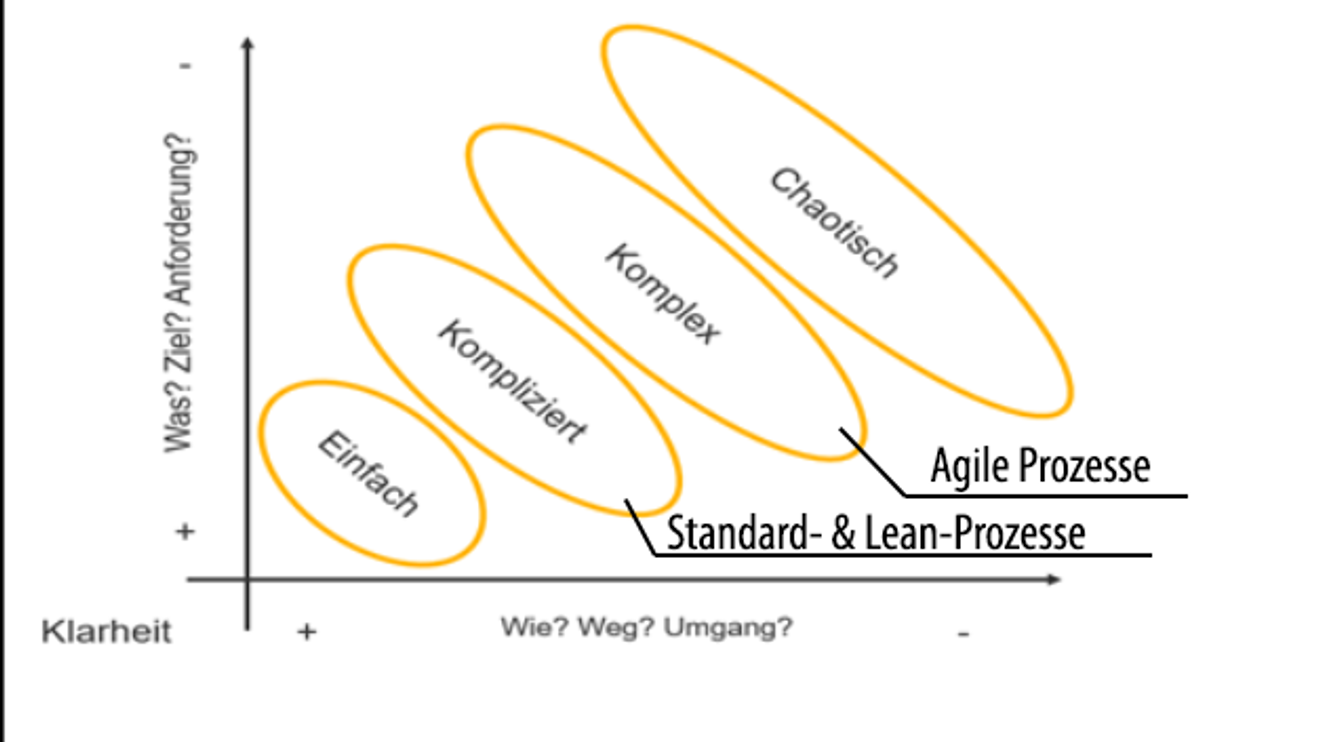
The Stacey matrix shows where the task requirement determines whether traditional working or agile working is required [4]. It uses the degree of clarity regarding the goal (Where do I have to go?) and the path (How do I get there?) to differentiate between task qualities, which are distinguished between complex tasks on the one hand and simple to complicated tasks on the other.
For simple tasks, the path and goal are clear, for example operating a simple machine.
In the case of complicated tasks, the path and goal are basically clear, for example operating a simple machine.
Complex tasks are no longer manageable because too many parts with an infinite number of interactions come together. Linear cause-and-effect thinking is no longer possible here. Very extreme examples are climate change or the Syrian war, less extreme examples are rapidly changing business worlds or business figures that need to be interpreted. Complex systems are always living systems - they can no longer be clearly planned and controlled. Stacey recommends avoiding or reducing the last quality, the chaotic tasks/states.
Managing complexity
The essence of complexity is its impenetrability. However, if I have to deal with complexity as a manager or as a management team, it is advisable to allow as many perspectives as possible (multi-perspectivity) in order to be able to create an overall picture from various individual images that all reflect something different.
A second approach to tackling complex tasks is the experimental approach, which automatically brings us to the willingness to take risks.
Another characteristic of complex states or tasks is that the relationship between cause and effect can only be determined in retrospect, not in advance.
Dave Snowden, the Welsh inventor of the Cynefin framework, therefore recommends tackling complex tasks in particular with the "Probe - Sense - Respond" approach, which roughly corresponds to "Try - Perceive - React". He calls the corresponding result emergent practices (emergent practice or solution).
This brings us to the first answer to the question of why and under what circumstances we need risk-taking teams: to solve complex tasks.
Encouraging a willingness to take risks
For the second question of how we can promote a team's willingness to take risks, we can use the findings of learning theories. Human behavior is - to a large extent - determined by the subsequent consequences of the behavior shown. Employees should therefore be rewarded or consciously encouraged for riskier behavior. The following tips for team leaders/project managers/scrum masters are derived from this:
Tip 1:
- Support and encourage the willingness to take risks by allowing a culture of error, or better a culture of learning.
- Allow employees to experiment and take a certain amount of risk.
- Be a role model yourself who is willing to try things out, make mistakes and be wrong.
Tip 2:
- Give your employees more responsibility bit by bit and thus promote empowerment.
- Accompany learning processes and evaluate them: What was the hypothesis, based on which assumptions did you take which risk?
- How should the result be evaluated and what do you learn from it?
Dave Snowden has recommended hypothesis-driven experimentation, which is not a quick shot in the dark but follows a practice-based hypothesis [1], especially for the approach to complex tasks.
Tip 3:
- Risk-taking teams should be allowed to follow their intuition. Intuition is most likely to emerge [2] with a lot of experience, because it represents the quintessence of experience. And: our intuition corresponds to quick thinking and is controlled by the gut.
- So allow the more experienced team members to take a certain amount of risk and allow less experienced team members to participate.
Tip 4:
- Risk-taking does not develop overnight, so as a leader, be prepared for it to be a continuous learning process.
- If your team is moving more and more towards chaotic conditions, it may have too high a risk appetite.

The author: Bernhard Broekman, Dipl.- Psych., is Senior Coach DBVC, Clinical Psychologist BDP, Systemic Organizational Consultant (ISB) and Stress Management Trainer (according to Kaluza), Partner of Leadership-Choices.
© B. BroekmanLiterature:
[1] Snowden, D. (2010): the Cynefin framework.
[2] Gigerenzer, G. (2020): Risk: How to make the right decisions. Pantheon
[3] Lüders, M. (2019): Who sows the wind: What Western politics is doing to the Orient. Beck Paperback.
[4] Grosser, T. (2018): Agility and the Stacey Matrix.


You might also be interested in
Dealing with conflicts confidently and openly
We've all been there - conflicts in the workplace! Unfriendly colleagues or supposedly uncooperative team members can cause stress and arguments. But how do you deal with them? Coach Susanne Schlenker gives some tips.
 read more...
Regulating emotions in everyday working life
Changing situations in everyday working life can quickly turn into a rollercoaster of emotions. How can you arm yourself against this? Coach Susanne Schlenker gives tips.
read more...Mental fitness and stress resistance
Mental fitness is a buzzword in competitive sport. And it is so much more! Mental fitness is relevant for all of us, both professionally and privately, and is crucial for success and satisfaction.
read more...What helps against "shiftitis"?
Who isn't familiar with putting off unloved tasks until later? But how do you tackle this unconscious strategy of self-boycotting? Coach Bernhard Broekmann gives some tips.
read more...How to control your stress level
Working from home and virtual meetings make leading teams a challenge. This increases the stress levels of many managers. Stress management is in demand.
read more...What does agile communication need?
Reacting quickly and flexibly to situations is particularly important in a professional environment. But how does communication become agile?
read more...Compassionate corporate culture makes the difference
Topics such as dying, death and mourning are often seen as private matters that receive little attention in the professional environment. However, a new approach that integrates these aspects of life could give companies a competitive advantage.
read more...How can you stay motivated after 20 years on the job?
Constant change, unpredictable changes, increasing complexity - motivation can suffer. Coach Oliver Erbe explains what you can do about it.
read more...Corporate values - and how not to work with them.
Many companies are aware of the fact that values such as integrity, trust and fairness act as attractors that promote positive behavior in the workplace. But how can values be established? Two coaches give tips.
read more...