

Pepperl+Fuchs
Vibration sensor provides information
Experienced mechanics can hear when an engine or machine is not running smoothly: they recognize a warning signal triggered by a change in vibration behaviour. Vibration sensors do this automatically for real-time condition monitoring.
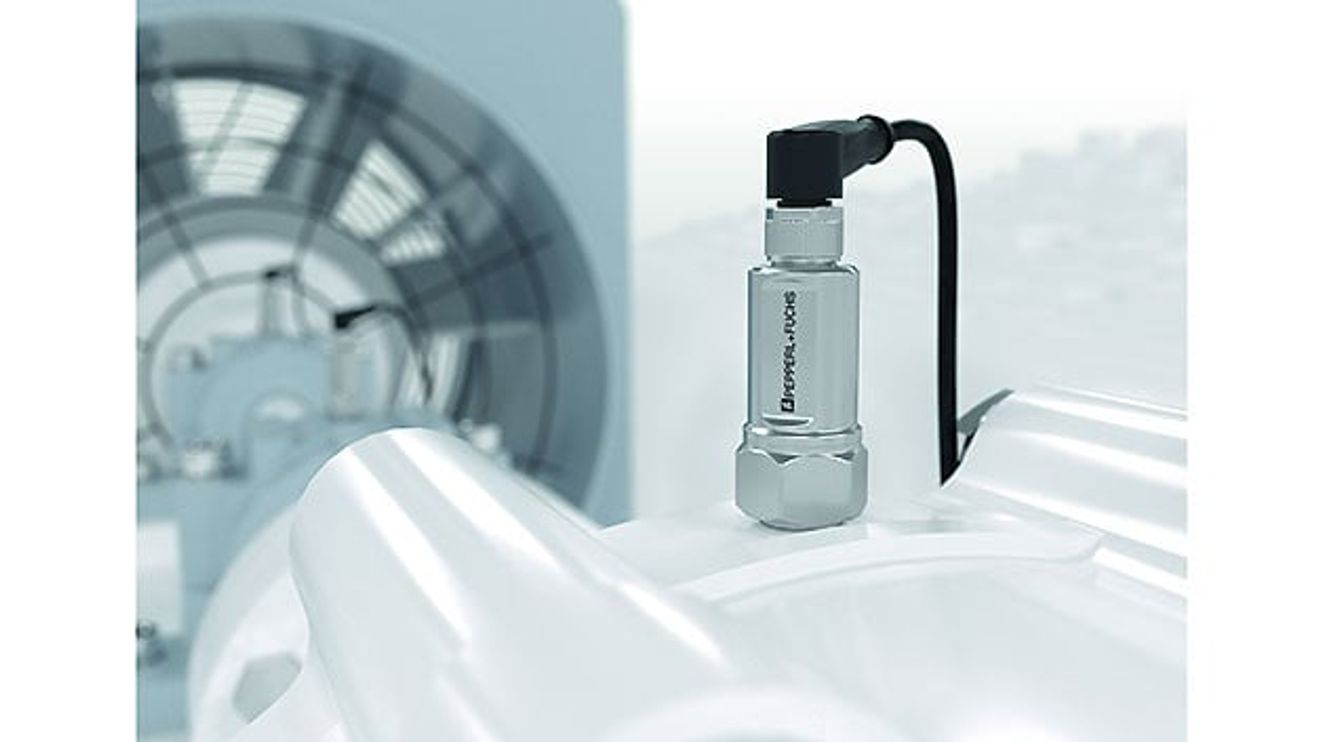
The work of a machine is generally based on the rotation of shafts and other components. When it is working properly, it 'runs smoothly' and exhibits a certain vibration pattern. During its service life, the moving parts of the machine are subject to wear and tear, which has an effect on concentricity. Effects such as contamination, material fatigue and vibration can also cause gradual changes and imbalances. Such changes are noticeable in the vibration behavior. Typical consequences are, for example, the loosening of gear connections, the breakage of mountings or damage to ball bearings. It can also happen that a machine is 'damaged' from the outset, for example due to installation problems or an unnoticed misalignment of a coupling.
Vibration patterns indicate risks
With large motors and machines such as centrifuges, blowers or pumps, the stakes can be high: the combination of heavy machine parts and strong centrifugal forces can not only cause serious machine damage, but also pose a considerable risk to operating personnel. Safety regulations with standards for functional safety are intended to eliminate this risk by requiring defined levels - SIL or PL - of functional safety. The prescribed safety precautions for larger machines include standardized vibration measurement.
Capacitive MEMS sensors can record both the speed and the acceleration that occurs during a vibration movement. The standardized vibration measurement is based on the so-called RMS value of the acceleration - the 'root mean square', a squared average value: the acceleration values are recorded and averaged over a defined period of up to twelve seconds, i.e. the peaks are mathematically cut off. Averaging filters out short-term, irrelevant changes in vibration behavior so that critical values are not falsely reported and alarms are not triggered. External influences - such as the vibration of a passing vehicle (e.g. a forklift truck) - can play a role here. Vibrations can also be transmitted to the machine from the surrounding building or through the floor and lead to a deflection of the vibration values without reference to the machine status.
Effective value and safety circuit
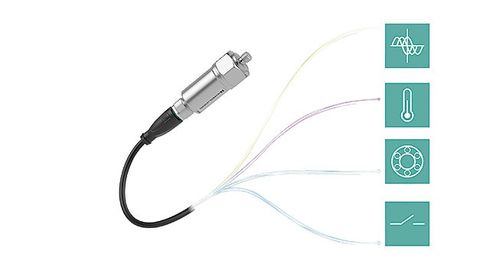
One sensor provides several measurement data simultaneously, such as vibration velocity, vibration acceleration, bearing condition parameter and temperature.
© Pepperl+FuchsThe vibration sensors of the 'VIM' series from Pepperl+Fuchs perform the RMS calculation themselves and transmit the averaged effective value to the controller. A trend analysis depicts the gradual change that leads to signs of wear in the machine over a longer period of time due to friction and wear. As certain vibration patterns can be assigned to specific machine parts, a very detailed diagnosis is possible. By defining limit values for alarms, needs-based predictive maintenance can be established in order to avoid unplanned downtimes and increase system availability.
Where special requirements are placed on functional safety, the sensors take over the corresponding monitoring: they ensure that critical vibration behavior is detected and reported to the machine control system, which switches to a safe state on this basis. Pepperl+Fuchs offers vibration sensors with the corresponding certificates. Their use reduces the certification effort, as the sensor is always classified as safe as part of the control chain.
Device variants for different applications
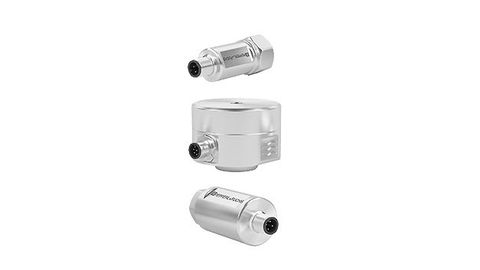
The three series of vibration sensors from Pepperl+Fuchs, which can cover IO-Link, hazardous areas and SIL2.
© Pepperl+FuchsThe vibration sensors in the VIM series detect a frequency range from 1 to 1000 Hz. The portfolio includes devices with explosion protection, robust housing materials for different applications as well as a wide temperature range, protection class up to IP67, globally valid approvals and the option of web-based remote maintenance via IO-Link. Three designs are available: While the compact VIM3 series is suitable for applications up to SIL 1/PL c, the VIM6 series is approved for hazardous areas up to Zone 1/21. With a temperature range of -40 to +125 °C, these sensors are also suitable for use in extreme temperatures. Series VIM8 in a robust stainless steel housing is designed for use in harsh offshore applications and is also certified for Ex zone 1/21 and SIL 2/PL d.
The sensors allow commissioning without programming and parameterization directly on the device. The VIM3 series also offers an optional IO-Link interface and the option of simultaneously collecting several measured values for long-term condition monitoring. In addition to the averaged vibration acceleration (g rms), peak values (g peak), the bearing condition characteristic value for the direct assessment of ball bearings and the temperature can also be output. For the best possible adaptation to the respective application, the sensor offers a wide range of setting options - for example, an adjustable switching signal that can be set up in parallel with IO-Link communication to immediately trigger a defined maintenance task. An additionally implemented counter or an operating time measurement can be used to define how long a machine may exceed a critical vibration value before a subsequent step is triggered. At the same time, the capacity of the control level is conserved as the device carries out the necessary calculation steps itself.
The IO-Link device therefore enables condition-based maintenance of the machine based on precisely defined parameters, which can lead to considerable savings compared to cyclical maintenance. This means that maintenance measures can be planned according to actual requirements. At the same time, there is no need for further adjustments, as the appropriate trigger setting for maintenance can be made directly in the sensor.
The author Markus Egerer is Product Manager Vibration Sensors at Pepperl+Fuchs in Mannheim.


You might also be interested in
Transparency in the process industry
Better insights into data from sensors and actuators are at the heart of tomorrow's process automation. Ethernet APL plays a decisive role in this. However, there are a few factors to consider when introducing it.
 read more...
Interview - Johann Elter, Pepperl+Fuchs
Flexible standard
The proximity switch is Pepperl+Fuchs' product of the first hour, and its invention is crucial to the company's success. Now the inductive cylindrical standard sensor is being launched on the market in a modern portfolio. Developer Johann Elter...
read more...Tablet for the Ex area
With the 'Pad-Ex 01 P12', Pepperl+Fuchs is launching a new tablet for professional use in potentially explosive atmospheres in Zone 2/22, Division 2.
read more...Flow of goods made transparent
With the 'IUR-F800-V1D-4A*', Pepperl+Fuchs is expanding its RFID portfolio with a UHF reader specifically for use in gate applications in logistics.
read more...HANNOVER MESSE DAILY Day 4
The top news from the fourth issue: Robert Habeck at the trade fair tour +++ Technological AI highlights from Beckhoff +++ Radar sensor technology in focus at Pepperl+Fuchs +++ ASi-5 counter module as an active distributor from Bihl+Wiedemann +++...
read more...followed up! - with Dr. Gunther Kegel
"Recognizably alien to the industry"
More and more regulations and bureaucracy are being imposed on companies. In an interview, ZVEI President Dr. Gunther Kegel criticizes politicians and calls for consistent action.
read more...Sensors plus evaluation unit for SIL 3 and PL e
To determine a safe absolute position, Pepperl+Fuchs relies on a combination of the 'PUS' evaluation unit with the 'safePXV' or 'WCS' sensors.
read more...Automatic check of your own resonance frequency
The RFID read/write devices 'IQH3-FP-V1' and 'IQT3-FP-IO-V1' from Pepperl+Fuchs perform identification tasks based on high-frequency RFID technology (13.56 MHz) standardized in accordance with ISO 15693.
read more...Configurable HMI systems
The modular platforms of the HMI portfolio from Pepperl+Fuchs offer individual solutions for applications from non-hazardous areas to Zone 1.
read more...