

Identification systems
Traceability optimized
Directly marked 2D data matrix codes ensure the traceability of engine and transmission parts at KIA Motors. Read rates of 99 % are the target.

A vehicle transmission consists of around 300,000 parts. Its main components - for example the differential, input and output gear, carrier, clutch, transmission housing, valve body and housing - are tracked throughout the entire production process. In addition, the main components on the engine must be monitored throughout the entire production and distribution process. To estimate the size: an engine consists of around 200,000 parts - including pistons, cylinder head, engine block, camshaft and crankshaft.
KIA Motors' traceability program reads the 2D data matrix codes on the components to determine whether the correct part is present. The system then stores manufacturing information such as production date and model number on the server for full traceability.
The production line for 6-speed gearboxes

As the parts of the 6-speed gearboxes are very small, reading the data matrix codes proved to be particularly difficult, especially as their size was reduced to 5 mm × 5 mm.
© Cognex GermanyAfter converting the production system to the 6-speed gearbox, the engine manufacturer set itself the goal of increasing the read rates of the 2D data matrix codes for better traceability. Up to this point, around 1800 units per day had been produced on the normal transmission production line, but read rates of only 96 to 97% had been achieved. On the motor line, where 1300 to 1400 motors were produced daily, the company was achieving read rates of less than 97%. An increase in read rate of only 2 to 3% on these lines would result in benefits such as increased production output, reduced manufacturing costs and improved labor efficiency.
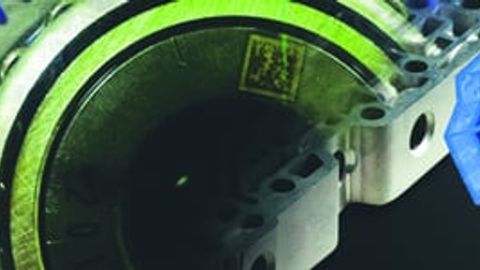
KIA Motors installed Cognex readers at each mounting point of the transmission and engine components, which capture and read the codes and, thanks to the direct Ethernet connection, transmit them to the PLC without an additional transmission device.
© Cognex GermanyThe barcode reader previously used led to frequent stops of the production machines due to code reading errors. It was operated manually, making it difficult to keep to the production cycle - with negative effects on both work performance and production output. At the same time, there was a risk of using the wrong parts if a code was misread, causing production errors. As the parts of the 6-speed gearboxes are also very small, the Data Matrix codes on this line proved to be particularly difficult. And last but not least, KIA Motors reduced the marking size from 10 mm × 10 mm to 5 mm × 5 mm. This also affected the marking quality.
Faced with these challenges, KIA Motors switched to Cognex barcode readers on its 6-speed transmission production line. The result is read rates of 99%. The readers feature patented algorithms that enable read rates of 99% and higher, even in the most challenging DPM and label-based ID applications.
Patented algorithm
The car components from KIA Motors are assembled with an anti-rust oil spray. Ergo, one of the challenges for the reader is to eliminate errors due to traces of oil on the code. The devices also have to ignore the fact that the 2D data matrix codes are stained or damaged due to dirt or scratches, even though they have been washed and kept clean. And last but not least, the codes are very small due to the reduced marking size and exhibit strong deviations in marking quality. However, the '2DMax+' code reading algorithm from Cognex is unaffected by this: The 2D code reading software is based on the company's pattern matching technology. Regardless of the cause, it can cope with a wide range of quality losses in two-dimensional DPM codes or printed codes, even if critical parts are missing. The software is able to read data matrix codes even with missing finder patterns or timing/clocking patterns. It locates and reads underexposed and overexposed Data Matrix codes without the need for multiple read attempts, improving throughput, speed and overall reliability.
As Cognex barcode readers are also Ethernet-connectable, they can be integrated directly into the factory network and enable direct communication with the PLC without a transmission device.
Stationary barcode readers were installed to check the quality of the laser markings on the production line. KIA Motors installed the 'In-Sight 5110' reader from Cognex at each assembly point of the transmission and engine components. The car manufacturer also opted for the 'In-Sight Micro 1110' in tight, narrow places. A portable reader was installed as a backup system
Author:
Janina Guptill is a Marcom Specialist at Cognex Germany in Karlsruhe.


You might also be interested in
The future of CANopen
Similar to the automotive industry, industrial automation also requires more and more bus bandwidth. In addition, the cloud is becoming increasingly important in terms of communication. How does the CAN protocol, which has long been established in...
 read more...
Unauthorized access fended off
Plant modernizations often require new safety precautions. This was also the case for a manufacturer of cleaning agents and disinfectants, who had to safeguard the material flow in the area of a roller shutter door, among other things.
read more...WLAN in the factory - the selection criteria
WLAN is suitable for various applications in the factory. However, due to the many influencing factors, it is not always obvious how a network based on the IEEE 802.11 standard can be optimized to meet the requirements of industrial use. - Here is...
read more...Compact controls and drives a must
Smart factories promise operators a high degree of flexibility - for example through the use of driverless transport systems or mobile robot solutions. The automation of these subsystems in turn requires extremely compact control and drive concepts.
read more...Simply integrate safety
Machine and system manufacturers are increasingly turning to mapping safety functions via the communication bus. How can integration on the component side be achieved with reasonable effort?
read more...Flexible buffering via software
The complete automation of manual or semi-automatic processes is a major challenge with very short cycle times. When it comes to workpiece carrier transport, the machine manufacturer Goldfuß relies on a system that allows the creation of flexible...
read more...Individual IoT systems
How big? How much power? How robust? Which housing? The requirements for IoT systems are extremely varied. By designing individual embedded applications, devices can be created that are perfectly tailored to the application.
read more...A digital image
The digital twin accompanies machines and systems throughout their life - from the initial idea to ongoing operation and a look into the future. The aim is to avoid errors, optimize systems and prevent failures.
read more...Stumbling blocks with direct current
The question "direct current or alternating current?" is becoming increasingly important - not least due to the increasing use of renewable energy sources that generate direct current. When switching and protecting with direct current, however,...
read more...