
Fieldbus technology
The future of CANopen
Similar to the automotive industry, industrial automation also requires more and more bus bandwidth. In addition, the cloud is becoming increasingly important when it comes to communication. How does the CAN protocol, which has long been established in both industries, take this into account?

Longer user data and higher data rates - many CANopen supporters have been demanding this for some time. In response to this, CiA members have adapted the CAN-open protocol to the more powerful CAN-FD protocol since February 2015 and at the same time specified functional extensions for some CAN-open communication services. The network management, including the heartbeat function, has remained unchanged, as have the time and sync protocols. While the time protocol is used to synchronize the local clocks in the hardware components with an accuracy of one millisecond, the sync protocol can be used to synchronize the CANopen devices, which is particularly useful in drive technology.
The user data (payload) provided by the CAN FD protocol is eight times longer than with the classic CAN protocol (maximum 8 bytes). The FD application layer uses this for the PDO protocol. A PDO message can now transmit up to 64 bytes of process data. This significantly improves the protocol efficiency. In order to make the PDO configuration as simple as possible with regard to the compilation of process data, bit-by-bit mapping has been dispensed with. The minimum size of a process data is 1 byte.
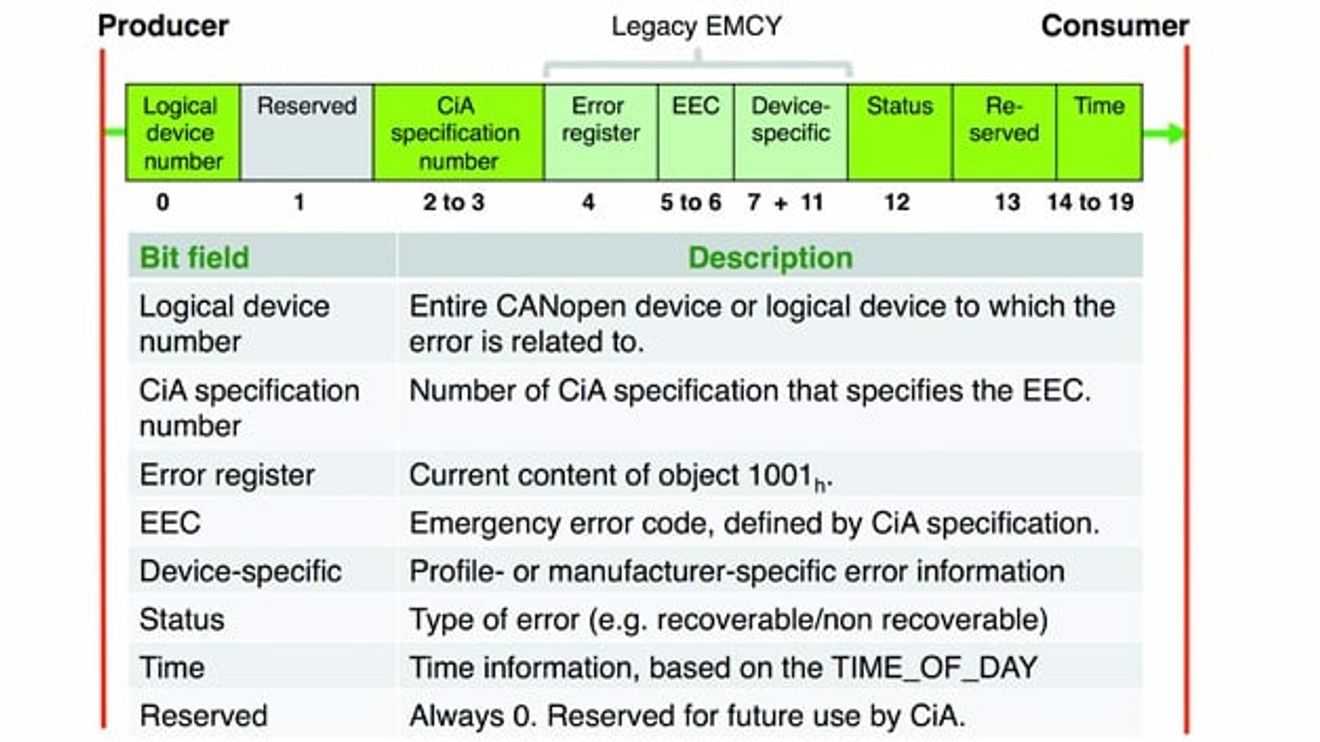
Figure 1: The Emcy message can now also reference a logical device and the implemented device profiles, which was previously not possible.
© CAN in AutomationThe user data (payload) provided by the CAN FD protocol is eight times longer than with the classic CAN protocol (maximum 8 bytes). The FD application layer uses this for the PDO protocol. A PDO message can now transmit up to 64 bytes of process data. This significantly improves the protocol efficiency. In order to make the PDO configuration as simple as possible with regard to the compilation of process data, bit-by-bit mapping has been dispensed with. The minimum size of a process data is 1 byte.
The Emcy protocol (for high-priority emergency information) also uses the longer payload of the FD protocol. In addition to the 8-byte content of the classic Emcy message, additional information is now available that was previously not available (see Fig. 1). For example, it is now possible to assign the Emcy message to a logical device. In general, CANopen allows up to eight profiles (logical devices) to be supported in one device. A typical example of this is a multi-axis controller with additional functions such as I/O functions, special sensors or even pipetting units. The Emcy message can also be used to indicate whether a permanent error has occurred or when. This 'time stamp' has a resolution of one millisecond.

Figure 2: Unlike the SDO protocol, the USDO protocol is not limited to a point-to-point connection, so that all or even different groups can be addressed; this speeds up the configuration of similar devices, for example.
© CAN in AutomationIn CANopen-FD, the classic SDO protocol is replaced by the USDO protocol (see Fig. 2). It not only has additional functions, but also uses a different addressing scheme to enable broad and multicast transmissions. This means that several similar devices can now be configured simultaneously. The CAN identifiers used result from an offset (600 h for the client plus the client's node ID and 580 h for the server plus the server's node ID). This means that the sender is coded in the CAN identifier. The recipient is coded in the protocol header of the user data - i.e. the node ID of an exclusive device (1 to 127), the ID of a group (128 to 255) or all participants (0). This long-cherished wish of many users has so far failed due to the protocol header of only 4 bytes. Other functional enhancements include the session number, information about the data type of the transmitted parameter and the option of transmitting several parameters in one USDO message.
Even if not all functions are implemented in the first version of CANopen-FD, these are already planned and will be available shortly. SDO remote access to devices in other network segments has also already been prepared, replacing the SDO remote access protocol (CiA 302-7) that was previously required.
Although various scientists had already submitted proposals similar to CAN-FD at the turn of the millennium, it was not necessarily to be expected that the automotive industry would improve the CAN protocol. This only came about in the second decade, when some car manufacturers called for CAN to be accelerated. Of course, CAN FD messages can also be transmitted 'slowly' if there is only interest in the longer messages, for example to encrypt data or authorize access. In this case, the bit rate is not accelerated in the data phase.
However, if you want to take advantage of the speed benefits of the CAN FD protocol, you need to pay more attention to design recommendations when developing the devices and the physical network than before. In particular, care must be taken to ensure that the rising and falling edges are as symmetrical as possible and that the impedance is as identical as possible over the entire distance.
Impedance jumps as well as unconnected stubs lead to 'ringing' on the signal lines. In the worst case, such effects lead to incorrect bit values and are recognized as errors by the controllers. The CANopen FD specification therefore refers to CiA documents in which corresponding guidelines and design recommendations are described. For example, it is important to configure the time quanta (atomic time unit in a network) in the arbitration and data phase to be the same size or to keep them as short as possible so that the unavoidable quantization error when switching from the slow to the faster bit rate is minimized.
The topic of the cloud is now an integral part of industrial communication. Taking this into account, CiA is currently standardizing access from the 'clouds' to CANopen networks - in the CiA 309-5 specification, which is about to be published. The Restful application programming interface (API) defined here forwards the data coming from the CANopen network via a CANopen IoT gateway and the http protocol to the 'cloud' or is the interface for the information sent to the cloud. The data and services are JSON formatted. However, the API does not support event-oriented processes. The MQTT protocol is used for these tasks.
Who way to the cloud
Both the physical and logical addressing of the devices and networks are specified in CiA 309-5.
Physical addressing is a mapping of CANopen services in ASCII format to the Restful API, as specified in CiA 309-3. For logical addressing, a device identifier is introduced which is used to address networks and devices at a logical level. A distinction is made between three types of this so-called reference designator. This allows the individual CANopen parameters to be uniquely identified system-wide as ParamRefd, the CAN-open devices as NodeRefd and the CANopen networks as NetRefd. As described in IEC 81346, this identification can relate to product, function and location. This means that the system developer does not have to deal with network and node numbers or parameter indexes during logical addressing.
In addition to direct access from the 'clouds', CANopen networks can be connected to the cloud via Ethernet-based backbone networks in order to process the data collected in CANopen networks - keyword 'big data processing'. Gateways to Profinet have been described for some time in the CiA 309-4 specification developed jointly with Profibus International (PI). A gateway to OPC UA networks is still under development. This specification is also about to be published and will be published by the OPC Foundation in a so-called compendium standard.
The data generated in 'embedded' and 'deep-embedded' CANopen networks can thus be transferred directly or indirectly to the 'clouds' in a standardized manner. However, communication also works in the other direction. This means that the CANopen networks can be configured and partially controlled from the cloud. In this way, no physical network access is required.
It is not yet clear when all of the new functions mentioned, including the conformity test, will be available. At the end of September, at least the first version of the CiA 1301 specification will be published, in which the majority of the CANopen FD services and protocols mentioned above are described. The first CANopen profiles should specify a PDO mapping for 64-byte messages so that they can be "launched" at this year's SPS IPC Drives. There is already a PDO mapping for 64-byte messages for the widely used CiA 402 drive profile.
Author:
Holger Zeltwanger is an executive board member of CAN in Automation e.V. (CiA).


You might also be interested in
Unauthorized access fended off
Plant modernizations often require new safety precautions. This was also the case for a manufacturer of cleaning agents and disinfectants, who had to safeguard the material flow in the area of a roller shutter door, among other things.
 read more...
WLAN in the factory - the selection criteria
WLAN is suitable for various applications in the factory. However, due to the many influencing factors, it is not always obvious how a network based on the IEEE 802.11 standard can be optimized to meet the requirements of industrial use. - Here is...
read more...Compact controls and drives a must
Smart factories promise operators a high degree of flexibility - for example through the use of driverless transport systems or mobile robot solutions. The automation of these subsystems in turn requires extremely compact control and drive concepts.
read more...Simply integrate safety
Machine and system manufacturers are increasingly turning to mapping safety functions via the communication bus. How can integration on the component side be achieved with reasonable effort?
read more...Flexible buffering via software
The complete automation of manual or semi-automatic processes is a major challenge with very short cycle times. When it comes to workpiece carrier transport, the machine manufacturer Goldfuß relies on a system that allows the creation of flexible...
read more...Individual IoT systems
How big? How much power? How robust? Which housing? The requirements for IoT systems are extremely varied. By designing individual embedded applications, devices can be created that are perfectly tailored to the application.
read more...A digital image
The digital twin accompanies machines and systems throughout their life - from the initial idea to ongoing operation and a look into the future. The aim is to avoid errors, optimize systems and prevent failures.
read more...Stumbling blocks with direct current
The question "direct current or alternating current?" is becoming increasingly important - not least due to the increasing use of renewable energy sources that generate direct current. When switching and protecting with direct current, however,...
read more...Traceability optimized
Directly marked 2D data matrix codes ensure the traceability of engine and transmission parts at KIA Motors. Read rates of 99 % are the target.
read more...