
Production software
A digital image
The digital twin accompanies machines and systems throughout their life - from the initial idea to ongoing operation and a look into the future. The aim is to avoid errors, optimize systems and prevent failures.
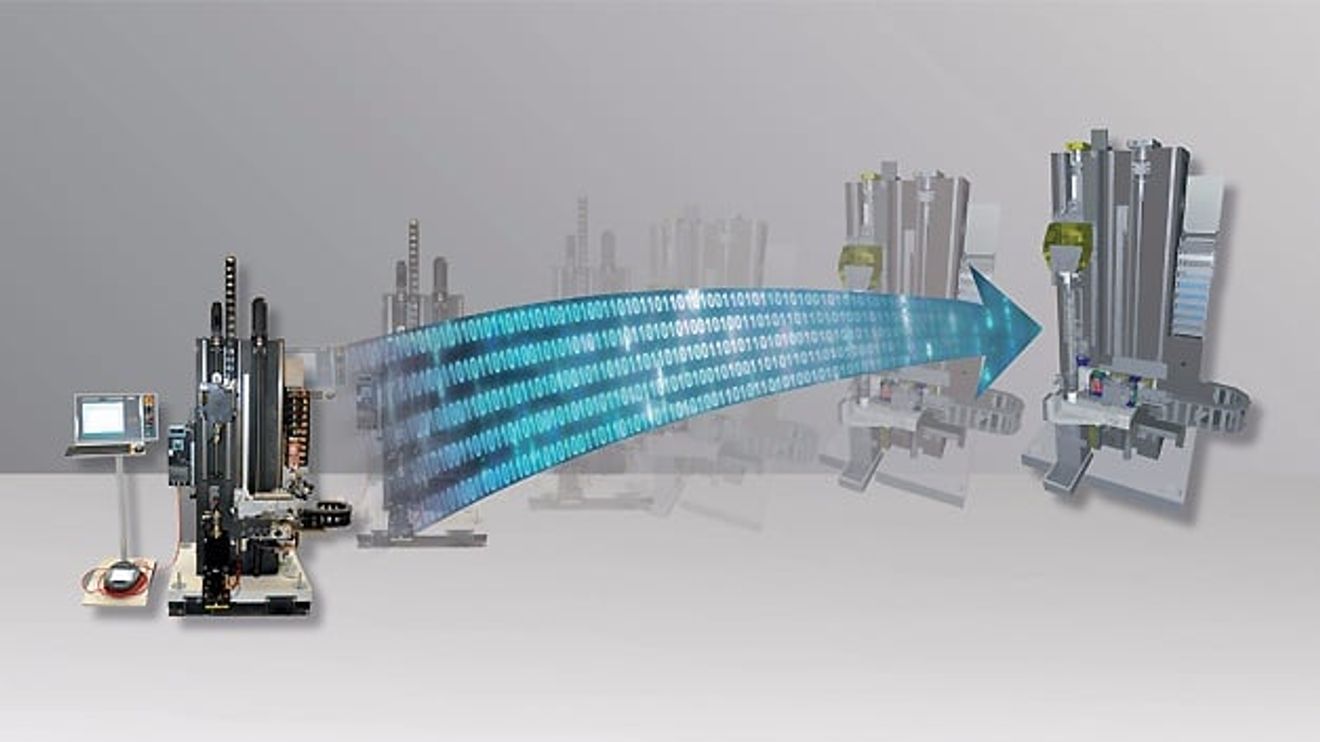
The virtual image of a real plant that accompanies its physical counterpart for a lifetime: The digital twin is playing an increasingly important role in the course of Industry 4.0 and the associated digitalization. A simulation model is assigned to a specific product and supplied with the corresponding real data. The model thus reflects the system status in real time and also provides valuable information on existing faults or optimization potential. With the digital twin, mechanical engineering is using digitalization to achieve higher efficiency and quality yields - and even more.
Thanks to the digital twin, plant operators have a virtual image of their real plant based on real-time data at their disposal at all times. This model makes it very easy to monitor any plant - regardless of its location or size. The smooth flow of materials or production processes can be ensured and targeted action can be taken immediately in the event of possible malfunctions or irregularities in the process. This prevents downtime. But it is not only the daily monitoring of a real plant that is made easier. Support and maintenance also benefit from the virtual image. Maintenance measures can be tailored to the actual condition of the system instead of carrying out preventive maintenance.
Optimize the systems
The digital twin is also used when it comes to optimizing the system or converting processes: the virtual image is based on real-time data that is updated at a frequency of 10 ms or faster. But there's more: the digital twin can even look into the future. Based on the existing data, the virtual model is connected upstream and thus depicts the system behavior with possible scenarios in the future. The upstream time period is freely selectable, whether a few seconds or several days - anything is possible and only a question of computing capacity. This allows system operators to run through various processes without any risk, measure efficiency and check whether they make sense. Only when the optimum solution has been found does the digital twin switch back to its real counterpart. In this way, negative surprises and any costs for downtime can be avoided. One example of the profitable use of a digital twin is work preparation. In this process step, the system can be run through completely digitally for hours or days for batch size 1 with an unknown workpiece. This allows complications in the entire system to be identified at an early stage.
Connection via fieldbus systems

Where do I place the robots, how fast should the conveyor belt run? The Industrialphysics software can be used to simulate start-ups in advance in order to avoid congestion in later production, for example.
© Machine engineeringBut where should the digital twin be located? Integrating the digital twin into the machine or in the control cabinet not only increases the real-time capability of the generated data - more importantly, no strategic data about production output or the product mix currently being produced leaves the production facility. The operator retains full control over the information that leaves its premises and can still provide remote access to its own or external personnel via a virtual network.
The digital twin runs via the physics-based 3D simulation software Industrialphysics from Machineering on an industrial PC in the control cabinet. It is connected to various internal and real control systems via TCP/IP or, with additional hardware, via various fieldbus systems such as Profibus, Profinet or Ethernet/IP such as OPC UA and ADS. In addition to an integrated library with numerous commercially available robot kinematics from companies such as Stäubli, Fanuc, Kuka, Universal Robots, Yaskawa and many more, users also have access to the integration of real robot controllers.
The prerequisite for the technical implementation of a digital twin is the reliable connection of the physical product with the simulation and a suitable simulation technology that uses real-time data and has an extremely high data cycle rate. This is guaranteed at all times with Industrialphysics. Thanks to the many connected systems and controllers, engineers can generate the digital twin of the planned machine in advance with just a few simple steps.
Helpers in development
However, the digital twin is not only useful in combination with a real machine. Developers can use it in the early phases of the development process as a simulation platform to validate concepts. Original and up-to-date CAD or CAE data is transferred bidirectionally from the engineering software to the simulation software. The major advantage is that any changes to the model are also immediately available in the CAD system. This eliminates the need for redundant changes to the model and all members of the mechatronic team have the latest version available at all times as a working basis. Industrialphysics currently has interfaces to the most common CAD systems such as SolidWorks, Inventor or Pro/E.
Enormous advantages
In a study of Industrialphysics users, Machineering found that commissioning time is reduced by up to 75% and overall throughput time by 15%. Software quality, on the other hand, increases by more than 40 %.
The simulation software is characterized by the exact representation of planning, implementation and sequence processes. Particularly in the development phase, the software as a universal platform enables a rapid exchange of information and effective communication within the mechanical engineering team. The use of simulation software also allows possible changes to the processes to be tested before the actual commissioning and the effects on all parameters in the virtual world to be analyzed in detail. Different working speeds, machine cycle times and material handling variants can be quickly visualized and optimized.
The holistic engineering approach has long been part of Machineering's corporate philosophy. The digital twin has a completely new role in system development that goes far beyond a mere verification function. Simulation models are available as a cross-divisional platform on which the current development status can be verified at any time and checked for feasibility with other areas. Immediate feedback is always guaranteed with the help of tests in a simulation model that realistically depicts the behavior of the system. The mechanical, electrical and software development departments simultaneously access the same models, which they each work on in their native development environment, develop further together and immediately test in interaction using the simulation. By constantly comparing the work status, the feasibility and achievability of the objectives are thoroughly checked at all times.
Reasonable effort
Although the digital twin is currently often just an advertising tool, many successful companies have been relying on a digital image of the machine for years. The benefits are high, the expense justifiable - small companies in particular can no longer afford to rely exclusively on real commissioning only to have to make lengthy and cost-intensive changes that could have been avoided by a previous simulation. In future, every manufacturer will know exactly which components with which features have been installed in which of their products and how - and can therefore react to problems in a targeted manner and optimize processes. The digital twin thus provides a perfect virtual representation of the running or planned machine. The manufacturer thus offers greater efficiency in development, virtual commissioning, production and service - including after sales.
Author:
Beate Freyer is Managing Director at Machineering.
VR and AR systems connected
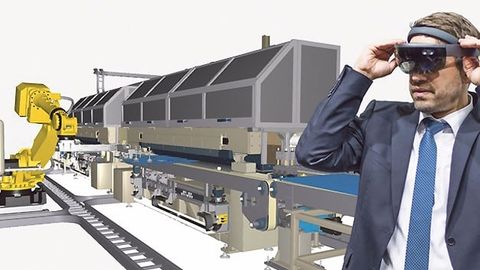
With the HoloLens glasses from Microsoft, systems can be projected directly into the field of vision as holograms.
© Machine engineeringBy connecting virtual reality or augmented reality glasses to Industrialphysics, Machineering offers users a special opportunity to immerse themselves even deeper in the simulated system. Users not only have access to the exact model of the real machine as a digital twin, but this counterpart can also be viewed directly in the goggles as a 3D simulation or as a hologram in the industrial hall, depending on the system used. The compatible HTC Vive and Oculus Rift models are based on a virtual reality (VR) system with a head-mounted display. The glasses completely cut the user off from the outside world, allowing them to move freely in virtual space, for example in a production hall during operation - without being on site. The Microsoft HoloLens, on the other hand, is an augmented reality (AR) system, i.e. a computer-based extension of reality perception that allows the user to display interactive 3D projections in the immediate environment with the support of a natural user interface. The user looks through transparent screens through which the projections can then be seen directly.
At SPS IPC Drives 2017, trade fair visitors can test the various AR and VR systems with the simulation software live at Machineering's stand in Hall 6, Stand 114. Machineering will also be presenting further developments relating to the software.


You might also be interested in
The future of CANopen
Similar to the automotive industry, industrial automation also requires more and more bus bandwidth. In addition, the cloud is becoming increasingly important in terms of communication. How does the CAN protocol, which has long been established in...
 read more...
Unauthorized access fended off
Plant modernizations often require new safety precautions. This was also the case for a manufacturer of cleaning agents and disinfectants, who had to safeguard the material flow in the area of a roller shutter door, among other things.
read more...WLAN in the factory - the selection criteria
WLAN is suitable for various applications in the factory. However, due to the many influencing factors, it is not always obvious how a network based on the IEEE 802.11 standard can be optimized to meet the requirements of industrial use. - Here is...
read more...Compact controls and drives a must
Smart factories promise operators a high degree of flexibility - for example through the use of driverless transport systems or mobile robot solutions. The automation of these subsystems in turn requires extremely compact control and drive concepts.
read more...Simply integrate safety
Machine and system manufacturers are increasingly turning to mapping safety functions via the communication bus. How can integration on the component side be achieved with reasonable effort?
read more...Flexible buffering via software
The complete automation of manual or semi-automatic processes is a major challenge with very short cycle times. When it comes to workpiece carrier transport, the machine manufacturer Goldfuß relies on a system that allows the creation of flexible...
read more...Individual IoT systems
How big? How much power? How robust? Which housing? The requirements for IoT systems are extremely varied. By designing individual embedded applications, devices can be created that are perfectly tailored to the application.
read more...Stumbling blocks with direct current
The question "direct current or alternating current?" is becoming increasingly important - not least due to the increasing use of renewable energy sources that generate direct current. When switching and protecting with direct current, however,...
read more...Traceability optimized
Directly marked 2D data matrix codes ensure the traceability of engine and transmission parts at KIA Motors. Read rates of 99 % are the target.
read more...