

E-T-A
Sensory in view
Intelligent power distribution systems are valuable helpers when it comes to digitalization in the IT rack. Monitoring the IT racks using sensors is a particularly effective measure for increasing system availability.
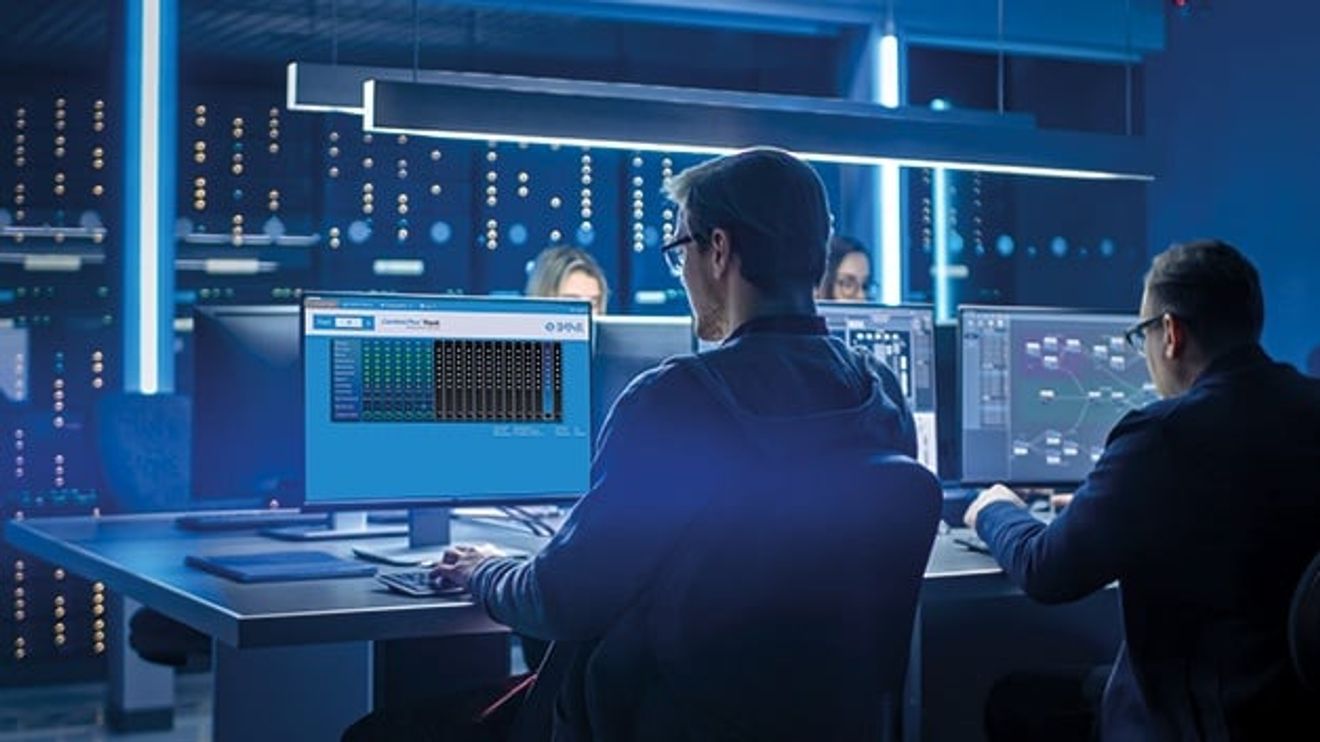
Data centers and communication and information technology systems are the linchpin of the digital transformation. Without them, transporting the enormous volumes of data would be just as inconceivable as meaningful processing or the use of cloud services.
An important issue when operating such systems is reliability. Data centers implement strategies to ensure the highest availability of the systems and thus guarantee the availability of their services. This includes back-up systems, emergency power or battery supply and other measures to minimize downtime. One of the core components here are power distribution systems that are installed directly in the IT rack. Traditionally, their task is to distribute the power for the connected consumers and to protect the loads against overcurrent and short circuits. In the data center sector, data centers usually use systems for alternating current (AC), while in traditional communication technology they often use direct current in the voltage range of -48 V(DC) or -60 V(DC). In modern infrastructures, however, conventional fuse and distribution panels reach their limits, as functions such as measurement data acquisition, transparent monitoring and remote control cannot be realized. The integration of sensors and the processing of their data with conventional power distribution systems is equally problematic. However, it is precisely the monitoring and automated processing of external signals, such as those provided by sensors, that offer system operators a wealth of opportunities to establish greater transparency and safety in their systems. For such demanding applications, intelligent DC power distribution systems that integrate electronic circuit breakers and I/O interfaces in one system offer a helpful alternative. One example is the 'ControlPlex' rack system from E-T-A.
The benefits of the sensors
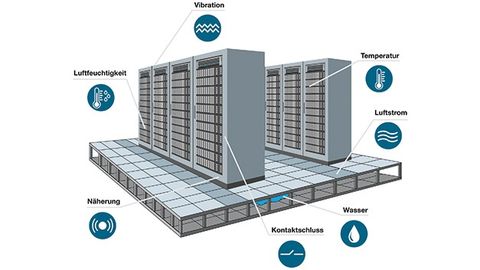
The External Alarm Interface (EAI300) acts as a signal collector for sensors in the data center.
© E-T-AIn a digitalized world, sensors are of central importance and inextricably linked to automated processes. The term 'sensor' is derived from the Latin word 'sentire', meaning 'to feel' or 'to sense'. This etymology already precisely describes the main task of a sensor: the measurement of physical or chemical variables such as temperature, brightness or humidity, followed by the conversion of this information into an electrical signal.
Opposite the sensor is the actuator, which is able to correctly interpret the electrical signals transmitted by the sensor. The actuator can then generate a physical variable and initiate a corresponding action. This leads to logical process chains that enable the entire automated process from data collection and conversion into electrical signals to the execution of actions.
This combination of sensors and actuators is also frequently found in IT racks. An illustrative example of this interaction is a door contact that detects when the door is opened. An electrical circuit breaker is then activated to activate a video camera, which documents access to the rack via video. This illustrates how sensors and actuators work together to control automated processes efficiently and precisely.
Signal acquisition made easy
The decisive step in setting up an automated process chain is the acquisition of the signals provided by the sensors. In most cases, this is the responsibility of separate input/output modules. Modular complete systems such as the 'ControlPlex Rack' integrate this function in a space-saving manner by inserting a module into the 19-inch power distribution system, for example the External Alarm Interface (EAI300). This means that no additional valuable height units are lost in the system cabinet, but are instead available for active technology such as routers, servers or switches. In addition to eight digital inputs, the External Alarm Interface also has an analog input for connecting sensors for temperature and humidity, proximity, vibration and contact connections.
What is the difference between analog and digital signals? Analog signals are like a stepless controller and can assume an infinite number of values between the start and end. A simple example is a temperature sensor in the data center that measures the rising or falling temperature. Analog sensors measure a continuous change.
Digital signals, on the other hand, act like switches. They can only have two values - on (1) or off (0) - an example is again the door contact in the data center, which reports whether a door is open (1) or closed (0). Digital sensors measure in clear steps. Digital signals are more robust against interference and can be transmitted over greater distances without significant loss of quality. They are also easier to store and process.
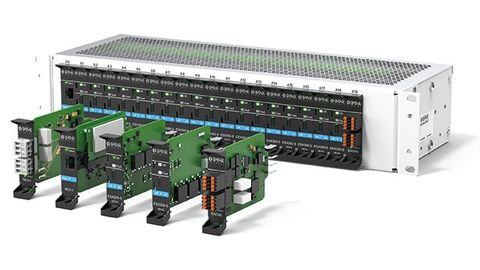
On the output side, the External Alarm Interface has two digital relay outputs, i.e. electromechanical switches that use digital signals to control electrical contacts. They process the signals to open or close an electrical contact according to their programming. By opening or closing the contact, they can control external devices or loads, such as a warning light that can be switched in the IT rack or control room. They therefore offer a reliable method of remote control and, due to their digital nature, are less susceptible to interference and noise than analog systems. The External Alarm Interface is connected to all electronic circuit breakers and the 'Remote Control Interface' (RCI10) communication module via an integrated bus system. The 'RCI10' is the central intelligence of the system and, in addition to internal communication, also connects the rack system to the higher-level control or control room. This enables sensor data, status conditions and error messages to be queried and temporarily stored and forwarded or alerted to the management system. The built-in Ethernet interface enables seamless integration of the entire power distribution system into the company network. Administrators can access the data from anywhere in the world. Protocols such as TCP/IP, SNMP (v1, v2, v3) and http/https are used for data transmission.
Integrated PLC functionality
The functional scope of intelligent power distribution systems goes far beyond simply recording sensor data. Additional software functions are available for this purpose, such as those offered by modern PLCs. With the 'ControlPlex Rack', the combination of 'RCI10' and 'EAI300' enables the programming of logical functions. This allows users to combine the operating states of the electronic circuit breakers with the sensor data determined in the web interface using the standard AND, OR, NOT commands in order to initiate automated actions. For example, physical access control in the IT rack is increased by the system activating a video camera that switches on when the door is opened based on the status message from the door contact. The logic function can also be used to activate physical alarm signals, for example by switching on a warning light or triggering an acoustic warning. This is particularly useful if the door contact of the IT enclosure reports that the enclosure has been opened even though the active technology is still live.
In addition to these safety-related issues, automated switching can also provide system operators with economic benefits. For example, it is possible to switch loads on and off on a time-controlled basis. This allows the operator, for example, to switch off defined hardware that is not needed at night for a variety of reasons. This is an interesting approach to optimizing consumption, especially in times of high electricity costs and increasing legal requirements to reduce emissions and ultimately save electricity.
Transparency thanks to web interface
In order to monitor and configure the system remotely, intelligent power distribution systems offer access via a web interface. These graphical user interfaces are platform-independent and can be accessed via all common web browsers. Operators should make sure that the connection to the web browser is established via an encrypted HTTPS connection.
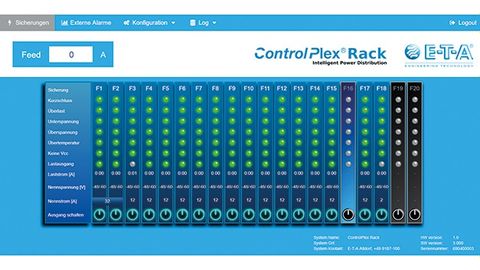
In addition to the graphical user interface, the 'ControlPlex Rack' also offers the option of configuring the system via the Secure Shell (SSH). This option is often used by administrators when the user only has limited bandwidth available. The user interfaces display the complete system and the user can immediately see the status of each individual load channel thanks to LED indication. If all LEDs are green, the system is in perfect condition. If an LED lights up red, it shows the user, for example, whether the load channel has been switched off due to a short circuit or whether an overvoltage, undervoltage, etc. is responsible. If, for example, an electronic circuit breaker trips due to an overvoltage, the control room recognizes this immediately and initiates specific countermeasures.

The author: Michael Bindner is Product Manager at E-T-A Elektrotechnische Apparate in Altdorf near Nuremberg.
© E-T-ABy forcing power on/off restarts, the system can also enable significant cost savings by reducing costly on-site visits. Other functions include the measurement of power consumption - either individual measurements per load channel or for the entire system - and the recording and reading of log files in which the status of each load channel is permanently tracked.


You might also be interested in
Dynamic haptic feedback
With the 'Smart-Knob Mini', Elektrosil is expanding its series of intelligent rotary pushbuttons with a compact solution. The rotary encoder combines rotation and pressure functionality in a robust housing with IP65 protection and a glass surface.
 read more...
Double security through redundancy
The 'Safety Key' from Hy-Line allows the simple integration of safety-relevant switches in glass displays.
read more...ipf electronic at the SPS 2024
Compact multi-color LED signal light
With the 'EZ650520', ipf electronic presents a flat multi-color LED signal light with a height of only 25 mm.
read more...Illuminated pushbutton with 5 V supply voltage
Rafi is now offering twelve additional versions of the 'Lumotast 16' series illuminated pushbuttons with an operating voltage of just 5 V for LED control. This makes these actuators, which are designed for standard installation openings of 16.2 mm,...
read more...Two new surface-mounted keyboards
Wöhr is expanding its 'Surta' industrial keyboards with versions 15 and 16, which have been specially developed for environments such as medical and dental areas, the pharmaceutical, clean room and food industries, as well as general industry and...
read more...Keyboards with glass surface
Ateg offers capacitive PC keyboards with a glass surface from the French manufacturer Tactys. The glass of the user interface is made of 3 mm thick, hardened white glass, which is robust against mechanical influences.
read more...Components made from biomass-balanced plastics
Siemens Smart Infrastructure and BASF have presented the first electrical safety product that contains components made from biomass-balanced plastics.
read more...Enclosure light in aluminum housing
With the 'Gogaswitch LED A-1000', Gogatec offers a switch cabinet light in an aluminum housing that has a motion detector that switches off automatically after ten minutes.
read more...Motto "Sustainable!"
The EU Commission has presented a proposal for a new Ecodesign Regulation for Sustainable Products (ESPR), which is to become a central component of the European Green Deal. Schmersal is also already on the road to sustainability.
read more...