
E-T-A
Well secured
In the course of digitalization, the demands on power distribution are also increasing. But how can transparency at the 24 V (DC) voltage level be increased and thus improve system availability?
The global use of production systems and remote maintenance require flexibility and direct external access to the systems. Whereas in the past the technician sometimes had to travel halfway around the world to rectify faults on a system, today systems located abroad can often be accessed at the click of a mouse. On the one hand, this requires the necessary equipment to enable remote access and, on the other, the consideration of high security requirements. Equally important is the early detection of undesirable developments in plant operation. A key aspect of this is the recording and processing of measured values. Measured values also play an important role in quality control. However, the large amount of information results in a higher volume of data on the bus systems. As this is not desirable, measured values are often transferred directly to the cloud bypassing the control bus. Communication types such as OPC UA are suitable for this.
Remote access to the 24 V (DC) power distribution system
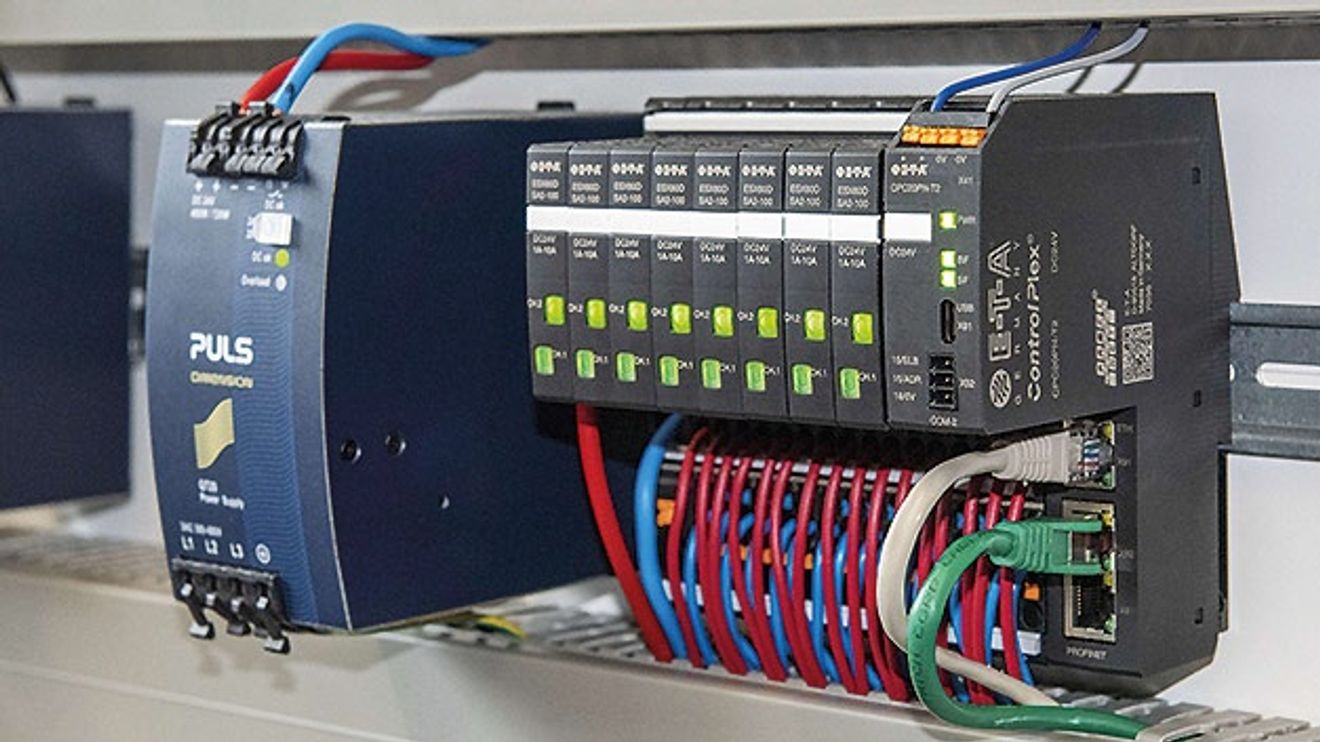
At the heart of every system is the 24 V (DC) fuse and power distribution. The control voltage supplies a large number of sensors, pumps and valves that measure the values for process control and then control the process with the connected actuators. The 24 V (DC) voltage level is also used to supply the control systems. If there is a power failure, the control system is no longer supplied, which would result in the system being switched off and the production process being interrupted in an uncontrolled manner. To prevent this, intelligent protection of the connected loads is required. The 'ControlPlex' system from E-T-A, for example, is ideal for this purpose. It consists of the 'CPC20' bus controller for communication with the higher-level systems, the 'Modul 18plus' power distribution system and the 'ESX60D' electronic circuit breaker for selective protection of the connected loads.
Transparency via bus controller
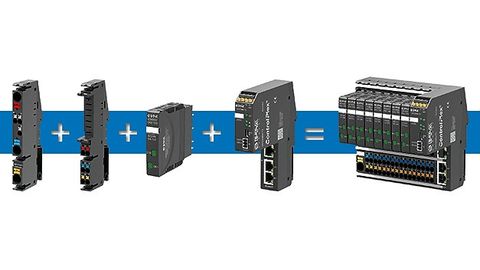
Intelligent power distribution systems are finding their way into industrial production facilities. A modular design increases flexibility.
© E-T-AThe bus controller is the 'brain' of the 'ControlPlex' system and acts as an interface to the various control systems and to the cloud. It is connected directly to the power distribution system, to which the electronic circuit breakers are plugged. In the standard configuration, 16 connection modules can be connected to the bus controller. A two-channel circuit breaker can be plugged into each connection module, so that 32 channels can be protected. The number of connection modules can be doubled with the aid of a transfer module. This means that the bus controller can communicate with up to 64 fuse channels.
The primary communication interface of the device is the connection to the respective bus system. Connection to Profinet and Ethernet IP is currently possible via two RJ45 sockets. The integrated switch ensures simple connection to the bus system. A third socket enables a service laptop to be connected to the integrated web server. This allows users to access all the information and functions of the system and adapt it quickly and easily when commissioning the system or during subsequent operation. This interface can also be used to transfer system data in JSON format. An OPC UA interface is in preparation. It enables status information and measured values to be transferred directly to the cloud. This allows users to compare different systems worldwide and analyze their measured values.
Modular design
By using base systems, users have the option of adding new consumers during system operation without having to switch off the system's power supply. Unlike DIN rail mounting, the control cabinets with the base systems can be pre-wired in the workshop and adapted as required during commissioning or later operation.
The '18plus' power distribution system consists of three components: The power supply module is connected directly to the switching power supply unit. This enables the connection of cables with a cross-section of up to 16 mm². The maximum current of the system is therefore 80 A. The current is distributed to the connected connection modules via busbars. To install the system, the connection modules are connected in series to the power supply module. Each connection module has three push-in terminals for each fused channel, to which the fused load is connected. These three terminals are: the fused load from the circuit breaker, the 0 V and a terminal for the functional earth.
Up to 16 sockets can be connected to the standard system, thus protecting a maximum of 32 loads. This number can be doubled by using a transfer module. The transfer module is connected to the CPC20. In this case, communication takes place via the connected bus line. As with the standard system, power is fed in via the power supply module. This means that a further 32 channels can be fused and supplied with 80 A. The overall system therefore has the option of protecting up to 64 channels.
Selective consumer protection

The CPC20 power distribution system enables intelligent and transparent protection of 24 V (DC) power distribution.
© E-T-AThe 'ESX60D' electronic circuit breakers have two channels over a width of 12.5 mm. Integrated LEDs indicate the status of the individual channels, which provides an overview of the status of the 24 V (DC) power distribution and fuse protection as soon as the switch cabinet is opened. In fault-free operation, the LED lights up green; if the parameterized limit value is exceeded, it flashes orange, and if the circuit breaker trips, it signals this in red. In addition, the bus controller sends all status information to the higher-level control systems and also transmits the current load current of the circuit breaker. This enables a change in the load current to be detected at an early stage so that maintenance personnel can initiate countermeasures. The reason for such a change could be a fault in the load, for example.
It is also possible to compare the measured values of different systems worldwide and thus carry out optimizations. The recording of the load current is supplemented by the comparison of this current with a pre-parameterized limit value. The limit value can be parameterized in a range between 50 and 100 % of the set rated current of the circuit breaker. If this limit value is exceeded, the automatic circuit breaker indicates the excess and transmits it to the control system. This means that maintenance personnel are informed of faulty developments at an early stage - they can detect faults before they occur, rectify the problem at the load and thus prevent the system from being switched off unintentionally.
If the automatic circuit breaker is nevertheless switched off, the reason for the switch-off is transmitted to the control system. The automatic circuit breaker distinguishes between a short circuit and an overload, which simplifies troubleshooting. In the event of disconnection due to an overload, the fault lies with the consumer. In this case, it may be that a motor is dirty, for example, which leads to a higher current consumption. In this case, the maintenance personnel will therefore start looking at the load. In the event of a short circuit, everything points to damage to the cable. For example, if a forklift truck drives over a cable, this can damage the cable and cause a short circuit. In this case, troubleshooting starts at the control cabinet and continues in the direction of the consumer. This targeted troubleshooting enables downtimes to be reduced.
Remote access to the circuit breakers

The author: Thomas Kramer is Business Development Manager, Automation and Process Control Division, at E-T-A in Altdorf near Nuremberg.
© E-T-ARemote access to the circuit breakers allows them to be switched on or off or reset if they have previously tripped. This allows them to be switched back on quickly, as often only temporary problems at the consumer have led to an overcurrent event and the corresponding switch-off. The rated current of the circuit breakers can also be parameterized by the control system and the connected visualizations. The rated current can be freely selected in 1 A increments within a range of 1 to 10 A. If changes are made to the system configuration, the fuse protection can be easily adapted to the changed rated current. If a device needs to be replaced, the automatic circuit breaker is automatically parameterized and set to the specified current rating. This reduces stock-keeping, as only one type of device needs to be kept in stock.


You might also be interested in
With a focus on control technology
The e-paper of issue 10/2022
Although the software determines the function of the process, it is still the hardware sold that ultimately binds customers to a product line. This is currently changing. Read how and why in the 10/2022 issue of Computer&Automation.
 read more...
Computer&Automation Interactive
The new e-paper experience
Where print reaches its limits, our e-paper unfolds its full potential - true to the motto: pictures say more than 1000 words. Our e-papers now contain more information in the form of videos, GIFs, web links and picture galleries! See for yourself!
read more...Transparency through web server and fieldbus connection
The CPC12 bus controller from E-T-A has a separate 24 V (DC) power supply and thus enables an independent supply to the circuit breakers and records all status information and measured values.
read more...UPS with high efficiency
The '93T' uninterruptible power supply (UPS) from Eaton has a rated output of 15 to 80 kVA and provides a stable power supply for critical applications such as server rooms and small data centers.
read more...DC/DC converter with wide-range input
Bicker Elektronik presents the 'DC300WS', a contact-cooled 300 W DC/DC converter with up to 98 % efficiency.
read more...22.5 mm wide electronic circuit breaker
The electronic 4-channel circuit breakers (ECBs) 'Pisa-M' from Puls are aids for protection and power distribution in applications with power requirements from 90 W to 480 W.
read more...Power supply for high-performance computer systems
The ATX power supply units of the 'Delta GPS' series from Bicker are suitable for high-performance computer systems and graphics-intensive applications.
read more...Power supply units with Ethercat connection
Puls offers three DIN rail power supply units with 240 W and 480 W output power and an integrated Ethercat interface, which provide power supply and application data such as voltage and current characteristics on the input and output side.
read more...3-phase power supply unit with Ethercat interface
'Fiepos FPT500' from Puls is a 3-phase power supply unit with 600 W output power, four electronically protected outputs and a fully integrated Ethercat connection for direct access to power supply functions and numerous measured values.
read more...