
Sensors 4.0
Sensor communication of the future
What does Industry 4.0 mean for sensor manufacturer Sick? Dr. Robert Bauer, CEO of Sick, comments on the need for openness and problems with standardization.
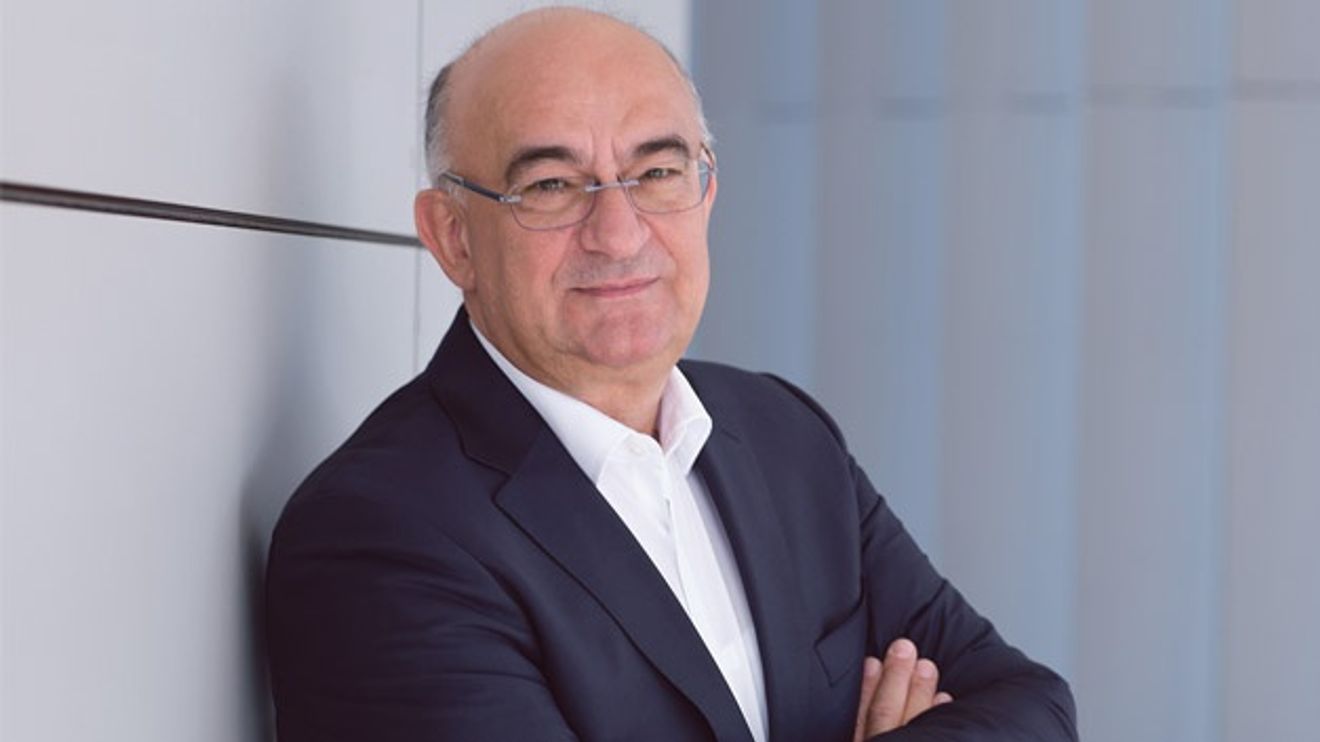
"What bothers me a little about Industry 4.0 at the moment is the discussion about whether we have already achieved everything today," says Dr. Robert Bauer.
© SickDr. Bauer, Sick's growth figures are truly impressive...
Bauer: We have grown continuously for 40 years, in fact by an average of 10% a year. Of course, our growth is also due to the fact that modern machines need more and more sensory capabilities - in other words, the normal growth of a factory is additionally boosted by a higher proportion of sensor technology. This is the real driver that lifts us above the 'normal' 3% growth.
We have now clearly specialized in 'sensor intelligence' - a young technology with many growth opportunities that we will continue to expand in the long term. It is important to note that the area of intelligence is not limited; it concerns both the area directly connected to the sensor and the intelligent communication paths.
How would you define the requirements for sensor communication in the future?
Bauer: Sensor communication must be two-way and equipped with high bandwidths. The return channel is important in order to be able to integrate sensor technology into autonomous systems, because learning systems are not possible without a return channel.
What key issues does Sick see itself facing in the face of Industry 4.0?
Bauer: As a sensor manufacturer, we provide the technical data. So we need an ecosystem to be able to process the data optimally. On the one hand, this results in technical challenges for the processors, and on the other, it raises questions about data security and sovereignty over the data, so that every customer also makes data available. If data security is not guaranteed, I4.0 will be blocked due to economic or other considerations. This then hinders actual progress.
Sick is certainly not a founding member of the 'Industrial Data Space' initiative for nothing ...
Bauer: Data sovereignty is a key to the real success and breakthrough of Industry 4.0. But there are two sets of interests: some want to provide data, others want to use the data they receive as they wish - for example, there are very large cloud providers who want to process the data anonymously. There is a real conflict of interest here. That's why we believe that we need a generally recognized data system - an ecosystem - where you can hand over the data and know exactly what happens to it. Either you sell it or you say 'no' and only want to see it processed for specific purposes. This is already possible today with a bilateral procedure that can be negotiated via contracts. However, if the whole thing is networked, there are any number of transfer points and, above all, multiple stations - the data is passed on from cloud to cloud. This can only be regulated contractually with an extremely high level of effort. A reliable technical solution is therefore required. We are convinced that the 'Industrial Data Space' can provide this ecosystem and thus increase the level of trust for all parties involved. Once this is in place, data can be handed over responsibly because sovereignty and sovereignty are retained. This is the big challenge.
In the Industrial Data Space, the highest level of trust is designed in such a way that it is not the data that is transferred, but only the function. In this way, a gradation can be created from completely free data to highly confidential data.
The Industrial Data Space now has many and large members, because it is gradually becoming clear that a single company cannot manage to build an ecosystem. The next step for the Industrial Data Space is therefore aimed at more international companies.

Dr. Robert Bauer: "The company generating the data remains the owner of the data. That's the be-all and end-all, otherwise nobody will hand over the data."
© SickHow digital is Sick already with its own processes?
Bauer: In our own production facilities, we are introducing Industry 4.0 ideas 1:1 in new systems - for example, agent systems.
Do you not retrofit old production systems?
Bauer : Old systems are of course connected, but they are not fully retrofitted. For example, we have had a batch size 1 factory for light barriers for a good ten years, which can definitely be seen as an I4.0 system. Whereas today it is still networked by a conveyor belt, in future the individual functions will be independent of each other and will be controlled by agent systems. This will make the whole thing more flexible - especially for new, as yet unknown products. In my view, the vision of Industry 4.0 is to make production so flexible that it can produce something that hasn't even been invented yet. But that will certainly take another ten to twenty years.
The disruptive role of sensor technology
Where do you see Sick in Industry 4.0?
Bauer: Backwards compatibility is important for us with I4.0: we have the current products that run on the previous systems. At the same time, we have Ethernet connections for higher-value services. The customer can use these higher-level services gradually, depending on when they set up their ecosystem. One example: We have long experience with pollution alarms. Sick has been offering it for 20 years - but less than 10% are actually connected. So it's not enough to offer the function; the entire system has to be geared towards it.
In the Industry 4.0 environment, sensors are even predicted to play a disruptive role in the future. What does that mean?
Bauer: Disruptive means that the data is viewed as a network - as a system - and not just as an individual data instance. Networking brings additional benefits. However, the control loop must be closed, and this is still lacking. After all, the entire data processing must first be successively prepared for this.
If you take an evolutionary approach to Industry 4.0 and gradually upgrade today's existing systems, you also build a bridge for those who still have difficulties or are hesitant. This is why we place so much emphasis on backwards compatibility. So nobody has to be afraid, you just have to be prepared. At the end of the day, nobody builds a new factory just because there is a new idea! It takes continuous small steps to implement Industry 4.0.

Do you see more willingness in Asia or the rest of the world?
Bauer: A major trend in Asia is moving away from manual work towards automation. The latest concepts are being used there, nobody is using old technologies, but really the most modern ones - that is a challenge. That's why our growth is greatest in Asia.
To what extent is openness an issue for Sick? I'm thinking, for example, of the 'AppSpace' ecosystem, which is considered an open platform for programmable sensors, or the disclosure of your Hiperface DSL encoder interface. Are the days of proprietary solutions over in the age of the smart factory?
Bauer: The two are directly linked: If you want open data communication, the interfaces must also be accessible to everyone. With IO-Link, we have long been in favor of open interfaces. Overall, however, there are too many open interfaces, which is where we have our problem. This is precisely why we have opened up 'AppSpace' so that it is widely recognized.
It's the same with the encoder interfaces: Hiperface DSL has been on the market for seven years and is already installed in 40 controllers. If someone now also operates these interfaces, they can draw on a large infrastructure.
Are your market competitors joining in?
Bauer: There is a great deal of interest in moving towards a common standard.
Ethercat, Ethernet IP, Powerlink, Profinet...
Bauer: For many reasons, the variety of industrial bus systems has multiplied in the 'new world' - now it is of course difficult to establish a standard.
We have a hodgepodge of protocols - is there too little pressure from the user side?
The economic interests of the system operators are apparently greater than the interests of the customer side, which is fragmented and has no unified voice. Of course, every customer would like to work with a standardized system. But not even the highly influential automotive industry is able to generate the necessary pressure. It's not just the German automotive industry that is active, but also the Japanese and American ones, so we already have several systems here. And it also depends on the degree of specialization of certain suppliers. When applied to the entire industry, standardization per sector is of course even more difficult. And that's why there are so many different Ethernet protocols. This is not really necessary - but it is a fact. Each standard is associated with or promoted by a major manufacturer, who naturally wants to push through its strategy and establish its standard.
We see the same thing in the Industrial Data Space. We want standardization, but then there are new ideas for other consortia. New clubs are being founded all the time ...
TSN is a good example! It's a fundamental technology, so to speak - which is again being covered by protocols. The main problem of the real-time capability of Ethernet is solved nicely - but it is again possible to run different protocols. At the lower level, however, TSN is a nice and good standardization.
Back to AppSpace once again. Where is the journey going here?
Bauer: With AppSpace, we have the networking of many sensors in mind. The 'SIM4000' that we offer in this context is also called the 'Sensor Integration Machine': we integrate a large number of sensor functions here and generate new, additional information as a result. You can also think of it as an intelligent node. Many people in the open community are already developing software on AppSpace.
As the interfaces are standardized, AppSpace can be used to connect third-party cameras and the like. We offer interfaces for our entire sensor portfolio, from RFID, 2D and 3D cameras to encoders and time-of-flight sensors.
Linking a wide range of sensor functions opens up completely new possibilities. For example, we can address all bus interfaces internally in a standardized and targeted manner using software, which is a great relief. The fact that this is virtually done by the machine is also the difference to an industrial PC, where additional interfaces have to be programmed.
Growth and growth opportunities
Now a few more figures: 2016 was another record year for Sick, with an increase in turnover of 7.4% to 1361 million euros and a 10% rise in incoming orders. How did business go in 2017?
Bauer: Our long-term strategy is: 10% growth, 10% EBIT and 10% development expenditure - and 2017 was no exception. We were definitely aiming for the upper single-digit range and are pretty sure that it will be another best year in Sick's history.
Where do you see the greatest opportunities for growth?
Bauer: In logistics, electronics and the automotive sector - when electric cars have to be produced. After all, electronics and electrical equipment in cars will increase significantly.
Could the topic of 'autonomous driving' play a role for Sick?
Bauer: We do that in the factory. We are not currently established as an automotive supplier in actual road traffic. We are explicitly not focusing on this completely different business field.
Why doesn't Sick's knowledge flow into applications or new products outside of industrial applications, for example in the fields of medicine and smart building?
Bauer: Industrial applications are extremely challenging in themselves. With our relatively high level of innovation, we are concentrating precisely on this area. For me, this concentration also guarantees reliability and stability.


You might also be interested in
Sick opens the Hiperface DSL interface
Sick is making the previously proprietary 'Hiperface DSL' interface available to all users. As a result, manufacturers of servo drive technology will benefit from an expanded product portfolio for data transmission in the motor cable.
 read more...
Industrial Data Space Association
A secure space for data
The Fraunhofer-Gesellschaft founded the 'Industrial Data Space' association over a year ago. An initial reference model of the underlying architecture was published at the Hannover Messe 2017.
read more...Another record year for Sick
In the 2016 financial year, sensor manufacturer Sick once again achieved record figures for incoming orders, sales, EBIT and employees. And the forecasts for the current financial year are also very positive.
read more...The first steps towards digitization
Real-time transparency in the material flow: this was the goal set by Miba when it set out to digitalize its internal logistics processes. But how successful was the close link between ERP and MES in the end? - A field report.
read more...How will the IoT change companies in 2020?
How will network technology in companies change in 2020? Axel Simon, Chief Technologist at HPE Aruba, takes a look into the crystal ball
read more...Digital twin revolutionizes maintenance
As virtual representatives of real machines, digital twins open up new possibilities for maintaining and servicing complex industrial plants and systems. A project report.
read more...You can't do without Edge and Swarm
The IoT has changed the requirements for processing data provided by machine sensors and actuators. This needs to happen as quickly as possible - preferably where the data is generated. Edge nodes and swarm computing systems take on this task.
read more...Online machine data under control
Turning huge amounts of data into valuable information - how can this smart industry approach be implemented? Linking PC-based controllers with Matlab and a cloud-based IoT analytics service can be a viable approach.
read more...From modeling directly into the PLC
Despite digitalization and I4.0, the technical functions in a process plant do not become simpler if you break them down to the smallest detail. Nevertheless, the high level of difficulty can be overcome by combining the right tools in the right way.
read more...