
RFID systems
Sensor and cloud connected end-to-end
Collecting data from production lines centrally and evaluating it online is an initial step towards Industry 4.0. This can be achieved using cloud-supported software based on data from RFID sensors.
Automated process control based on data from production lines reduces manual effort and the susceptibility of machines and systems to errors. In addition, a cloud-based solution enables analysis, forecasting and predictive maintenance regardless of location. Neoception offers software that can be implemented with little effort. The only technical requirements are RFID sensors and an IoT gateway with an internet connection.

Plug & Play integration into the 'Asset Tracker' works with RFID gateways from Pepperl+Fuchs.
© Pepperl-FuchsThe first generation of the software, called 'Asset Tracker', is based on UHF and HF RFID sensors that can be used in production and logistics. The assets to be tracked - for example small load carriers (SLCs), pallets or trays - are fitted with RFID transponders (tags). These are recognized by the read/write heads, which are placed at significant points in the process. The sensors record the passage of the asset, including the location, time and any additional data recorded.
Transparency in the process

The data from the RFID read heads is sent to the Neoception application via the IoT gateway, from where it is available at any time.
© Pepperl+FuchsThe data recorded by the RFID sensors is collected by software running locally on the IoT gateway, processed for sending and transmitted to the corresponding data endpoint in the cloud via the Advanced Message Queuing Protocol (AMQP). Users rent the IoT gateway for the duration of the booked service. Thanks to the intelligent gateway software, both hardware detection and configuration take place automatically. New assets can be added either using permanently installed onboarding stations or RFID-enabled handhelds.
The transmitted asset data is then made centrally available and evaluated in the cloud application. Through user-specific adaptations, it can also flow into a higher-level merchandise management system, which ensures end-to-end transparency throughout the entire process.
Application-specific software
As soon as the gateway is installed in the user's network and the RFID data is available online, the Neoception software takes over all the tasks that need to be completed. It analyses the raw data, visualizes cycle numbers and provides an overview of all active reading points, transponders and events with corresponding time stamps. If a defined threshold value is reached, individualized messages are generated and sent.
Once the user has identified themselves, the Asset Tracker dashboard is simply opened in the browser. It is possible to differentiate between roles with different rights. New assets appear on the display after they have been scanned and can be assigned immediately. It is also possible to make specific settings for tags and read heads. Notifications can also be defined in the dashboard after certain throughput figures. Operation is intuitive and simple.
This makes it possible to precisely plan the maintenance required for each cycle and prevent failures and quality losses in production. Thanks to the process transparency, certain inspection steps can be completely eliminated or at least reduced to a minimum.
Another advantage is the possible reduction in capital tied up in 'replacement assets', as only the transport systems that are actually needed are still in circulation. And since the software is booked as a service, only the service actually used is paid for. Thanks to the software's SaaS subscription model, operating costs can be planned and controlled in concrete terms.
Examples from practice
Many process components require maintenance or cleaning after a certain number of cycles. Such assets can be found in a wide variety of systems - typical examples include electroplating or concrete casting. As the assets in these systems constantly undergo a repetitive process, they are subject to wear or build-up.
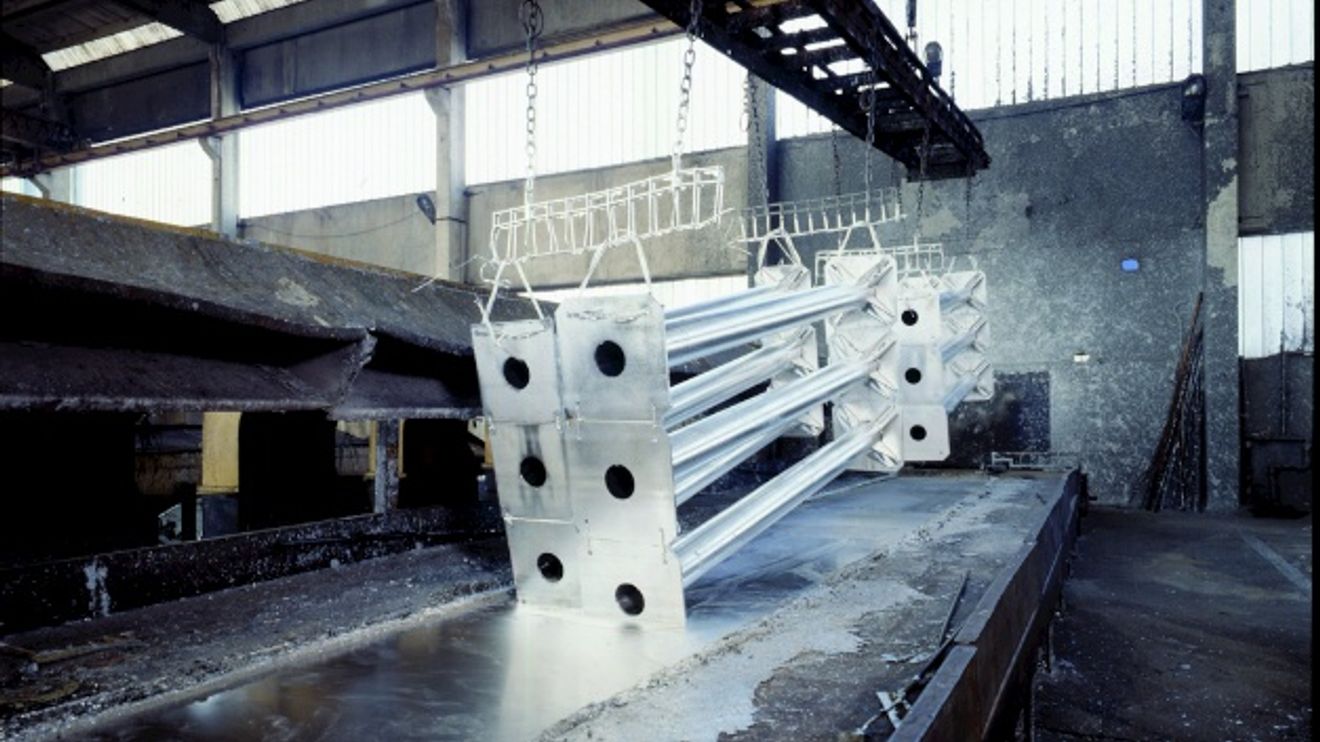
In electroplating, the workpieces are usually attached to metal frames (racks). Both together are immersed in the tanks containing the electroplating chemicals. The racks and workpieces are therefore exposed to the effects of these often very aggressive substances. Cleaning or replacement is due regularly after a certain number of runs. However, individual racks can be used with very different frequencies.
Something similar happens when casting concrete blocks, for which wooden molds are usually used. During each casting process and the subsequent hardening, some material adheres to the wooden surface. Depending on the parameters of the workpiece, the tolerance limit is reached after a certain number of casting processes.
As different as the applications are, the principles and requirements for a tracking solution for the maintenance-relevant carrier systems are very similar: With each pass, the RFID tags on the assets are recorded at defined points. The software issues a message as soon as a threshold value is reached and an action is required. Cleaning, maintenance or replacement of parts can always be precisely tailored to actual requirements.
Thanks to the Asset Tracker's IoT technologies, the sensor data can be read out without interfering with the existing infrastructure and retrofitted via plug & play. RFID technology was chosen as the measuring principle for the first generation of the cloud application. However, other sensor types such as optical, magnetic-inductive or ultrasonic sensors can also be integrated into the system - corresponding extensions are planned.
Author
Caius Ruff is Product Manager Digital Services at Neoception in Mannheim.


You might also be interested in
No chance of manipulation
A paperless recorder cannot solve all the cyber security problems in the world. However, it can ensure that the processes it monitors are a 'safe bet' for the user.
 read more...
The IIoT potential of process automation
The digitalization of plant and device automation is also in full swing in the process industry and is less complex than often assumed. FDT-based IoT scenarios with Pactware, for example, can help you get started with the implementation of...
read more...Under control even when switched off
A malfunctioning actuator on a gate valve, fire pump or smoke extraction system can have fatal consequences. Therefore, its functional safety should always be ensured. This task can be performed by insulation monitors.
read more...SensoPart and Cambrian Robotics
Partnership for 3D-Guided Robotics
Cambrian Robotics and SensoPart are jointly developing an AI-powered solution for 3D-guided robotic applications. The combination of vision sensors and AI is designed to simplify gripping and positioning processes.
read more...Expansion of the Sensor Portfolio
Infineon Completes Acquisition of ams Osram's Sensor Business
Infineon has completed the acquisition of ams Osram's non-optical analog/mixed-signal sensor portfolio. The business is expected to generate approximately 230 million euros in revenue in 2026.
read more...Technologies for precise data and analytics
From June 9 to 11, 2026, Sensor+Test once again brought together trade visitors from the fields of sensor technology, measurement, and testing in Nuremberg. With its focus on these core technologies and the wide range of application areas, the trade...
read more...Increased revenue and expanded production capacity
The Fraba Group, a manufacturer of sensors for industrial motion control, looks back on a successful 2025, during which both revenue and the number of employees increased.
read more...From sensor to intelligent system
Sensors, measurement technology and artificial intelligence are merging to form intelligent systems. From June 9 to 11, 2026, Sensor+Test in Nuremberg will showcase the most important trends in a changing industry.
read more...Technology and innovation center opened in Chengdu
Balluff has opened a technology and innovation center at its production site in Chengdu, China. The aim is to provide even more targeted support to local and international customers with solutions and expertise.
read more...