
Insulation monitoring
Under control even when switched off
A malfunctioning actuator on a gate valve, a fire pump or a smoke extraction system can have fatal consequences. Therefore, its functional safety should always be ensured. Insulation monitors can perform this task.

Drives are monitored in many applications. The function of the drive system as a whole can be verified by monitoring the speed, while temperature and vibration measurements can detect faults on the mechanical side of the drive, such as bearing damage. On the electrical side of the drive, it is particularly important to detect insulation faults. This is because these can lead to drive failure as well as to personal injury due to electric shock or damage. This can also result in a fire in the motor.
Earthed or unearthed?

The insulation monitors from the 'Varimeter IMD' series from Dold & Söhne are suitable for monitoring switched-off drives in earthed systems.
© E. Dold & SonsWhen monitoring drives for insulation faults, it depends on how the installation is designed; it is important to note whether the system is earthed or unearthed.
- In unearthed IT systems, there is no low-impedance connection between the active conductors of the system and the earth potential. Insulation monitors are therefore used to measure the resistance between conductors and earth potential.
- For earthed TN or TT systems, standard residual current monitors can be used, which measure the total current in the three phases and in the neutral conductor. If this total current is not zero, there must be an insulation fault.
In both cases - with earthed or unearthed systems - the monitoring device switches off the drive in a controlled manner as soon as an insulation fault is detected. Appropriate measures can then be taken to eliminate the fault.
However, it is not so easy to monitor switched-off drives using these methods:
In unearthed IT systems, the insulation monitors work as described above. In electrical drive technology in industrial environments, however, such installations tend to be the exception - they are only used where the power supply must not fail. Typical examples are hospitals and special areas in the process industry.
The residual current monitors used in earthed systems only work when the electric motor is in operation, as no currents flow when the drive is at a standstill. Depending on the application, however, it is also important to monitor switched-off electric motors in TN or TT systems. Typical applications where this is important are, for example, fire pumps, smoke extraction systems, pumping stations and other systems that must be reliably started up in an emergency. For drives here, it must be ensured that they actually work when required.
One option is to check such drives regularly. However, this is associated with high costs on the one hand, and on the other hand this method does not offer the security of permanent monitoring. If electric motors are not in operation, environmental influences such as moisture or dust can attack the insulation in the supply cables or in the electric motor. If the drive is then switched on, the protective device responds and switches the electric motor off again. However, if a smoke extraction system or a fire pump cannot be switched on in an emergency, this can have fatal consequences.
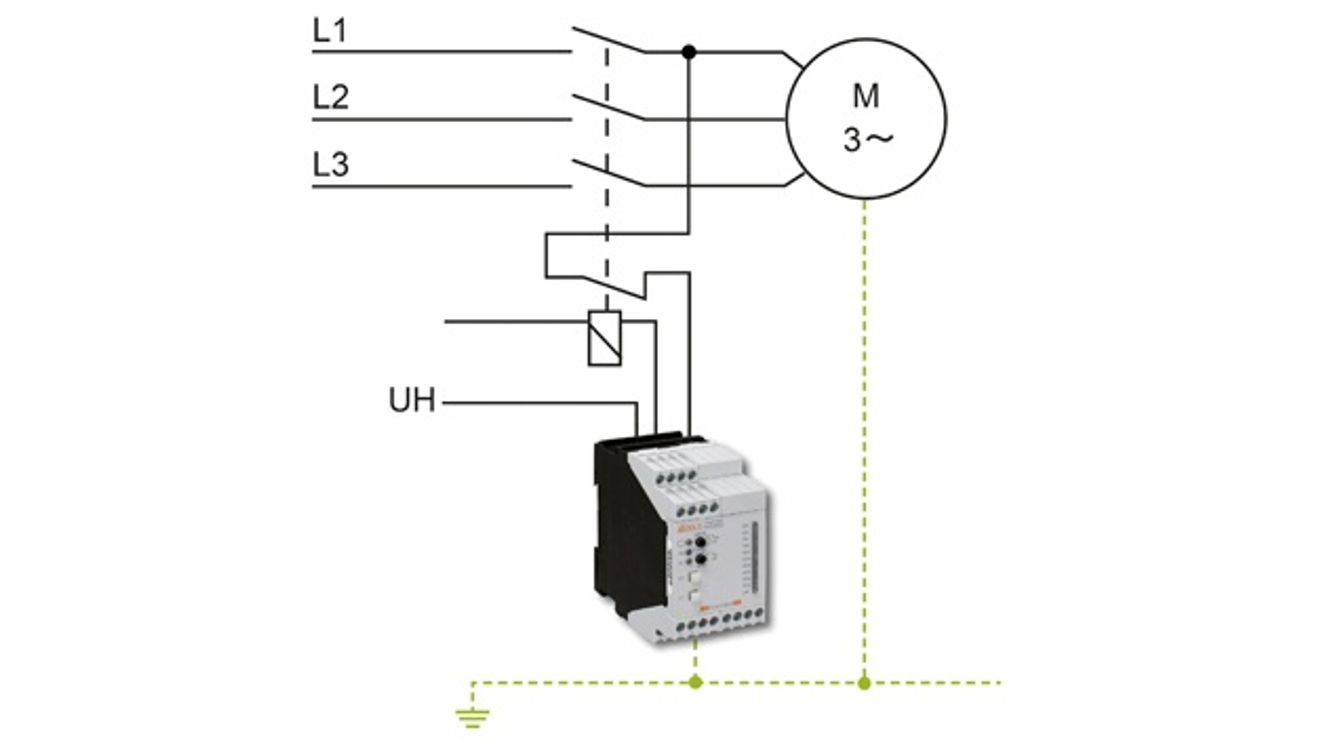
Insulation monitor for earthed systems

The insulation monitor only measures when the contactor or circuit breaker switches off the motor.
© E. Dold & SonsSpecial insulation monitors, such as the 'Varimeter IMD' series from Dold & Söhne, are available for monitoring disconnected loads even in earthed systems. In detail, the MK 5880N and MH 5880 insulation monitors are connected to a drive in such a way that they only monitor the insulation resistance as long as the drive is disconnected from the mains. For this purpose, an insulation monitor is connected via the normally closed contact of the contactor or circuit breaker. It only works when the drive is switched off. Otherwise the insulation monitor would trigger a false alarm during operation. With three-phase drives, it is sufficient to monitor only one phase, as the three phases in the motor are coupled with low resistance. This means that insulation faults can also be detected on the phases that are not connected.
The two insulation monitors are suitable for three-phase and alternating current systems up to 500 V and for system frequencies from 10 to 1000 Hz. The devices are designed for installation on DIN mounting rails and can therefore be easily installed in a terminal box or control cabinet. The connections are available either as screw or spring-cage terminals; the auxiliary voltage, measuring circuit and output contacts are electrically isolated from each other. The alarm value for the earth fault can be set from 5 Ω to 100 kΩ for both devices. If the value falls below the set value, the output relay drops out and the alarm is triggered. At the same time, a red LED signals the insulation fault.
Condition-based maintenance
The MK 5880N insulation monitor also has a pre-warning value that can be set from 10 kΩ to 5 MΩ. This allows a slowly occurring deterioration of the insulation resistance to be detected. A second output relay and an additional yellow LED are provided for this purpose. This allows maintenance staff to check the relevant installation before a critical fault occurs. With the MH 5880, the currently measured resistance is output via an analog output from 0 to 10 V. In addition, an 11-stage LED bar display visualizes the value directly on the device. The insulation value can be evaluated by a higher-level system - such as a PLC - via the analog output. Here too, an alarm and, if necessary, condition-based maintenance are possible.
Author:
Jörg Lantzsch is a freelance journalist in Wiesbaden.


You might also be interested in
No chance of manipulation
A paperless recorder cannot solve all the cyber security problems in the world. However, it can ensure that the processes it monitors are a 'safe bet' for the user.
 read more...
The IIoT potential of process automation
The digitalization of plant and device automation is also in full swing in the process industry and is less complex than often assumed. FDT-based IoT scenarios with Pactware, for example, can help you get started with the implementation of...
read more...Sensor and cloud connected end-to-end
Collecting data from production lines centrally and evaluating it online is an initial step towards Industry 4.0. This can be achieved using cloud-supported software based on data from RFID sensors.
read more...Sensorless standstill monitoring
The sensorless standstill monitor UG 6946 of the Safemaster S series from Dold with a width of only 22.5 mm offers the option of bridging the standstill monitoring (muting) for the realization of different operating modes.
read more...Enclosed in accordance with standards
In order to turn an electronic assembly into a functional module for installation in the control cabinet, a suitable housing is essential. The requirements for this go beyond packaging and protection for the electronics. What needs to be considered...
read more...Collaboration on Open Energy Standards
Weidmüller Joins the EEBus Initiative
Weidmüller has joined the EEBus Initiative. Together, they aim to further promote the international EEBus communication standard for smart grids and intelligent energy management.
read more...AI Platform Aims to Enable Energy Sharing in Industry
As part of the EU project FlexBit, Fraunhofer IFF is developing an AI-powered platform to optimize energy storage systems and manage industrial energy-sharing systems. The concept is being tested in an Industrial Energy Community in Magdeburg and is...
read more...EMC and radio testing in Germany and worldwide
In a world filled with smartphones, connected cars, medical devices and smart appliances, supporting optimal electromagnetic compatibility (EMC) and wireless performance to minimize interference between electronic products is critical.
read more...Marco Geiser becomes new Vice President Secure Power DACH
Marco Geiser has held the position of Vice President of Secure Power DACH since April 1, 2026. In this role, he will strategically develop the Secure Power business in Germany, Austria and Switzerland, strengthen it operationally and focus it on...
read more...