
Vega
No need for cabling
Vega is launching the self-sufficient 'Vegapuls Air' radar sensors on the market in early 2021. Product Manager Clemens Hengstler explains what makes them so special.
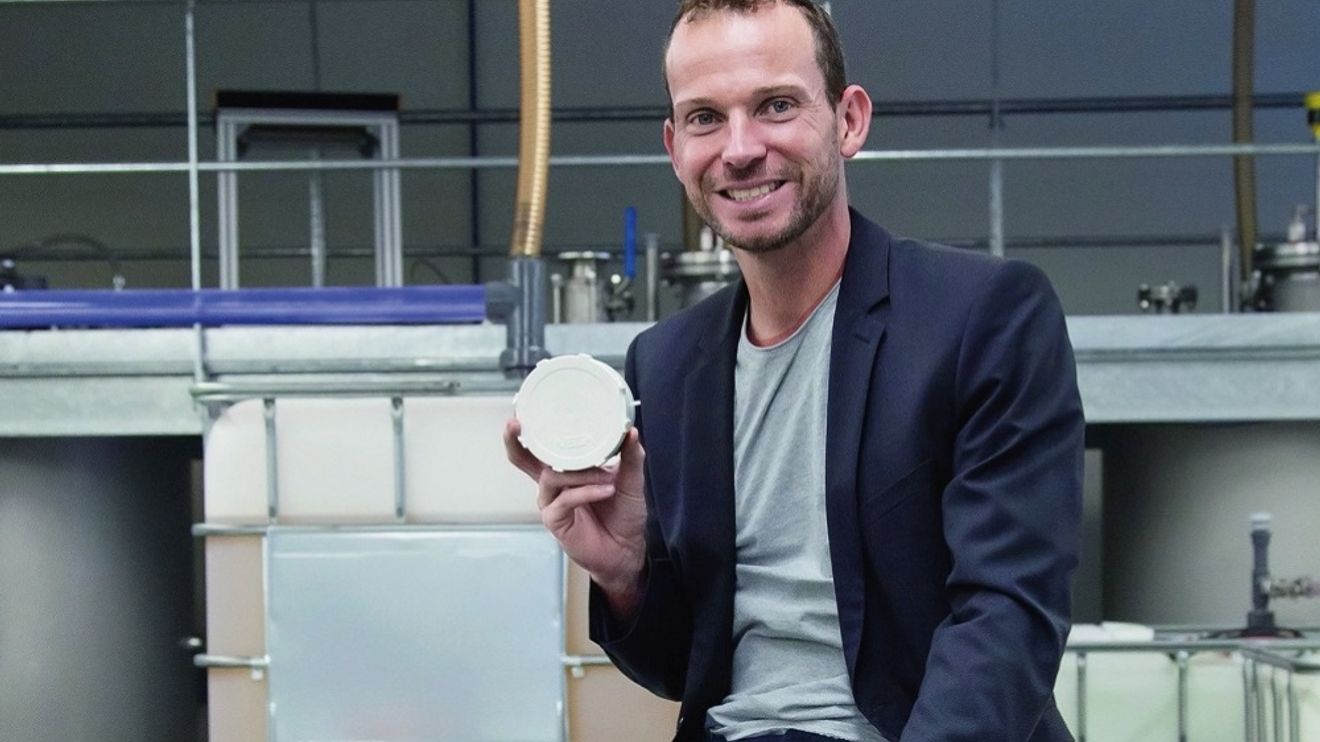
Mr. Hengstler, what are the main application scenarios for the new radar sensors for level measurement?
Clemens Hengstler: The stand-alone sensors based on our 80 GHz radar technology can be installed quickly via plug-and-play - regardless of whether they are used in mobile containers for liquids or bulk goods, IBC containers, transportable silos or tanks. Or stationary and remote containers, such as cisterns, catch basins and decentralized supply tanks, where no sensors were previously used because the installation and wiring costs were too high.
Why does the market need a new solution?
Today, there are still many containers in which the fill level is not recorded because it was previously too time-consuming and costly. Our sensors create transparency and make it possible to optimize processes, workflows and logistics. Cyclical processes can be designed to meet demand and consumption. This reduces costs and saves resources. Availability and security of supply are increased.
Summarized in a few sentences: What is special about the sensors?
The 'Vegapuls Air' sensors are battery-operated and can be installed in just a few simple steps. No cabling is required. The measured values are transmitted wirelessly. The user does not have to worry about the infrastructure: install the sensor, switch it on - done. Thanks to the integrated battery, runtimes of more than ten years can be achieved.
What measured values do the sensors record?
The self-sufficient devices record the fill level, temperature, GPS position, orientation and battery status in each container several times a day and transmit them wirelessly to the cloud.
How is communication regulated and how is the data transmitted?
Communication takes place via low-power wireless standards that have been specially designed for IoT sensors: firstly via LoRa, a standard that is currently used in smart cities. It allows the sensors to be integrated into a local LoRa network. There is also a mobile radio version. It uses NB-IoT or LTE-M, both of which are integrated into 4G and 5G. They are optimized for high range and penetration so that network coverage can be achieved even in the basements of buildings.
What about data security?
Security - a good keyword! We paid particular attention to this during development. The devices have end-to-end encryption in addition to the standard encryption of the wireless standards. Maximum security is guaranteed.


You might also be interested in
Select process connections as required
Vega's 'Vegabar' pressure sensors and 'Vegapoint' point level switches were to be the protagonists at this year's SPS, as they made Vega a full-service provider for level and pressure in food and pharmaceutical processes at the beginning of 2020.
 read more...
Clear control of the process statuses
A new generation of control units from Vega simplifies level and pressure measurement. With the high-contrast display of the Vegamet series, all options for clear visualization of measurement data are available.
read more...Limit switch masters sticky and viscous substances
Vega has developed the flush-mounted Vegapoint 24 point level switch especially for use with highly sticky, viscous or abrasive media. Even with the strongest build-up, it reliably detects the coverage status and indicates it with a colored...
read more...Use in the low temperature range down to -25 °C
As the successor to the UFA series, the ultrasonic sensors in Waycon's UFA2 series offer improved linearity (<0.4 % compared to <1 %) with the same measuring range of 20 to 200 mm.
read more...Sensor portfolio completed
With the Vegabar pressure sensors and Vegapoint point level switches, Vega has become a full-range supplier for level and pressure in food and pharmaceutical processes.
read more...3D system planning right from the start
A virtual journey can help to efficiently define the appropriate level, interface and pressure solutions for refining and petrochemicals in a refinery in advance. Vega demonstrates this using a 3D animation.
read more...Robust detection plus IO-Link
The ultrasonic sensors of the 'UB*-F42' series from Pepperl+Fuchs can detect objects and levels even under difficult conditions.
read more...Changes to the Endress+Hauser Executive Board
Three new people will strengthen the top management level of Endress+Hauser in the future: The Board of Directors has appointed Dr. Mirko Lehmann, Prof. Dr. Katja Windt and Helena Svensson to the Group's Executive Board.
read more...Industrial AI at SPS | Endress+Hauser
"AI will become a natural functional component"
Industrial AI is also becoming increasingly relevant in process automation: although field devices themselves still make little use of it, it is already proving helpful in evaluation and peripheral devices as well as control systems. Christian...
read more...