
Safety
Encoders fit for SIL2 and SIL3
The BiSS open source interface can now also be used for safety applications in accordance with SIL2 and SIL3. The previous protocol with its standard physical layer is retained.

The BiSS protocol was introduced in 2002 by ASiC manufacturer iC-Haus as an open source interface for automation technology. The aim was to achieve fast bidirectional sensor-actuator communication with simultaneous hardware compatibility with the established SSI interface (synchronous, serial). In addition to technical details, there are three prerequisites for today's globally used standard: the free license for applications, the stability and continuity of the protocol since its introduction and the physical layer compatibility with existing standard interfaces.
As far as the integrability and hardware realization of the user application are concerned, the electrical realization of the BiSS interface requires only two unidirectionally controlled lines in both the sensor and the drive (master). The use of standard RS422 transceivers ensures high interference immunity with low hardware costs.
Technical background

"BiSS Safety is a manufacturer-independent protocol for safe data that will help many users, as a broad base of sensors will implement the interface," explains Lothar Kübler, Managing Director of Fritz Kübler.
© Fritz KüblerBiSS makes it possible to send commands from the master to slaves without interrupting the sensor data flow, for example in a drive control system. Fast digital controls such as motor feedback systems benefit from this in particular. The interface uses an in-band protocol for this purpose and forwards fractions of a data word to the connected slaves with each cycle on the clock line. The bidirectional communication with in-band protocols can also be used in a variety of ways, for example for maintenance (condition monitoring) and temperature information (encoder and motor temperature).
BiSS defines standard information content such as serial number, manufacturer and product identification and an electronic nameplate (EDS) for encoders, which also offers the user the option of storing and reading out their own data - for example motor data - in the encoder. This standardization means that encoders from different manufacturers can be used interchangeably in control systems; there is no interface-related binding to specific component manufacturers. The BiSS interface has been released as an open standard and is disclosed as a manufacturer-neutral protocol definition. Processes and designs with BiSS are patented by iC-Haus and are part of the free license for BiSS device manufacturers. This license includes the use of the BiSS brand and the BiSS IPs as source code. More than 380 licenses have now been issued to manufacturers of encoders and controllers, among others.
Safety' growth market
Sin/cos analog transmissions combined with digital absolute information are usually found on the market for safety encoders. More complex protocols from the market leaders and proprietary solutions are also available.
The further development of BiSS for safety-relevant applications (BiSS Safety) was based on two requirements: firstly, to achieve SIL2 and SIL3 with the existing BiSS protocol and secondly, to maintain the physical interface for using existing and new sensors in current system developments. The first drives and encoders have already been announced by various manufacturers for 2016.
BiSS Safety is 100% based on BiSS C and uses all protocol options. The identification features, electronic data sheets and diagnostic options are fully retained.

The external structure of the encoder remains a point-to-point wiring as with a standard BiSS encoder. Internally, however, two independent sensors are used to generate the position data and safeguard the transmission. BiSS Safety uses the 'black channel' approach for safe transmission. Two independent position words are transmitted together in one cycle: the position data for control (Control Position Word) and the position data for safety monitoring (Safety Position Word). Both sensors use the BiSS bus structure within the device and record the respective position at the same time. The sensors can perform redundant or diversified position detection on a common code disk, for example using a combination of optical and magnetic technology.
The Control Position Word (CPW) offers increased resolution for precise control applications and is identical to the position word of a standard BiSS encoder with status information and CRC polynomial. Depending on the application, the CPW can be processed directly by a standard drive.
The Safety Position Word (SPW) provides the position for comparison with the CPW and offers a 'Sign-Of-Life' counter in addition to the standard status information. This counter distinguishes between a one-off start status '0' and consecutively counted cycles 1 to 63. The standardized length of 6 bits clearly covers periods in the millisecond range for typical cycle times. The CRC polynomial in the SPW with 16 bits also allows a high error detection rate or Hamming distance.
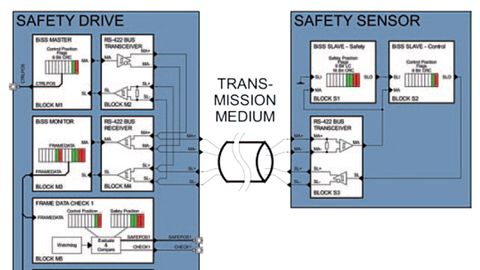
System structure of BiSS-Safety: Insight into a 'BiSS Safety Drive' and a BiSS Safety Encoder
© iC HouseMix-up errors or repetition errors are clearly identifiable due to the different structure of the CPW and SPW, combined with the serially arranged BiSS hardware structure. With BiSS Safety, the two independent position values of CPW and SPW are compared to check the transmission.
For manufacturers of BiSS Safety encoders, the infrastructure for identification, data transmission and calibration is retained. The internal system structure of the encoder is expanded using a combination of available modules.
For the manufacturer of BiSS Safety Drives, the infrastructure for data transmission and identification is retained. Communication must be implemented and monitored in the drive according to safety aspects. Existing hardware can be used for BiSS Safety for this purpose and existing concepts can be transferred.
The safety communication layer of BiSS Safety was tested by TÜV Rheinland in 2015 and confirmed to be suitable for safety-relevant communication up to and including SIL3 in accordance with IEC 61508:2010 in accordance with DIN EN 61784-3:2010-02.
Dr. Heiner Flocke, Managing Director of iC-Haus, explains an important aspect of BiSS Safety: "With BiSS Safety, the protocol and the physical interface and thus the user know-how acquired worldwide are retained. The existing standard and the protocol's own freedom are used for BiSS Safety."
BiSS systems are 'Industry 4.0' capable and meet all the features of digitalization. The market is responding with scheduled product innovations that also prepare BiSS Safety for communication via two lines as a 'BiSS Line'.
Author:
Marko Hepp is an application engineer at iC-Haus in Bodenheim.


You might also be interested in
Safety first
The development of cobots into a commodity product is closely linked to the issue of safety in robotics - a challenge that needs to be mastered efficiently.
 read more...
Locking with need for clarification - help with risk assessment
DIN EN ISO 1419 has already been available for five years. However, there are always uncertainties regarding the actual safety functions of a guard locking device, which the machine manufacturer must evaluate based on his risk assessment. Here is...
read more...Safe operation via radio - (how) does it work?
Many machine builders want to use tablets in addition to the existing machine operation. Demanded features such as WLAN, camera, multi-touch and much more are available here - but if safety functions are required, these devices reach their limits.
read more...Heavy-duty HRC requires new safety approaches
The topic of HRC is not just for 'lightweights'. In the field of heavy-duty robotics, solutions will also be in demand in the future that allow humans and robots to work together directly without the need for a safety fence. However, this requires...
read more...Secure hold in the slip ring
Transmitting safety-relevant data via slip rings is no trivial matter. Motion control experts from Kollmorgen have developed a TÜV-certified safety solution, including UL approval, together with slip ring manufacturer Stemmann-Technik.
read more...Validation neglected
EN ISO 13849 is decisive for the integration of safety-related control functions in machines. However, the part of the standard relating to validation is often neglected in practice - a major shortcoming.
read more...Dangerous movements well secured
How can dangerous movements be safeguarded? A challenge for the user, as there are a wide variety of functional and normative requirements. An overview.
read more...The intelligent safety switch
Safety modules and safety switches that communicate at I4.0 level simplify troubleshooting. However, the communication capability also has interesting potential for predictive maintenance and tamper protection.
read more...The vampire effect of quantification
There are always controversial discussions regarding the determination of risks for products and systems. But which approaches actually make sense in the context of safety and security? What approach does the new framework for safety and security -...
read more...