
Condition monitoring
Data collector ICE
In order to regularly monitor the condition of the rail network, Deutsche Bahn is also using control trains to monitor the infrastructure as part of its DB 4.0 digitalization strategy. Sensors scan the track bed with millimeter precision.
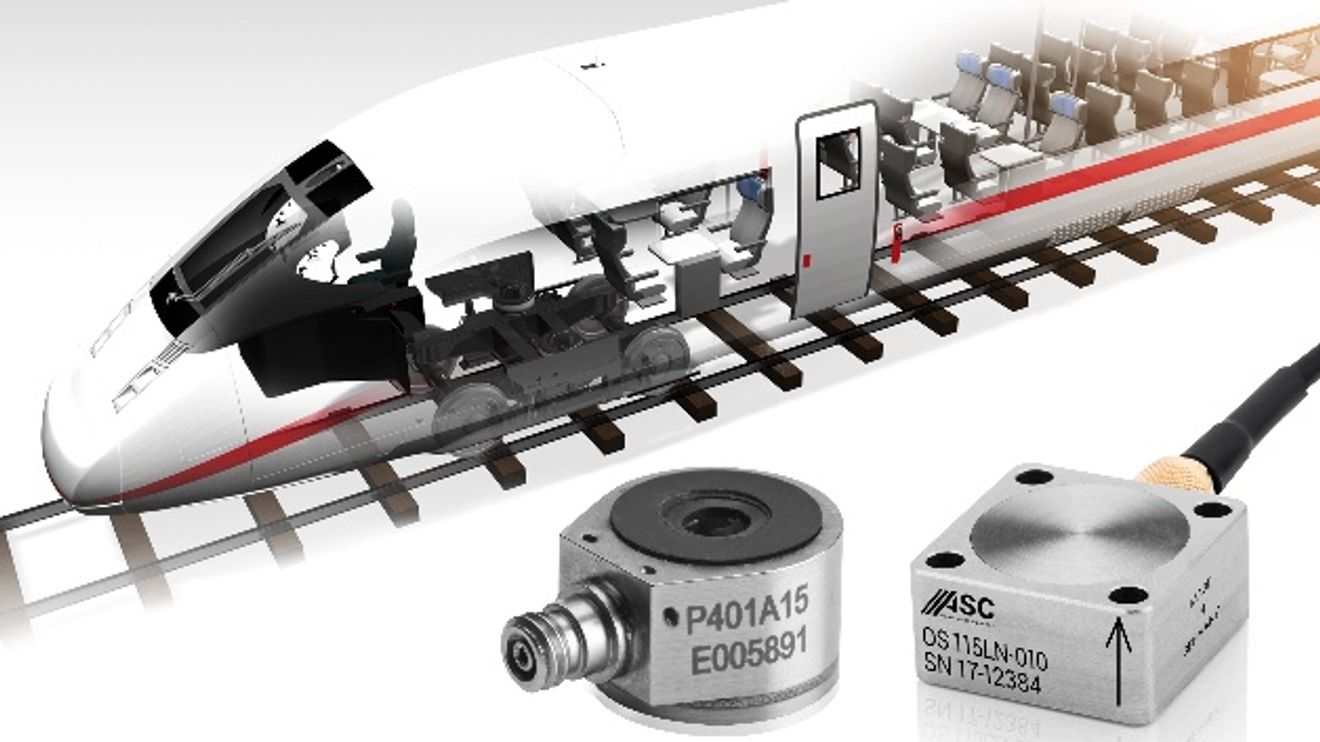
Three to four trains, including second-generation ICEs and ICs, are used for continuous condition monitoring. The idea behind this: When long-distance trains travel the route network day after day, they can collect data at the same time. DB Netz AG, which is responsible for the infrastructure, has commissioned DB Systemtechnik with this task within the Group. The main errors recorded are longitudinal level errors, which account for around 75% of all track geometry errors. The measurement runs help Deutsche Bahn to detect deviations in the track geometry before costly damage occurs. They supplement the regular inspections with track measurement trains, which are carried out at longer intervals - high-speed lines are usually inspected every three to four months and regional train lines once a year.
"Our aim is to monitor a large network of lines with just a few vehicles," explains Dr. Klaus Ulrich Wolter. He is the 'Continuous Route Monitoring' consultant at DB Systemtechnik in Munich and has been involved in setting up the measuring system from the outset. The main components of the system are sensors located in the bogie and inside the carriage body of a train. There is also a data acquisition system, a positioning system and a data transmission system. The locating system continuously stores the current position of the train so that the measured values can be assigned to a specific section of track. The data transmission unit in turn sends the complete data to DB Systemtechnik in real time. Here, the data is evaluated once a week and made available to the system managers for the relevant section. As the evaluation is largely automated, even data that is only a few hours old at the time it is sent can be included in the report.
Weekly monitoring
Around 2500 km of track are now monitored on a weekly basis. Long-distance trains with special sensors run on the busy north-south route between Bremen/Hamburg and Munich as well as on the Berlin - Cologne and Halle/Leipzig - Bremen routes.
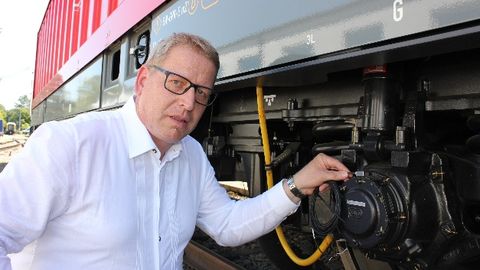
Dr. Klaus Ulrich Wolter was instrumental in developing the continuous condition monitoring system.
© DB Systemtechnik / Martin Loibl"On some routes, trains with measurement technology only run every two weeks, on others there are up to two per day," reports Dr. Wolter. "On average, however, the routes are used four times a week by a train equipped with measurement technology."
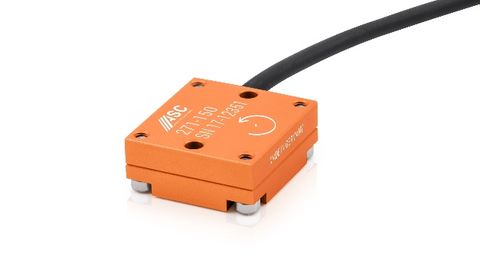
The data is recorded using acceleration sensors from ASC. In addition to uniaxial capacitive acceleration sensors, a piezoelectric version is fitted to the long-distance trains. The latter is one of the high-frequency IEPE sensors (Integrated Electronics Piezo Electric), which are robust, highly shock-resistant and hermetically sealed. Thanks to their maximum shock resistance of 5000 gpk, these sensors are particularly suitable for rail transportation with its high shock loads. A wide temperature range also plays an important role, as the temperatures at the measuring points on the trains can vary between around -30 and +70 °C.
Preventing track closures and delays
The sensors measure both the vertical acceleration at the wheelset bearings and the acceleration inside the car bodies. In this way, they primarily monitor the longitudinal height of the superstructure, which is made up of rails, sleepers and ballast.
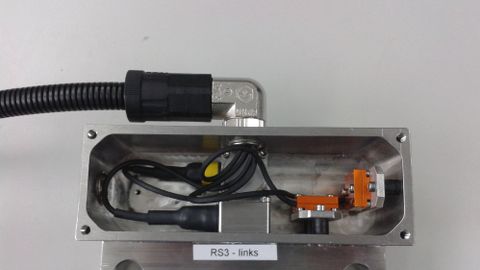
The sensors from ASC are installed in so-called 'sensor boxes'. They measure the vertical acceleration at the wheelset bearings and inside the carriage bodies and thus monitor the longitudinal height of the track superstructure.
© ASCThe focus is on measuring the longitudinal height, as this changes the fastest and deviations in this area have the greatest impact on operating quality. If there are errors in the geometry here, maintenance measures must be taken immediately or slow-speed sections set up.
The measuring ranges of the capacitive ASC acceleration sensors used by Deutsche Bahn are 2 and 50 g. Their signal-to-noise ratio is between 7 and 400 µg/√Hz, depending on the measuring range. The high sensitivity and shock resistance of the sensors are particularly important for continuous condition monitoring. Another decisive factor in the decision to use ASC sensors was the small size of the measuring systems, as the installation space in the so-called sensor boxes on the trains is limited.
In addition to the capacitive and piezoelectric acceleration sensors, DB Systemtechnik also uses angular rate sensors. These are based on MEMS technology and are particularly suitable for measuring track geometry errors in curves. One feature of the sensors is their bias instability of 9°/hr. They also offer a noise density of just 0.02°/s/√Hz and a low angle random walk (0.2°/√Hz).
Slow speeds minimized
Since the introduction of continuous condition monitoring, the mobile measurement technology has already been in use for more than 6,000,000 kilometers. On the basis of the data obtained, measures have been introduced that have significantly improved the quality of the track superstructure consisting of rails, sleepers and ballast - the number of slow running areas and track closures has been reduced by an average of 95%.
At the request of those responsible for the system, more and more lines are gradually being included in the monitoring. Although continuous condition monitoring is currently still limited to long-distance routes, Dr. Wolter is already thinking about expanding it: "The technology is also of interest for the extensive network of regional trains.


You might also be interested in
Acceleration sensors for low power applications
The ECO-x311 capacitive acceleration sensors from ASC have been specially developed for mobile applications with tight installation spaces. The inertial sensors can be used to cover a wide range of industrial measurement tasks.
 read more...
SensoPart and Cambrian Robotics
Partnership for 3D-Guided Robotics
Cambrian Robotics and SensoPart are jointly developing an AI-powered solution for 3D-guided robotic applications. The combination of vision sensors and AI is designed to simplify gripping and positioning processes.
read more...Expansion of the Sensor Portfolio
Infineon Completes Acquisition of ams Osram's Sensor Business
Infineon has completed the acquisition of ams Osram's non-optical analog/mixed-signal sensor portfolio. The business is expected to generate approximately 230 million euros in revenue in 2026.
read more...Technologies for precise data and analytics
From June 9 to 11, 2026, Sensor+Test once again brought together trade visitors from the fields of sensor technology, measurement, and testing in Nuremberg. With its focus on these core technologies and the wide range of application areas, the trade...
read more...Increased revenue and expanded production capacity
The Fraba Group, a manufacturer of sensors for industrial motion control, looks back on a successful 2025, during which both revenue and the number of employees increased.
read more...From sensor to intelligent system
Sensors, measurement technology and artificial intelligence are merging to form intelligent systems. From June 9 to 11, 2026, Sensor+Test in Nuremberg will showcase the most important trends in a changing industry.
read more...Technology and innovation center opened in Chengdu
Balluff has opened a technology and innovation center at its production site in Chengdu, China. The aim is to provide even more targeted support to local and international customers with solutions and expertise.
read more...Dr. Volker Frey becomes CTO
On May 1, 2026, there were personnel changes in the top management of the ifm group of companies. Dr. Volker Frey succeeds Benno Kathan as CTO, who has retired.
read more...Self-learning sensor systems monitor industrial manufacturing processes
In the 'GenSATIOn-Edge' project, the Fraunhofer Institute for Microelectronic Circuits and Systems IMS is working with partners to develop intelligent sensor systems for the continuous monitoring of industrial processes. AI models run directly on...
read more...