
60 years of Leuze
"The lasting success of our customers is our motivation"
Leuze is celebrating its 60th anniversary this year. Dr. Henning Grönzin, CTO and Technical Managing Director of the Group, provides an insight.

Dr. Henning Grönzin, CTO and Technical Managing Director of the Leuze Group
© LeuzeCongratulations on 60 years of Leuze! Looking back: What was the most significant technological development of your company?
If you want to be successful in the long term, there is no such thing as ONE most significant development. You have to keep innovating at regular intervals, keep up with the times and sometimes be a bit ahead of them. In the start-up phase of Leuze electronic, the 'RK03', the smallest diffuse reflection sensor in the world at the time, played a central role. It opened the door to the production of a series machine manufacturer and brought the first large, recurring quantities. However, the first barcode reader in the early 1980s - a few years after the barcode had even been introduced in Germany - and the development of the world's first safety laser scanner also played an important role in Leuze's current positioning. This first security laser scanner was not really 'secure' in today's sense because there was no standard for it at the time. This only developed in parallel to the product together with the BIA. Today, a safety laser scanner can be found on almost every automated guided vehicle system (AGV).
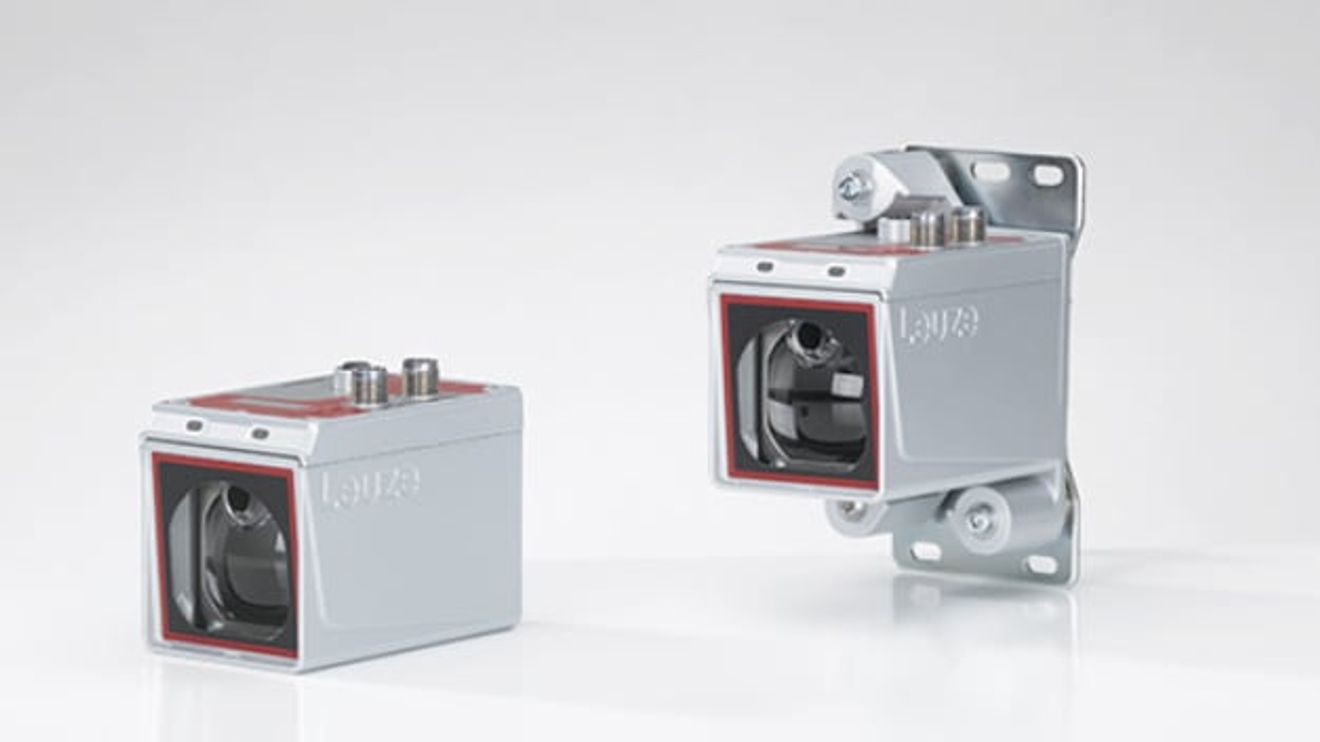
The AMS 100i is suitable for positioning applications in intralogistics and offers a modular mechanical design.
© LeuzeIs there an absolute 'bestseller' and what makes it so?
Here, too, there is no ONE bestseller. We have a few mainstays in each product area. One of them is our '5/5B' series, which we also call 'Global Beam'. This is an optical sensor that we offer in various versions. We deliver well over 1 million units of this series every year.
On the other hand, the 'AMS 300i', a sensor for positioning applications in intralogistics, plays a central role in our focus industry of intralogistics. In this positioning application, a position is not only approached once by a trolley and then measured, but the trolley is in constant motion at high speed. The sensor is used to determine the position with millimeter precision every millisecond. It not only determines the position, but also calculates braking and acceleration ramps.
And in the area of machine guarding, we have our safety light curtain, the 'MLC', which is available in various lengths, resolutions and configurations - including our patented 'Smart Process Gating' variant.
It's not all rosy in 60 years - what do you think was the most difficult time for the company?
The oft-quoted saying that the first million is always the most difficult certainly applies here. Entering the market as a start-up with your first own product, acquiring your first series customer, then building up a portfolio and a sales network: This initial phase was certainly the most challenging time in Leuze's 60-year history.

What does the roadmap look like for the next ten to 15 years?
Given the speed at which technology develops, it is practically impossible to predict what will be on our roadmap in ten or 15 years' time. What is certain, however, is that we will continue to develop our core portfolio in the field of optical sensor technology - including switching and measuring sensors, as well as our barcode readers and sensors for occupational safety - and adapt it to the needs of our customers. After all, the long-term success of our customers is our motivation and ultimate goal.
What technological trends do you see that are or will be important for Leuze?
The technological changes that are just around the corner are security issues, i.e. data-secure networks in the industrial environment. There is still a lot to do in this context. As sensor technology experts, however, we will certainly not take on a leading role here. But we will serve the needs of our customers in the same way as we have done over the last ten years in the context of the network connection of our sensor technology. The increasing use of neural networks and artificial intelligence in sensor technology is also very likely. AI is already almost standard in the field of imaging sensor technology, and we are also looking into this technology. The use of AI to process signals in non-imaging optical sensor technology is very likely only a matter of time.
What do you think will be the biggest challenge in the next few years, commercially and/or technically?
The industrial sensor market is a dynamic and growing one. The biggest challenge has been and will continue to be keeping pace with this dynamic, anticipating changing market needs and consistently developing products in line with these needs. In addition, global political developments and international interdependencies will certainly have an impact on industrial automation. However, the extent to which these influences will have an impact is not yet really foreseeable. The global shortage of materials over the past year and a half has given us a feeling for the extent of international interdependencies.


You might also be interested in
Sensor manufacturer gets new CEO
Xavier Hamers will join the Leuze Management Board as the new CEO and Chairman of the Management Board on April 1, 2023.
 read more...
Turnover grows by 25
Despite difficult economic and political times, Leuze has far exceeded its own ambitious growth targets for 2022, as CEO Ulrich Balbach explained at the annual press conference.
read more...The interactive e-paper of the winners
The interactive e-paper Computer&Automation "Products of the Year 2022" offers twelve categories, 36 winners and video interviews with the award winners at a glance! Click right in and experience the industry's pacesetters up close.
read more...Technologies for precise data and analytics
From June 9 to 11, 2026, Sensor+Test once again brought together trade visitors from the fields of sensor technology, measurement, and testing in Nuremberg. With its focus on these core technologies and the wide range of application areas, the trade...
read more...Sensors and measurement technology
Application start for AMA Innovation Award 2026
The AMA Association for Sensors and Measurement (AMA) is inviting scientists and developers from industry and research to apply for the AMA Innovation Award 2026. We are looking for research and development results in sensor and measurement...
read more...3D surface inspection and defect detection
The '3D ReflectControl' sensors from Micro-Epsilon are used for surface inspection and defect detection on highly reflective and transparent surfaces.
read more...Double focus
With the 'DCR 1048i OCV', Leuze is expanding its Simple Vision portfolio with a further functionality: The sensor can both read 1D/2D codes within an application and check the quality of a print using the OCV method.
read more...Mourning for Gisela Sick
Gisela Sick passed away on November 1, 2024 at the age of 101. She supported the company from the very beginning until it became the global group it is today.
read more...Record figures for Vision 2024
Vision, the world's leading trade fair for machine vision, will kick off with a record number of exhibitors on October 8, 2024. Around 500 exhibiting companies - more than ever before - will showcase their new developments and innovations to an...
read more...