
Mushroom
Target: zero risk!
The Italian company ACMI S.p.A., based in Fornovo di Taro, specializes in the production of high-end filling and packaging systems. Pilz provides support with their safety concept - from risk assessment to implementation.

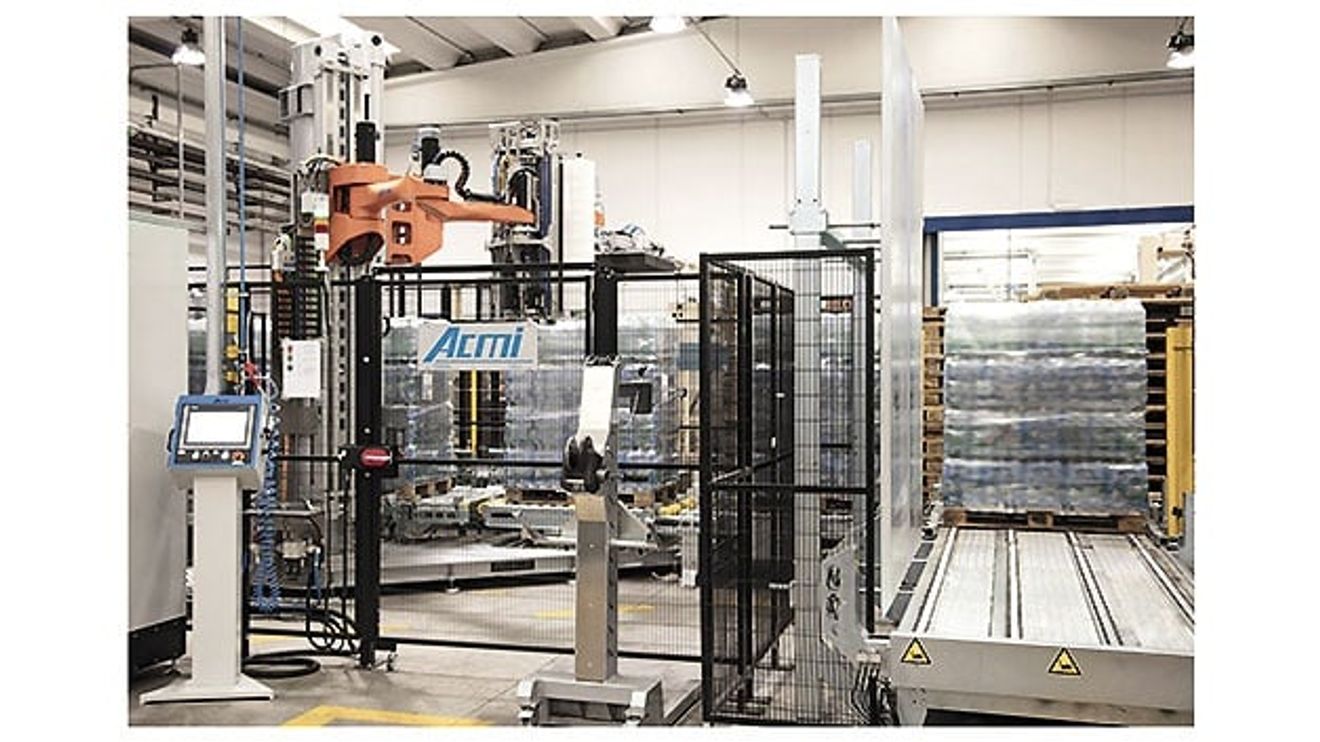
ACMI develops and installs turnkey systems for all areas of the food and beverage industry - including a mineral water bottling line for the Italian Compagnia Generale di Distribuzione and its 'Acqua Minerale Rochetta' line. This mineral water bottling line was to be able to fill 44,000 square 1.5-liter bottles per hour - fully automatically. The process behind this involves several steps: The blow molder-filler block is located at the plant entrance, where the so-called plastic preforms are blown, filled with mineral water and sealed. A complex conveyor belt system then guides the bottles through various stations. After a series of quality checks, they are finally passed through a drying tunnel. In this process step, the correct fill level and the correct application of the cap must be ensured. This is followed by the labeling and marking of the bottles. A further check is carried out to ensure that the labels are applied uniformly and accurately to the bottles before they are shrink-wrapped. In the final section of the interlinked machines, the carrying handles are first attached to the individual packs and the individual packs are then stacked on pallets by the 'palletizer'. At the system exit, so-called wrappers wrap the pallets with stretch film.

The bottles are transported to the various machine systems via a complex conveyor belt system. The Pilz solution ensures safety and therefore high productivity on the bottling line for mineral water.
© MushroomKeeping this operation running smoothly and productively at a very high cycle rate is only possible with reliable and efficient monitoring of the entire process.
In flow
Despite its size, the filling machine can currently be monitored by just three operators thanks to the fully automated operating sequence of the interlinked machine: The first is responsible for the machine area of the blow molder and filler, the second for manually loading the labels into the labeler and the third for the process step at the system output.
ACMI consulted Pilz as a long-standing partner to assess the possible risks involved in operating the interlinked machine and the protective measures required to protect the operating personnel. The task: to carry out a risk assessment of the individual plant components in accordance with the applicable standards and regulations - i.e. the packaging and carry handle machine, the palletizer and the two different wrappers and the loader. The interfaces between these machines and the parts of the system that do not originate from ACMI were also checked. Pilz also identified and documented the hazards in the life cycle of the machinery in order to determine the limits of the interlinked machinery. On this basis, the company then carried out a risk assessment with risk evaluation in order to develop optimal strategies and measures for risk reduction.
| Eight steps from risk assessment to CE marking |
|---|
|
From risk assessment to CE marking - what exactly needs to be considered? |
In a further step - i.e. during a second inspection - Pilz validated the implemented protective measures so that the so-called RESS (Requisiti Essenziali per la Salute e la Sicurezza, meaning: Essential Requirements for Health and Safety) could be drawn up to reduce the risk of accidents.
The RESS describes national, basic health and safety requirements in Italy, which are part of the European Machinery Directive 2006/42/CE. Pilz also implemented the technical documentation and the operating and maintenance manual for the entire production plant.
Aiming for zero risk

The non-contact safety switches PSENcode installed on the safety doors of the filling system meet the highest safety requirements. Thanks to the integrated evaluation and the standard interfaces, the safety switches are open to products from other manufacturers and can also be retrofitted.
© MushroomSuch risk assessments are essential to ensure the safety of machinery and are an efficient and appropriate way to minimize risk. Many of the tasks carried out by operators and service technicians have a high risk of accidents. For this reason, risk assessment is an essential factor for the design, modernization or series connection of machinery to check the level of safety achieved. It is also an effective tool for identifying possible further protective measures to be implemented.
At ACMI, the intuitive graphical user interface of the 'Safety Calculator PAScal' from Pilz made it possible to create the safety functions using predefined libraries, which accelerated the evaluation and testing of the performance level. It was also easier to calculate the performance level achieved in order to check the individual safety functions precisely.
The configurable safe small controller PNOZmulti 2 from Pilz monitors ACMI's filling and packaging plants as the central safety authority.
© MushroomThe safe control technology was also put to the test: in the ACMI plant, the configurable small controller 'PNOZmulti 2' monitors the safety functions. The 'PSENcode' non-contact safety switches installed on the plant's safety gates meet the highest safety requirements up to PLe (Performance Level) or SIL (Safety Integrity Level) CL (Claim Limit) 3 in accordance with EN ISO 13849-1 and EN IEC 62061. These safety switches enable position monitoring of guards and position monitoring. Based on RFID transponder technology, the coded safety switches offer both tamper protection and compliance with the minimum distance. A version with 'unique fully coded' - based on the lock-and-key principle - is also available.
Central safety instance monitors the system

The software tool PNOZmulti Configurator supports project planning, configuration creation, documentation and commissioning of the small controller PNOZmulti 2.
© MushroomThe safety controller offers the option of expanding the safety logic retrospectively and controlling safety functions such as speed monitoring. This solution allows intuitive operation and the flexibility that ACMI requires. The ability to connect the configurable safe small controller PNOZmulti 2 to the machine's existing automation system was made possible by using the 'PNOZ m ES Profinet' fieldbus, which can be used to communicate the status of the safety devices. This allows problems to be identified quickly and easily and ensures high productivity of the individual machine parts. Adaptation to other standard PLC controllers is also possible with just a few clicks in the 'PNOZmulti Configurator' software tool, so that both ACMI and the end customer remain flexible. The base unit 'PNOZ m B0' of the small controller centrally monitors the safety functions emergency stop button, safety gate sensors, operating mode selector switch and enabling switch.

Configuration is carried out using the 'PNOZmulti Configurator' software tool, which offers intuitive parameterization (or configuration) of software and hardware. By using different safety gate sensors and emergency stop buttons, it was possible to optimize the number of cable connections and simplify the installation process. A CRC check was recorded in the technical documentation and can be shown on the integrated display of the base unit PNOZ m B0 together with the project name and creation date when the small controller is started. This check guarantees the clarity and integrity of the project. Online diagnostics via the PNOZmulti Configurator allow the status of the safety devices to be viewed directly. Fault stack and diagnostic data always make it possible to identify the problem immediately.


You might also be interested in
The interactive e-paper of the winners
The interactive e-paper Computer&Automation "Products of the Year 2022" offers twelve categories, 36 winners and video interviews with the award winners at a glance! Click right in and experience the industry's pacesetters up close.
 read more...
Protection for the weakest link
Industrial security is a 'moving target'. This means that everyone involved must also keep moving and constantly put the available tools to the test. This also applies to user administration.
read more...Protected against water jets and dust
The safety relays in the 'Tethys IP65' family from Zander Aachen include the Tethys IP65 SR safety relay and the Tethys IP65 KR safe coupling relay. Their housing functions as a mini switch cabinet and requires no additional protection.
read more...Solenoid interlock functionally extended
Schmersal has equipped the electronic solenoid interlock 'AZM40' with new accessories and new features.
read more...Security technology for today and tomorrow
Tailored to the needs of customers from various industries, EUCHNER develops and produces solutions that safeguard guards on machines. This minimizes hazards, protects people and makes processes more efficient at the same time.
read more...Germany is top 3 target for ransomware attacks
A recent report by the Var Group sheds light on the cyber security situation in Europe. The so-called Y-Report shows a significant increase in security incidents; the manufacturing industry is particularly affected.
read more...Risk reduction in hazardous environments
Monitoring pumps in industrial processes is more than just a protective measure for the pump unit. In addition to preventive maintenance and the recording of operating data, ignition source monitoring has become increasingly important, especially in...
read more...Components made from biomass-balanced plastics
Siemens Smart Infrastructure and BASF have presented the first electrical safety product that contains components made from biomass-balanced plastics.
read more...Motto "Sustainable!"
The EU Commission has presented a proposal for a new Ecodesign Regulation for Sustainable Products (ESPR), which is to become a central component of the European Green Deal. Schmersal is also already on the road to sustainability.
read more...