
Schmersal
Safety for set-up operations
The safety function 'Safely limited speed with safety gate open' is relevant for set-up operation or troubleshooting on machines. Below is an example of a safety solution with a redundant encoder and safety controller.

In the case of larger machines or systems - for example in the packaging industry - the operator is usually protected from dangerous movements by a safety fence or enclosure. Access to the danger zone is possible via a door. From the point of view of machine safety, in addition to the safety functions 'protection against unexpected start-up' and 'stopping via emergency stop device', a further safety function must often be guaranteed: the 'safely limited speed (SLS) when the safety gate is open'. The SLS function makes it easier for the operator to set up a production system or carry out troubleshooting.

An exemplary structure of the safety function: In addition to the encoder for detecting the speed, the evaluation logic, such as the 'PSC1' safety controller from Schmersal, and the drive itself, the monitoring of the safety gate must usually also be included in the consideration, as the SLS function is generally activated with this.
© SchmersalA current white paper from Schmersal and Wachendorff presents an exemplary safety solution for such a system, which includes a redundant encoder and a small safety controller, and provides assistance in evaluating the safety-related suitability of this solution. In order to determine and verify the required safety level, the EN ISO 13849 series of standards is used in this example. The risk assessment has resulted in a performance level (PLr) of d for the machine in question. This can be implemented in various ways. Category 3 is usually suitable for technical implementation. It requires single-fault safety, which is typically achieved through a consistent two-channel design.
The use of a rotary encoder is ideal for measuring the speed. In addition to the encoder, the evaluation logic - such as the 'PSC1' safety controller from Schmersal - and the drive itself, the monitoring of the safety gate must usually be taken into account, as the SLS function is generally activated with this safety gate.
In this structure, consideration of the rotary encoder for speed detection is particularly relevant.
The easiest way to achieve the required dual-channel capability would be to use two separate encoders, which would have to be mounted at different locations in order to be mechanically dual-channel. In practice, however, this is often time-consuming and difficult. It is more practical to only have to use one mounting position. The rotary encoder from Wachendorff combines these two properties: it consists of two completely independent encoders with different technologies in one housing. In addition to the simplified installation, the internal redundancy also allows the requirements of category 3 to be met.
The redundant encoder
A redundant encoder basically consists of two completely self-sufficient standard encoders, which means that the entire electronic part of the encoder can be regarded as a two-channel system. Only the mechanical structure, consisting of the shaft and bearing assembly, is designed as a single-channel system. The standard for electric drives EN 61800-5-2 stipulates that the fault must be considered by disconnecting the mechanical connection between the encoder and the drive. In many cases, fault exclusion is required, as the control system cannot necessarily detect such a fault. This fault exclusion can be achieved by dimensioning the mounting elements accordingly and using a 100 % reliable mechanical connection.
Wachendorff encoders are based on the principle of diversity. This means that reliability is specifically increased by using different measuring principles and therefore using as few identical components as possible. The basic idea here is that the different sensor platforms also react with different levels of sensitivity or insensitivity to faults of any kind and therefore do not fail at the same time, so that the downstream electronics can reliably detect this possible failure.
The redundant standard encoder provides diverse (magnetic and optical) signals that are generated completely independently of each other, but can still be correlated with each other. Even the supply voltage is available separately for each sensor unit.
Subsystem 'Speed detection'
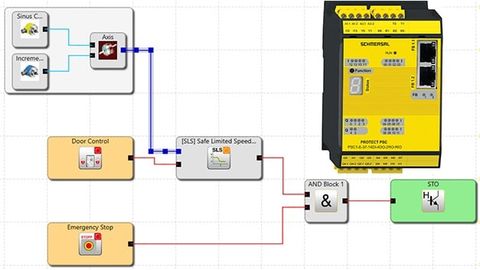
The PSC1 safety controller and the programming of the application in SafePLC2. Category 3 requires, among other things, fault detection (DC). In the example described, this takes place via the 'PSC1' safety controller. Function blocks for the most important monitoring functions are already integrated in the 'SafePLC2' programming tool of the 'PSC1' and the probability of errors is minimized due to the simple programming.
© SchmersalThe single-fault safety required by category 3 is ensured by the continuous two-channel speed/direction detection in the encoder. The fault detection (DC) also required is not integrated in the encoder and must therefore take place in the evaluation logic.
The 'PSC1' safety control series from Schmersal is a good example of this. If required by the application, it can be used to safely monitor up to twelve axes. The encoders can be easily connected via D-Sub interfaces. By cross-comparing the two encoder signals or, in the case of sin-cos encoders, by evaluating the relation sin²+cos²=1, any errors that occur are detected and an error response is initiated. In addition, the 'SafePLC2' programming tool of the 'PSC1' already contains function blocks for the most important monitoring functions in accordance with DIN EN 61800-5-2, for example SLS, SOS (Safe Operating Stop) or SCA (Safe Cam, safe position monitoring). These can be easily integrated into the safety logic program.
Error exclusion

Particular attention must be paid to the mechanical coupling between the encoder and drive, which is only designed with a single channel due to the principle. This makes it necessary to exclude faults due to failure of this connection, as even a single fault would lead to a dangerous situation.
In addition to proof of the maximum load capacity of the connection, the EN ISO 13849 standard requires that an FMEA (Failure Mode and Effects Analysis) is carried out for this fault exclusion.
Other aspects that are necessary to fulfill category 3 according to EN ISO 13849 include measures to avoid common cause failures (CCF Common Cause Failure), the avoidance of systematic failures in the software of the small safety controller, the calculation of a failure probability of the control solution based on MTTFD values (Mean time to failure dangerous) and/or a higher quality diagnosis (DC - Diagnostic Coverage). Taking these aspects into account, the white paper finally calculates the performance level for
for this exemplary safety solution. See also: https://bit.ly/2R7hqiN.

Steffen Negeli is a product manager and member of the technical sales team at Wachendorff Automation in Geisenheim.
© SchmersalA performance level of d can be achieved with the structure described. The possible PL in the example calculation is essentially limited by the PL of the frequency inverter. Despite the partial use of standard components, it is therefore possible to achieve a high level of safety. The use of the redundant encoder makes installation easier. And in conjunction with the 'PSC1' safety controller, it is also possible to implement additional safety functions such as emergency stop or the monitoring of additional safety circuits with just one device.


You might also be interested in
A new management team
On July 1, 2021, the shareholders restructured the management of the Hima Group. The previous CEO Sankar Ramakrishnan left the company at the end of June.
 read more...
Safety - the winners!
Nomen est omen: The people behind the award-winning products were certainly delighted to receive the award in the Safety category. The winners at a glance.
read more...Sensorless standstill detection of drives
With the 'SSW303HV', the Schmersal Group presents a sensorless standstill monitor that offers significant improvements compared to the predecessor models of the 'AZR' and 'FWS' series - including its universal application options.
read more...Predictive maintenance simplified
The Schmersal Group is launching the Safety Fieldbox with Profinet/ Profisafe fieldbus interface, which opens up new safety-related solution options especially for the packaging industry.
read more...Solenoid interlock functionally extended
Schmersal has equipped the electronic solenoid interlock 'AZM40' with new accessories and new features.
read more...Subsidiary founded in Vietnam
The Schmersal Group has founded a new subsidiary in Ho Chi Minh City, Schmersal Vietnam Co. Ltd.
read more...Motto "Sustainable!"
The EU Commission has presented a proposal for a new Ecodesign Regulation for Sustainable Products (ESPR), which is to become a central component of the European Green Deal. Schmersal is also already on the road to sustainability.
read more...K.A. Schmersal at the Hannover Messe
Door handle system with seven colors
The 'DHS' door handle system from Schmersal combines the functions of a robust door handle with the display of various machine statuses via the illumination of the handle.
read more...These are your winners!
We put 96 products in twelve categories to your vote in December, and now the winners have been chosen! The trophies were presented at a 'Winner's Dinner' at the Seehaus in Munich. These are your "Products of the Year 2024"!
read more...