

Collaborative robotics
Modular safety strategy for cobot concepts
When it comes to the question of safety in automated environments, the answer to date has usually been simply 'emergency stop'. With the advent of collaborative robots, new, much more powerful and flexible solutions are now required.

Automation, assembly lines and robots are nothing new in industry, nor is the implementation of safety functions in safety-relevant applications. As far as the latter is concerned, the 'emergency stop' mode is usually the first choice. This is either activated manually or triggered by additional or correspondingly cost-intensive auxiliary systems such as light barriers or video cameras. Once the fault has been rectified, the assembly line or production robot must be completely restarted, which usually results in longer delays.
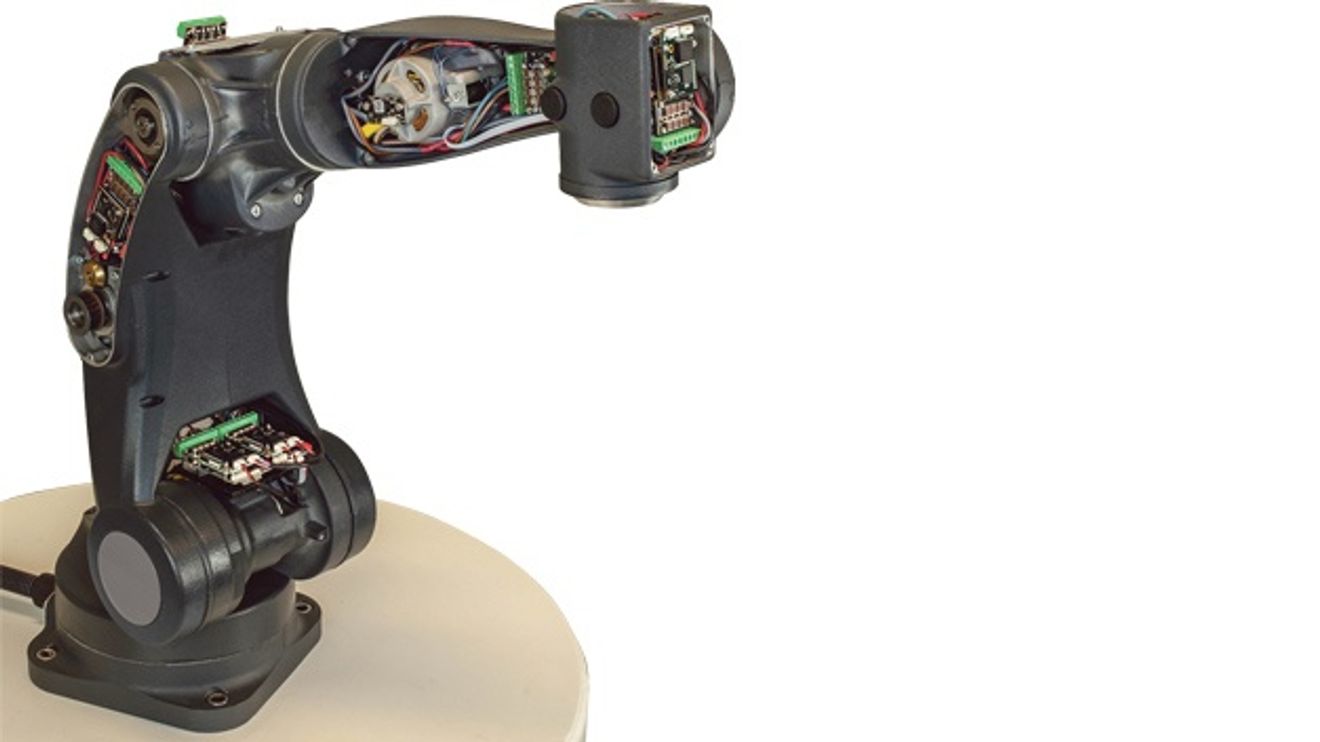
One trend with cobots is that the intelligence is increasingly located in the joint - or on the axle.
© SynapticonAs far as robotics in particular is concerned, safety functions in the field of motion control have also often been reduced to a single point: the safe torque off (STO) integrated into a drive. In view of the increase in electronically controlled motion control, however, this will no longer be sufficient in future. Instead, depending on the application or the electronics used, a variety of different safety requirements must be taken into account. In addition, safety systems must be able to react faster and faster. The following aspects play a role in this context:
- The increasing demand for human-robot collaboration (HRC) requires a new level of intrinsic functional safety of robotic arms if 'robot cages' are to be avoided.
- In addition to HRC, autonomous mobile logistics is currently experiencing enormous growth. However, in factory environments where humans and mobile robots move side by side, advanced functional safety is the key to smooth work processes.
- Interrupting production for machine maintenance can be very expensive. Safe motion control enables system designs that support uninterrupted maintenance operations, which has a positive impact on the total cost of ownership.
- Last but not least, the industry demands cheaper or less complex - i.e. 'leaner' - safety solutions with less cabling.
Stop functions can be found in both EN 60204 and ISO 13849 and define the same three functions with different titles: Stop Category 0 (Safe Torque Off), Stop Category 1 (Safe Stop 1) and Stop Category 2 (Safe Stop 2). These functions can now be integrated into the drive and enable a variety of more flexible stop and safety limitation options.
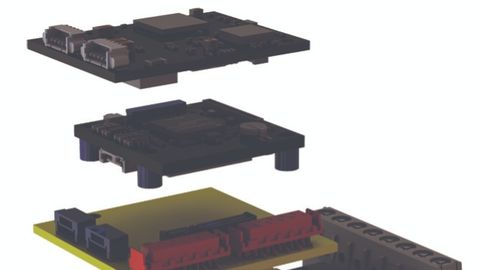
The 'Safe Motion Module' (yellow) is located in the Somanet node between the sensor/actuator interface board and the processor board.
© SynapticonEN 61800-5-2 also provides a systematic method for identifying the safety function. It therefore defines the various 'Safe Motion Modes' and divides safety functions into 'Stop Functions', 'Safe Motion Functions' and 'Safe Brake Functions'.
With this in mind, Synapticon has set out to integrate such safe motion functions directly into decentralized servo controllers for the first time. Until now, this was only possible with safety PLCs, which implement these functions centrally and with additional hardware. The result is embedded safety modules that are integrated decentrally into the controller on each axis.
To understand: A servo drive, which is realized with the so-called Somanet modules from Synapticon, consists of three modules: communication module (Com), processor module (Core) and drive module (Drive). One of the main ideas behind Somanet is to eliminate the control cabinets for the robot controller as far as possible through decentralization. There are different standard options for each of the modules mentioned, as well as the possibility of implementing application-specific solutions. The new Safe Motion Module (SMM) is an optional fourth component that is installed between the core and drive. This enables the safety module to monitor, generate and receive safety-critical signals without being dependent on the software in the servo drive.
Safety in the drive controller
The Safe Motion Module is designed for SIL3 (Safety Integrity Level) via FSoE (Fail Safe over Ethercat). The supported safety modes include safely limited speed (SLS) and position (SLP) as well as safely limited torque (SLT). The integration of such safe motion control functions directly into the drive controller offers several advantages:
- A safety PLC (programmable logic controller) can be omitted for most applications. The complete safety handling is shifted to the individual drives.
- Less cabling is required throughout the entire robot arm - for example between redundant encoders and a safety PLC - which reduces costs, complexity and susceptibility to faults.
- Faster signal processing due to shorter paths increases safety.
- Decentralized safety functions - i.e. local 'reflexes' - can be implemented. This means, for example, that a touch-sensitive surface (robot skin) can be connected directly to the servo controller. This reacts directly to sensor events and switches to the correct safety mode accordingly. Normally, the skin would report to a higher-level instance, which in turn switches and monitors the safety mode.
- Cost savings compared to conventional safety solutions thanks to reduced system complexity. This means that robot manufacturers can dispense with the Safety PLC in many applications. In addition, a safe encoder can be saved if two cost-effective, non-safe encoders can be used instead. The effect is even stronger for torque monitoring: only one non-safe sensor is required here, as the safety-relevant redundant signal comes from the current controller itself.
- Faster 'power cycles', i.e. very fast switching on and off.
- Increased productivity, as machines can be accessed in safe mode without having to switch them off. Conventional safety, on the other hand, usually only switches to emergency stop mode. However, the few solutions that already go into 'Safe Motion' today are very complex and cost-intensive.
The SMM supports two encoders and can therefore also guarantee safe motion modes with non-safe encoders. It also offers analog inputs that can be used for extended safety sensors such as touch-sensitive surfaces. This eliminates the need for additional hardware for the safe data request normally required for such artificial 'skins'.
Finally, it is important to emphasize: While safety functions on robotic drives can be of great benefit; they are not a complete safety solution. Rather, the complete robotic system must always be considered when assessing overall safety.
Author:
Nikolai Ensslen is the founder and CEO of Synapticon.


You might also be interested in
Safety first
The development of cobots into a commodity product is closely linked to the issue of safety in robotics - a challenge that needs to be mastered efficiently.
 read more...
Locking with need for clarification - help with risk assessment
DIN EN ISO 1419 has already been available for five years. However, there are always uncertainties regarding the actual safety functions of a guard locking device, which the machine manufacturer must evaluate based on his risk assessment. Here is...
read more...Safe operation via radio - (how) does it work?
Many machine builders want to use tablets in addition to the existing machine operation. Demanded features such as WLAN, camera, multi-touch and much more are available here - but if safety functions are required, these devices reach their limits.
read more...Heavy-duty HRC requires new safety approaches
The topic of HRC is not just for 'lightweights'. In the field of heavy-duty robotics, solutions will also be in demand in the future that allow humans and robots to work together directly without the need for a safety fence. However, this requires...
read more...Secure hold in the slip ring
Transmitting safety-relevant data via slip rings is no trivial matter. Motion control experts from Kollmorgen have developed a TÜV-certified safety solution, including UL approval, together with slip ring manufacturer Stemmann-Technik.
read more...Validation neglected
EN ISO 13849 is decisive for the integration of safety-related control functions in machines. However, the part of the standard relating to validation is often neglected in practice - a major shortcoming.
read more...Dangerous movements well secured
How can dangerous movements be safeguarded? A challenge for the user, as there are a wide variety of functional and normative requirements. An overview.
read more...The intelligent safety switch
Safety modules and safety switches that communicate at I4.0 level simplify troubleshooting. However, the communication capability also has interesting potential for predictive maintenance and tamper protection.
read more...The vampire effect of quantification
There are always controversial discussions regarding the determination of risks for products and systems. But which approaches actually make sense in the context of safety and security? What approach does the new framework for safety and security -...
read more...