
Fraunhofer IFF
Safe HRC from the planning phase
Without collision measurement and biofidelic measurement systems, it has not yet been possible to determine the maximum permissible speeds of a cobot. This is now set to change.

Since their introduction, collaborative robots (known as cobots) have proven to be an important building block in the automation of production. Thanks to their endurance and precision, combined with the skills and cognitive abilities of humans, they make a decisive contribution to sustainably improving working conditions, product quality and efficiency in the direct vicinity of people. For the fenceless operation of cobots, the power and force limitation safety mode (in accordance with DIN EN ISO 10218-2 and ISO/TS 15066) specifies the requirements in the event of contact with humans by the robot. According to DGUV information FB HM-080, the risk assessment of robots in power and force limitation mode must include a metrological examination of the biomechanical force and pressure loads that can occur in the event of a collision with a human (impact and clamping). Only when the measurement shows that the robot does not exceed the biomechanical limit values from ISO/TS 15066 is the application considered safe.
Until now, it was only possible to determine the maximum permissible robot speeds with the aid of collision measurement and the biofidelic measuring systems required for this. However, the increasing number of cobots installed to date makes it clear that this practice is associated with a high investment risk: if the collision measurement shows that the cobot exceeds the biomechanical limit values, it is usually necessary to reduce its speed, which is generally to the detriment of its cost-effectiveness. In the worst case, the profitability of the entire application is lost at a time when a large part of the investment costs for the procurement and installation of the cobot have already been incurred. Until now, there has been no solution that reliably shows whether the robot will achieve the specified cycle times at the maximum permissible speeds during the planning phase of an HRC application. The Fraunhofer IFF has now developed such a solution on behalf of the Berufsgenossenschaft Holz und Metall (BGHM): The 'Cobot Planner' is a web-based tool that supports cobot users in designing their HRC applications safely and economically at the same time. Designed as an intuitive application, the Cobot Planner shows after just a few mouse clicks exactly at which speeds safe human-robot collaboration is still possible if humans and robots can touch each other and the biomechanical limit values from ISO/TS 15066 must be adhered to. The tool is available free of charge to all cobot users and planners of HRC applications at http://www.cobotplaner.de.
The 'Cobot Planner'
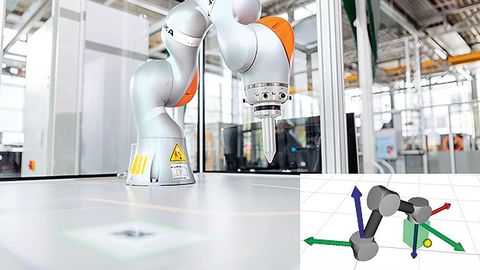
The visualization of the robot model in the 'Cobot Planner'. A simplified 3D model of the robot illustrates its state at the time of the collision and the position of the collision point.
© Fraunhofer IFFUsing the intuitive user interface of the Cobot Planner, users describe their robot application and the potential collision risks in three steps.
Step 1 records various details from the robot data sheet, such as the total weight or the maximum torques of the individual axes. A three-dimensional visualization of the robot model illustrates the entries. Step 2 records the data on the robot tool, such as its shape and weight. In step 3, the user describes the hazard. Analogous to risk assessment, the term hazard here is synonymous with a snapshot of the situation immediately preceding a possible collision.
Precise knowledge of the situation is necessary as it has a considerable influence on the collision event and therefore also on the level of collision forces and pressures. For example, the spatial conditions at the point of collision determine whether the collision is an impact or a clamping collision, and thus indirectly also how high the maximum speed of the robot may be before the collision. The parts of the human body at risk have a further influence on the speeds, as ISO/TS 15066 specifies a different biomechanical limit value for each. The position of the robot arm, its direction of movement and the procurement of the collision point also have a relevant influence on the effect of a collision. The cobot planner provides examples of selection options for the transmission of these and other influencing parameters, between which the user can choose interactively.
After creating a hazard, the Cobot Planner simulates the described collision and uses the results to determine the maximum permissible speed at which the robot is very likely to comply with the biomechanical limit values when the collision occurs. The output includes the maximum axis and TCP speeds. Based on the calculated speeds, the user can estimate the achievable cycle time and thus evaluate the cost-effectiveness of the entire application.
Protected user data and technological basis

The visualization of the robot model in the 'Cobot Planner'. A simplified 3D model of the robot illustrates its state at the time of the collision and the position of the collision point.
© Fraunhofer IFFUser input may well contain confidential information. To protect it from unauthorized access, the Cobot planner does not save the input data. The server on which the web application runs is configured so that it irrevocably deletes all entries as soon as a user has been inactive for more than 30 minutes. To save the input data permanently for later reuse, the user can download the entire Cobot Planner workspace and save it locally. The next time the tool is used, it is then sufficient to upload the workspace again. This very simple data interface ensures that the data remains with the user.
The Cobot Planner's upload function also makes it possible to load models - for specific robots, for example - from other sources. This would eliminate the need to create a robot model yourself. The idea is for robot manufacturers to offer their own models for their robots, which users can load directly into the Cobot Planner. The Fraunhofer IFF is making an initial compilation of various robot models available free of charge at http://www.aroundrobots.com.
The plan is to continuously expand the Cobot Planner's range of functions until 2025. By the end of 2021, for example, it should be possible to switch between German and English. In addition, new body parts that are not yet selectable will be activated this year. The regular updates will also include selective improvements and corrections that users can report back to the Fraunhofer IFF via the Cobot Planner.
The technological basis
The technological basis for the Cobot Planner and its simulation section are various models that precisely simulate collision events and their effect on humans. The models include a hazard model, a dynamic robot model and a biomechanical model of the human being.
The hazard model is a structured data model that records the situation immediately preceding the collision on the basis of relevant characteristics and reproduces it for later simulation. The robot model takes into account the dynamic influence of the robot on the collision. It represents the robot as a multi-body system (MBS), which is parameterized before the simulation based on the user input. To make it easier for users to get started with the Cobot Planner, the Fraunhofer IFF has deliberately limited the input options to information that the user can also find in the robot's data sheet. A statistical regression model then estimates the missing model parameters from the inputs and transfers them to the robot model. The development of the regression model was preceded by a statistical analysis of the cobots available on the market. This showed that the numerous mass parameters of the FMD correlate with the total weight and maximum torques of the axes.

The author: Dr. Roland Behrens is Group Leader INS (Model-based HRC Integration and Safety) at the Fraunhofer IFF, Robot Systems Department, in Magdeburg.
© Fraunhofer IFFBefore each simulation, the Cobot planner reduces the complex MBS model to a sufficiently accurate substitute model. Thanks to the reduction, the otherwise very long simulation time is shortened while the accuracy of the results is maintained. Other parts of the model reflect the influence of the robot controller. As the control systems of the individual robot manufacturers differ greatly, the model is limited to basic control principles, such as those of safety functions. In principle, the Cobot Planner can also process robot models whose description contains all the necessary data and the exact control algorithms.
The human biomechanical model is based on data and findings from numerous and globally unique test subject studies conducted by the Fraunhofer IFF on behalf of the German Social Accident Insurance (DGUV) and the BGHM from 2015 to 2019. In the Cobot Planner, the human model calculates a separate force-deformation curve for each selected body part, as would occur in the event of a collision at the point of contact. Each characteristic curve then precisely reproduces the biomechanical behavior of the corresponding body part in the simulation. The cobot planner uses the robot model and the characteristic curves to simulate the collision separately for each selected body part. It then returns to the user the lowest speed that resulted for the most highly stressed body part.
The Fraunhofer IFF has experimentally validated the Cobot Planner's simulation results together with doctors from Otto von Guericke University's Department of Trauma Surgery. In the tests, test subjects were subjected to light impacts from a representative cobot. As soon as the test subject felt a slight sensation of pain above a certain collision speed, the ongoing test was terminated. The experiments took place with the involvement of the responsible ethics committee and under the supervision of doctors. The results show that the experimentally determined speeds scattered within the usual variance around the speeds determined by the cobot planner from the simulation.
Further development
The Cobot Planner technology is the result of the Fraunhofer IFF's preliminary work on the Computer-Aided Safety research focus. In this area, the Fraunhofer IFF has been working on practical and semi-automated methods for the reliable planning of HRC applications since 2017. The Fraunhofer IFF already has market-ready software solutions for power and force limitation as well as speed and distance monitoring (in accordance with DIN 10218-2 and ISO/TS 15066) that can be easily integrated into existing software for planning robot applications. The Fraunhofer IFF is currently working on further validating the technology used in the Cobot Planner. The medium-term goal of the work is to establish a reliable and fully digitalized alternative to collision measurement.


You might also be interested in
Practical examples for cobots
Universal Robots (UR) can be found at Motek with a large number of practical applications.
 read more...
Working safely with cobots
At the Fraunhofer Institute for Factory Operation and Automation IFF in Magdeburg, the European COVR project is researching and promoting the 'safety' aspect of collaborative robotics in practice.
read more...Secure cobot installations
When it comes to safety, cobots place high demands on the knowledge of their human colleagues. A digital service developed by European research institutions aims to help companies share knowledge and carry out safe cobot installations.
read more...Hiwin is a partner in the UR+ ecosystem
The drive specialist Hiwin is a partner in the UR+ ecosystem and gives the cobots a greater range with a 7th mechanical axis.
read more...Human-robot collaboration / cobots
New ISO standard for the measurement of collision forces
In collaboration with numerous international partners, robotics experts at the Fraunhofer IFF have developed a new ISO standard that shows how contact forces and pressures on cobots will be measured in a standardized way in the future. The ISO...
read more...Robotics&AUTOMATION 3/2021
Is an industrial robot without a cage really safe? What needs to be considered in the planning phase of human-robot collaborations? And what does a gecko have to do with robotics? The latest e-paper from Robotics&AUTOMATION provides the answers.
read more...Digital twin for process plants
More efficient thanks to intelligent assistance system
A digital twin that reliably predicts the status of process systems is the aim of the TwinGuide research project. The aim is to expand the capabilities of the digital twin.
read more...Working safely with cobots
At the Fraunhofer Institute for Factory Operation and Automation IFF in Magdeburg, the European COVR project is researching and promoting the 'safety' aspect of collaborative robotics in practice.
read more...Secure cobot installations
When it comes to safety, cobots place high demands on the knowledge of their human colleagues. A digital service developed by European research institutions aims to help companies share knowledge and carry out safe cobot installations.
read more...