
BASF / Merck
Robotics in process automation
Robotics and the autonomy of systems promise high added value in the long term - especially with regard to demographic change. How can such systems support the digital transformation in the chemical industry?
The use of robots in industry is nothing new. With their origins in the automotive industry, robotic arms have long since found their way into production and packaging lines in the process industry. In addition to the typical articulated arm robots, Scara and Delta robots also have their applications in industry and have been ensuring increasing efficiency and quality ever since.
The degree of complexity of the respective task is within clear and usually narrow limits. The increase in quality and efficiency is generated by high repetition rates with very precise repeat accuracy.
A few years ago, collaborative robots emerged as experience with robot applications grew in conjunction with the desire to automate more and more and to see the robot as part of the working environment. These offer extended functions in the human-machine interface and have the advantage of a compact design.
These applications focus on automating highly repetitive work processes and standard processes that are physically demanding for humans. They therefore bring significant improvements and make an important contribution to occupational health and safety. However, this is by no means the end of automation: the trend towards transforming factories and production facilities into sustainably functioning environments is what makes concepts such as predictive maintenance, digital transformation and autonomous robots conceivable in the first place.
Modernize existing systems
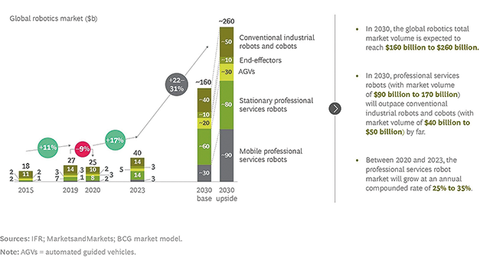
Outlook Global development of the robotics market (link BCG). In the global robotics market, the share of mobile service robots will increase significantly compared to stationary technologies in the not too distant future.
© IFR; MarketsandMarkets; BCG market modelSome systems in the industry have served their purpose for many years, but would require time-consuming and costly upgrades with technology in all automation layers in order to provide a broad and usable data set. This is where another application for robotics comes into play: inspection robotics.
An inspection robot can, for example, be a mobile platform equipped with an application-specific sensor payload. A high degree of autonomy allows this platform to adapt to changing conditions, to access and evaluate previously defined points of interest or to pass on information to higher-level systems. For example, analog display instruments, fill levels and valve positions can be checked and pump running noises can be evaluated; the search for leaks can also be automated in this way.
In summary, this increasingly involves the automation of complex and individual activities. Further developments and a stronger interlinking of robotics, digitalization and artificial intelligence will also be important in the context of the challenge of the expected shortage of skilled workers.
What are the requirements?
What does this mean for companies that already consider mobile inspection robotics to be one of their key technologies today or in the foreseeable future in order to ensure their competitiveness? Preparing for this new technology in terms of technology, processes and society creates new questions and challenges.
From a technical point of view, it is a matter of describing the requirements for a functional and safe end-to-end robot application. One major problem here is that the innovative field of inspection robotics is not yet represented in the world of standards. This leads to uncertainty when introducing and operating such systems. The range of topics to be addressed extends from machine and plant safety to cybersecurity issues and the aspects of occupational safety and data protection.
In order to use autonomous inspection robots efficiently, it is necessary to adapt or further develop existing working methods. This involves 'thinking together' operational processes and autonomous systems - and acceptance by employees is essential: only if the technology is seen as support and an improvement can it ultimately make a positive contribution.
In addition to the aforementioned requirements, however, the question also arises as to what solutions the market currently offers specifically for the chemical industry. Is it in a position to meet the existing requirements?
The AIRA Challenge
Together with industrial partners, robot manufacturers and integrators, the chemical industry is supporting the further development of these technologies with a view to making them ready for the market. As part of the innovation competition 'Advanced Industrial Robotic Applications Challenge' (AIRA Challenge for short), BASF, Bayer, Boehringer Ingelheim, Merck and Wacker, under the patronage of NAMUR, have joined forces with the company Invite to look for innovative and autonomous solutions to automate routine activities in chemical plants.
The parts of this article series to be published in later issues will show what such autonomous solutions could look like, what challenges they pose for users and how these could be overcome.


You might also be interested in
Robotics & Automation - The pacemakers 2023
The robotics market has been experiencing enormous growth for years. The mechanical helpers are used in many sectors - industry, logistics, retail and medical technology. They can be used to increase productivity, efficiency and accuracy in...
 read more...
Robotics to overcome the shortage of skilled workers
Around half of employees in Germany see robots as a way of helping to overcome the shortage of skilled workers - according to one of the results of the automatica 2023 trend index, for which a market research institute surveyed 1,000 employees in...
read more...Products of the year - The e-paper special
"Products of the Year 2023" goes interactive: the new e-paper including video news is here! The winners of the readers' poll have been chosen and in our interactive special edition you will find all the winning products at a glance and exclusive...
read more...The NAMUR 'Robotics' working group
The automation of complex and individual activities requires a strong interlocking of robotics, digitalization and artificial intelligence. What does this mean for system integrators and manufacturers in Europe when it comes to operating inspection...
read more...The AIRA Challenge
Robotics and the autonomy of systems promise high added value in the long term. The 'Advanced Industrial Robotic Applications Challenge' innovation competition was launched to see how the process automation market is prepared for this.
read more...Industrial companies feel little
Concerns about the next corona wave are growing. The sickness rate is also rising. What does this mean for the country's industry?
read more...The IIoT in a test scenario
technologies from the fields of Industrial IoT and Industry 4.0 'just like that' in process engineering systems for chemical and pharmaceutical production? At Merck, they are first put through their paces in the plant's drinking water storage system.
read more...Flexible modular system
Shorter time-to-market is playing an increasingly important role in the process industry and this must be mapped early on in the product life cycle.
read more...Winner of 'Jugend forscht 2018' chosen
The winners of the national final of 'Jugend forscht 2018' have been announced: at the end of May, Federal Education Minister Anja Karliczek presented the awards to the talented youngsters. The winners from technology, computer science, earth and...
read more...