
Endress+Hauser
The IIoT in a test scenario
technologies from the fields of Industrial IoT and Industry 4.0 'just like that' in process engineering systems for chemical and pharmaceutical production? At Merck, they are first put through their paces in the plant's drinking water storage system.

The products manufactured by Merck 's three business sectors include numerous biotechnologically produced pharmaceuticals - including ultrapure laboratory water or highly sensitive diagnostic tests as well as products and services for industrial microbiology. In addition, the company also produces material solutions for electronic semiconductor production, the automotive and cosmetics markets, for example. In production, the main focus is on continuously increasing efficiency and safety, but also on sustainability - the company has set itself ambitious climate targets. To achieve these goals, Merck is focusing on smart sensor technology and connectivity solutions, among other things. The IIoT ecosystem 'Netilion' from Endress+Hauser is currently being tested in this context.
Unsuitable test scenario

If redundant instrumentation is used in the drinking water storage test scenario and different devices are used, the displayed values can be directly compared with each other and conclusions can be drawn.
© Endress+HauserIn production facilities, however, device and technology tests would be associated with a high level of risk. In the biotechnology sector, for example, plants are subject to GMP regulations that make it virtually impossible to temporarily replace one measuring device with another for testing purposes without a conformity check. In chemical production, on the other hand, ubiquitous explosion-protected areas or SIL safety devices make it difficult to test new technologies. In addition to regulatory restrictions and plant safety requirements, there are also practical reasons for not carrying out tests in productive plants: For example, the ongoing process would have to be interrupted to replace a measuring device, but this would be too costly.
Proof of concept in drinking water storage

For these reasons, Merck identified the drinking water storage facility as the ideal environment for proof-of-concept scenarios. This system acts as a drinking water storage facility for the entire plant in Darmstadt. On the one hand, the storage serves to increase the security of supply, as the drinking water supply can be maintained from the buffer storage tanks in the event of external supply interruptions. The two storage tanks cover slightly more than the plant's daily requirements. As the plant's drinking water requirements fluctuate greatly, the drinking water storage tank is also intended to balance out the fluctuations in withdrawal from the municipal network - the inflow from the supplier now takes place evenly over 24 hours. The storage system and the supply to the internal network are fully redundant, so that the water supply can be maintained even in the event of a burst water pipe in the plant. Should the internal drinking water supply nevertheless fail, the system switches back to the municipal supplier.
At Merck, the drinking water storage facility is considered ideal for testing technologies and trying out technological innovations - partly because it does not have any explosion-protected areas and all areas of the facility are easily accessible. In addition, Merck uses the same assets in this plant that are also used in chemical and pharmaceutical production.
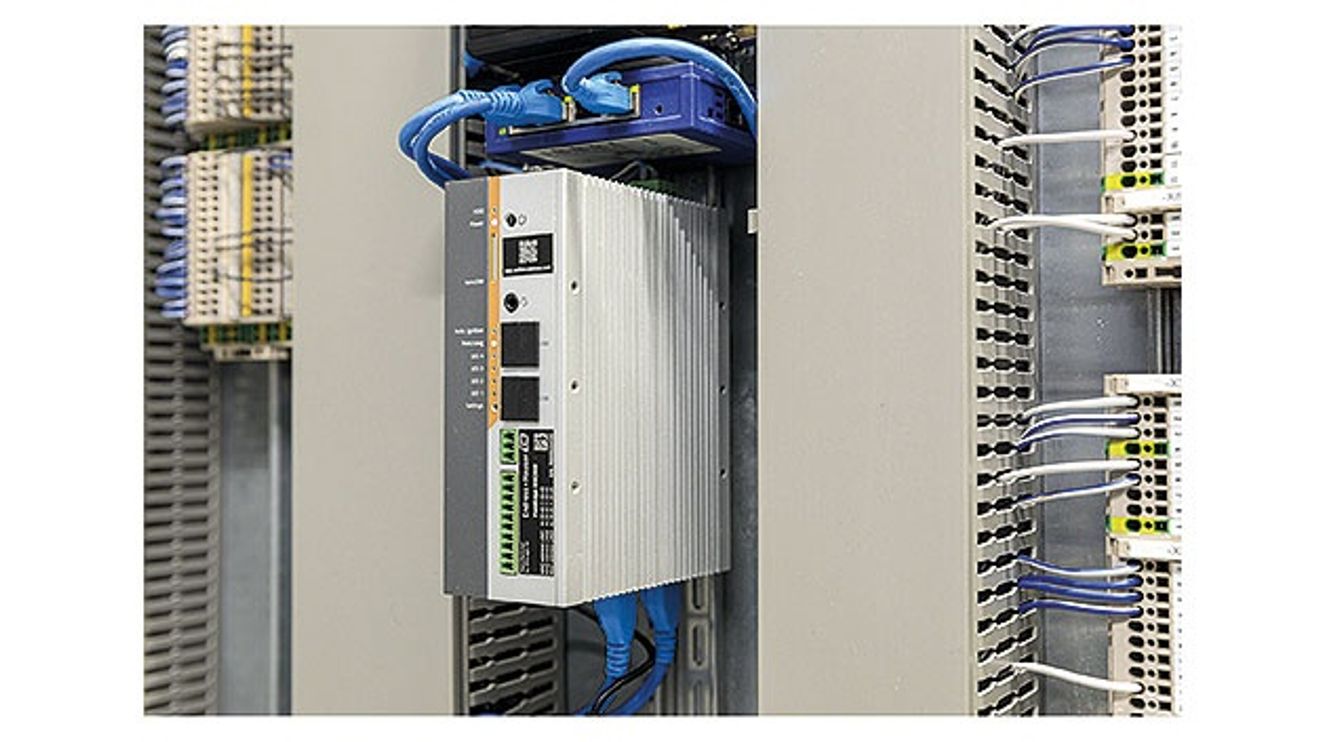
The FieldEdge SGC500 connects the measurement technology with the Netilion IIoT ecosystem in the control cabinet.
© Endress+HauserFor example, the IIoT ecosystem Netilion is being tested, as are augmented reality applications with lidar scanning from other providers. As various innovations are being tested in parallel, the new technologies are linked together. For example, the asset information from Netilion can be integrated into the augmented reality application. Netilion can act as a data platform and make the processed data available to other systems via Connect and API. The redundancy of the drinking water system makes it easy to replace devices. The system also offers sufficient space for extensive installations and expansions as well as for various tests. The aim behind the various pilot projects is to To use new technologies that have proven themselves in drinking water storage in production areas and roll them out to the entire plant.
Measurement technology and cloud solutions in test operation
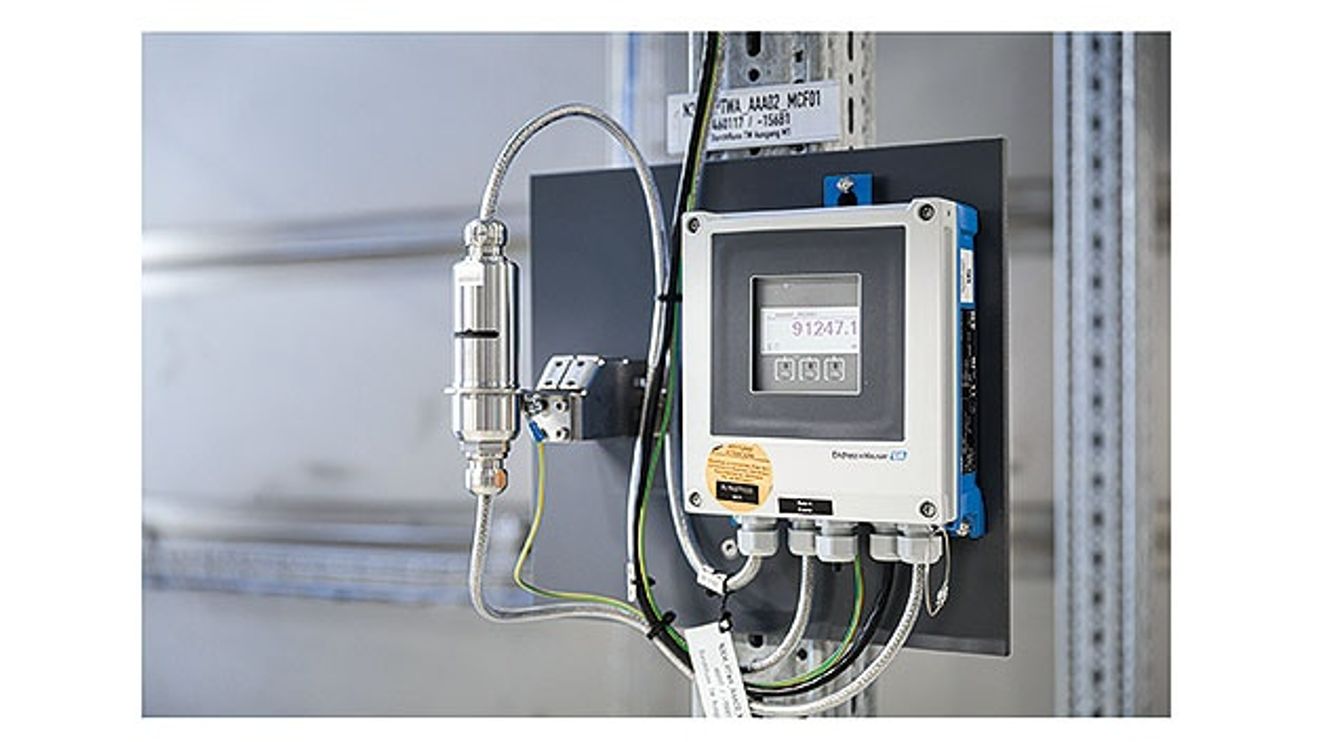
The FieldPort SWA50 WirelessHART adapter (left) can be retrofitted to existing systems and brings measuring devices into the cloud.
© Endress+HauserIn addition to Netilion, the tests will also focus on various new measuring devices from Endress+Hauser. These measuring instruments cover a wide range of measurement parameters: In addition to temperature sensors and pressure transmitters, an analysis panel for test measurements of the chlorine concentration in drinking water, the cloud-only level measuring device 'Micropilot FWR30' or the magnetic-inductive flow meter 'Promag W' with 'Heartbeat Technology' are also used.
Thoroughly testing devices also means stressing them: for example, the Promag W flowmeter simulates ageing or build-up in order to gain insights into the devices in productive use. For example, the electrodes could be manipulated, whereupon the device's internal heartbeat diagnostics would then issue corresponding error messages and maintenance requirements. One wish for the future is for a test cycle to run automatically in the sensor and for a report to be created automatically. This would mean that maintenance personnel would no longer have to be sent to the device for routine checks. This function, known as heartbeat verification, is part of many smart measuring devices. In order for it to be used in practice, it must be implemented in the work processes. So what already works technologically cannot always be implemented 1:1 in practice.
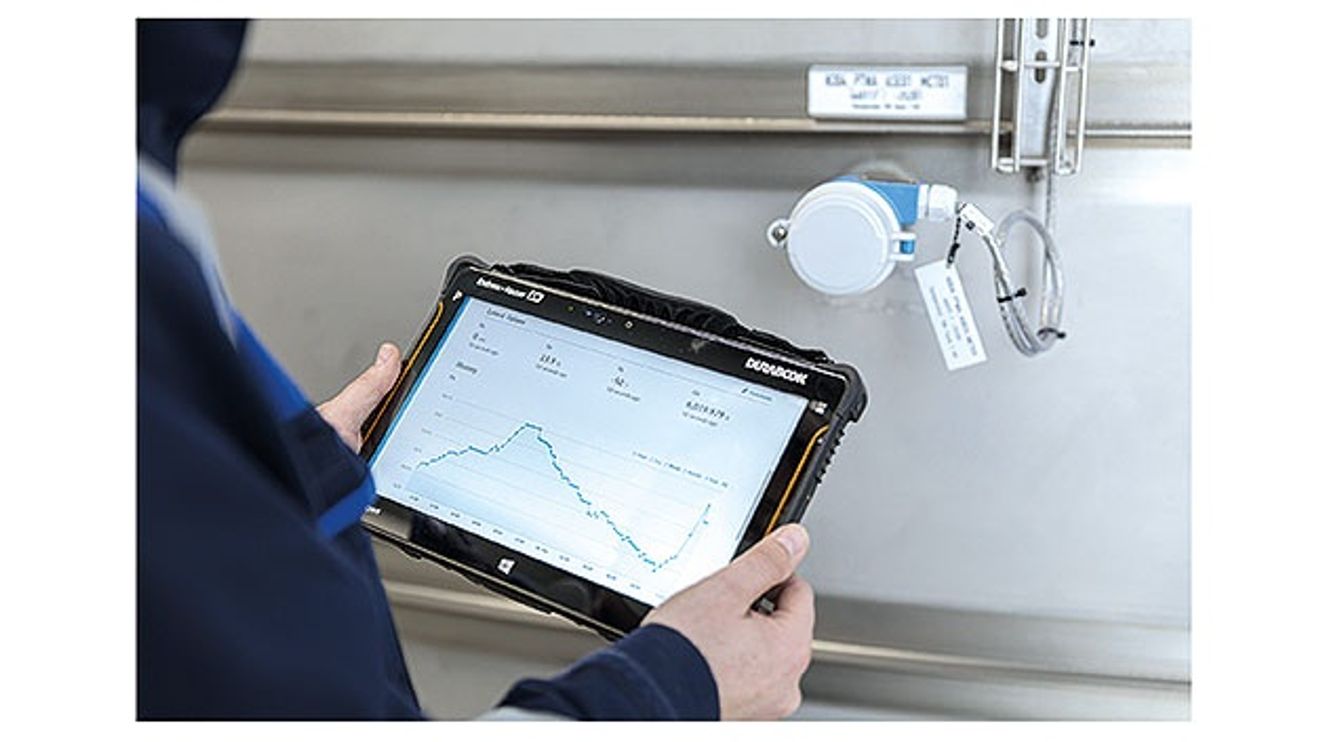
Netilion Value visualizes the measured values on clear dashboards, for example on a tablet PC such as the Field Xpert SMT70 from Endress+Hauser.
© Endress+HauserMerck sees great potential for the new IIoT technologies currently being tested in the maintenance and servicing of systems: the plan is to carry out maintenance as condition-based as possible in the future. Maintenance is currently carried out at fixed intervals, which costs money and resources. In future, maintenance intervals are to be dynamically aligned to the needs of the sensor.
This can be illustrated using the example of a billing-relevant flow measurement, which is also used in drinking water storage: this is either tested annually on a test bench or the device is monitored continuously. The savings in working time and the positive effects on system availability are obvious.
Retrofitting WirelessHART
With the WirelessHart adapter 'FieldPort SWA50', any HART-capable measuring point can be integrated into the WirelessHart network. The device is loop-powered and can be retrofitted to all HART-capable measuring points with little effort. This allows any measuring point to be brought into the cloud. The robust adapter also works with third-party manufacturers, so that at Merck all assets in the plant in the neighboring building could theoretically be integrated into Netilion with the FieldPort SWA50 via WirelessHART. The data can be used with the IIoT ecosystem to generate an overview of the plant, develop predictive maintenance strategies, optimize calibration intervals or implement mobile asset management, for example.
Level measurement values on digital dashboards
The author: Florian Kraftschik is Sales Marketing Manager Communication at Endress+Hauser Germany in Weil am Rhein.
© Endress+HauserAnother new device from Endress+Hauser in the test is the cloud-based level measuring device 'Micropilot FWR30'. It was placed on a plastic tank containing an educt for the chlorine generator. The device works completely without cables and transmits its measured values directly to the Netilion cloud via mobile radio. The measured values and other data - such as the current position, battery status or outside temperature - are displayed in the Netilion 'Value' application on various dashboard views that can be accessed via smartphones, tablet PCs or stationary computers. The visual display of data and information offers great added value: employees can see at a glance whether the system is running within its specifications.
Gaining experience in the test environment
Merck in Darmstadt has had very positive experiences with testing new technologies such as smart sensors and Industry 4.0 solutions in the drinking water storage test environment before they go live. The devices are tested under real conditions and know-how about the technology used is gathered before it is then used for other systems and incorporated into the plant's own standards. In this environment, the hurdles in terms of regulations, Ex and SIL requirements are low. The findings from the tests can then be transferred to the instrumentation for new construction or modernization of systems.


You might also be interested in
Change in the Executive Board
There will be a change on the Executive Board of the Endress+Hauser Group, as Chief Sales Officer Nikolaus Krüger is retiring. He will be succeeded by Laurent Mulley (54) on January 1, 2023.
 read more...
Follow up with Stefan Messerkliger, B&R
"The same mistakes!"
In industrial manufacturing, OPC UA is regarded as the data exchange format of the future. In the world of mobile machinery, such an agreement is still missing. Stefan Messerklinger calls for OPC UA to be introduced in this sector too.
read more...Increased sales and profit
Endress+Hauser put the coronavirus pandemic behind it economically in 2021 with strong growth. The Group's consolidated sales increased by more than 11%.
read more...Analysis expertise bundled
On January 1, 2022, Endress+Hauser merged the two subsidiaries SpectraSensors and Kaiser Optical Systems into the newly formed company Endress+Hauser Optical Analysis.
read more...Pressure transmitter with additional Bluetooth interface
Endress+Hauser is relaunching the 'Cerabar' and 'Deltabar' pressure measuring devices. The devices offer simplified document management; the documents can be accessed via a QR code on each nameplate.
read more...The top 10 articles in August 2024
The top 10 articles from Computer&Automation in August 2024. Readers were most interested in these reports.
read more...Sick and Endress+Hauser establish joint venture
Sick and Endress+Hauser have signed an agreement to jointly drive forward the decarbonization of the process industry. The companies are establishing a joint venture for this purpose.
read more...Digital twins on the rise
Digitalized processes along the entire value chain require a digital twin. Behind this virtual image of a real object is a wealth of data and algorithms that are used to simulate, control and improve processes.
read more...Strong growth recorded
The specialist for measurement technology and automation solutions increased its consolidated turnover in 2023 by 11% to over EUR 3.7 billion and created 715 new jobs worldwide.
read more...