
IFR
Robot density in Germany at record high
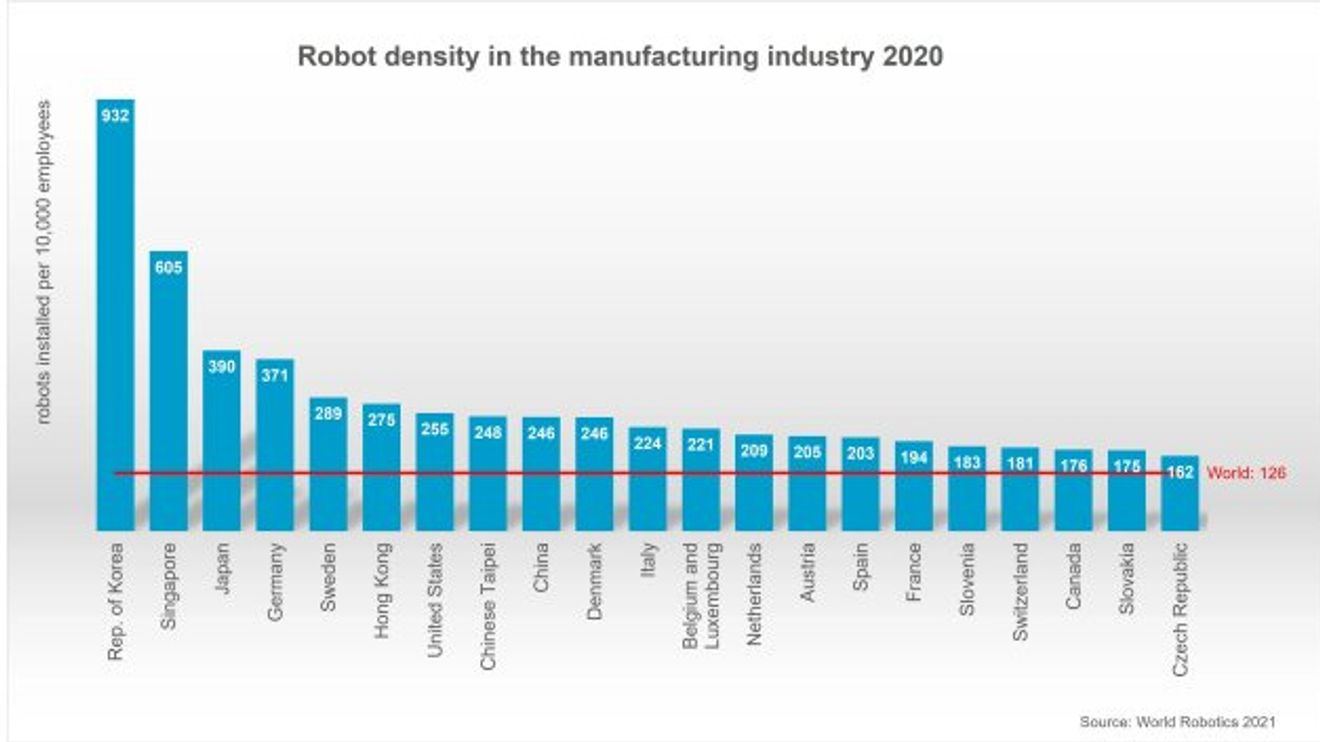
Germany is the most automated economy in Europe: according to the IFR, robot density - i.e. the number of industrial robots per 10,000 employees - has risen to a record 371 units (2020).
With a total of 230,600 units, Germany has a 38% share of the total number of industrial robots in operation in Europe. These are the findings of the World Robotics 2021 Report, which is published by the International Federation of Robotics (IFR).
"Robot density is a very important metric to understand the differences in the level of automation in different economies," says Milton Guerry, President of the IFR. Globally, the average robot density has almost doubled over the past five years, rising to 126 units per 10,000 employees in 2020 (2015: 66 units).
Broken down by region, the average robot density in Western Europe is 242 units, in North America 167 and in Asia/Australia 134. The five most automated countries in the world are South Korea, Singapore, Japan, Germany and Sweden. France has a robot density of 194 units (16th place worldwide). This puts Germany's neighbors well above the global average of 126 robots and puts them in a similar position to other EU countries such as Spain (203 units), Austria (205 units) and the Netherlands (209 units). EU members such as Sweden (289 units), Denmark (246 units) and Italy (224 units), on the other hand, achieve a significantly higher level of automation through the use of industrial robots.
The UK is the only G7 country with a robot density of 101 units, which is below the global average (126 units) and puts it in 24th place. However, the trend here is also pointing upwards: Five years ago, the robot density in the UK was 71 units. The exodus of foreign workers following Brexit has increased the demand for robots in 2020. This trend is likely to continue in the near future. The modernization of the manufacturing industry is being promoted by the government through a massive tax incentive, the 'Super Deduction': From April 2021 to March 2023, companies can claim 130% capital allowance as tax relief for investments in plant and machinery.
From a global perspective, China is developing the most dynamically: due to the very strong installation figures, robot density rose from 49 units in 2015 to 246 in 2020. This puts China in 9th place worldwide today - a big leap compared to 25th place, which the Middle Kingdom held just five years ago. Asia is also home to the country with the highest robot density in the world: South Korea has held this position since 2010, exceeding the global average by a factor of seven with 932 units. Since 2015, robot density has increased by an average of 10% every year. With its internationally successful electronics industry and strong automotive industry, the Korean economy has two sectors that are among the largest customers for industrial robots.
Japan is in third place worldwide, ahead of Singapore (605 units): In 2020, 390 robots per 10,000 employees were installed in the manufacturing industry. Nippon is the world's leading manufacturer of industrial robots: the production capacity of Japanese suppliers reached 174,000 units in 2020. Japanese manufacturers now supply 45% of the global supply.
Robot density in the USA rose from 176 units in 2015 to 255 units in 2020, putting the country in seventh place worldwide - ahead of Taiwan (248 units) and China (246 units). The modernization of domestic production facilities has boosted robot sales in the United States. The use of industrial robots is making a significant contribution to achieving decarbonization goals, for example in the cost-efficient production of solar cells and in the further transition to electric vehicles. Several car manufacturers have already announced investments to equip their factories for new vehicle models with electric drives or to increase battery production capacities. These major projects will increase the demand for industrial robots in the coming years.


You might also be interested in
International Federation of Robotics
New president elected
The Executive Board of the International Federation of Robotics (IFR) has elected Marina Bill from ABB as President. At the same time, Kenji Yamaguchi from Fanuc was appointed as the new Vice President of the IFR.
 read more...
Lightweight slewing ring
Franke's LVK swivel joints have a polyoxymethylene (POM) housing ring and are initially available in KK 100, 150 and 200 mm.
read more...Mechanics meets digitalization
The robotics industry meets at Automatica in Munich and showcases the latest trends and topics relating to the mechanical helpers. Included: megatrends such as digital transformation, artificial intelligence, sustainable production and man and...
read more...Cobots automate electronics function tests
Increasing quality requirements and growing cost pressure are forcing electronics service providers to achieve a higher degree of automation. Frank Elektronik relies on a collaborative robotics solution from TQ.
read more...New Vice President elected
Marina Bill has been appointed as the new Vice President of the International Federation of Robotics with immediate effect. She represents the IFR together with IFR President Milton Guerry.
read more...Robot thumb with a sense of touch
Teaching robots to feel is quite complicated. Researchers in Tübingen and Stuttgart are experimenting with tactile grasping - in other words, haptics. Also a reality in the laboratories: micro-robots swimming in blood.
read more...Robotic hands with a sense of touch
To improve the ability of robots to interact with sensitive or different objects, Melexis has developed a fully integrated tactile sensor called 'Tactaxis'. This enables robots to pick fruit, for example.
read more...Strong growth expected in 2022
The German robotics and automation industry is expecting double-digit sector growth in 2022. This was reported by the VDMA Robotics & Automation Association.
read more...Service robots are experiencing a boom
The market for industrial robots tended to stagnate in 2020. Professional service robotics, on the other hand, achieved global sales growth of 12% in 2020. The market amounted to a total of 6.7 billion US dollars.
read more...