
Automatica 2022
Mechanics meets digitalization
The robotics industry meets at Automatica in Munich and showcases the latest trends and topics relating to the mechanical helpers. Included: megatrends such as digital transformation, artificial intelligence, sustainable production and man and machine.
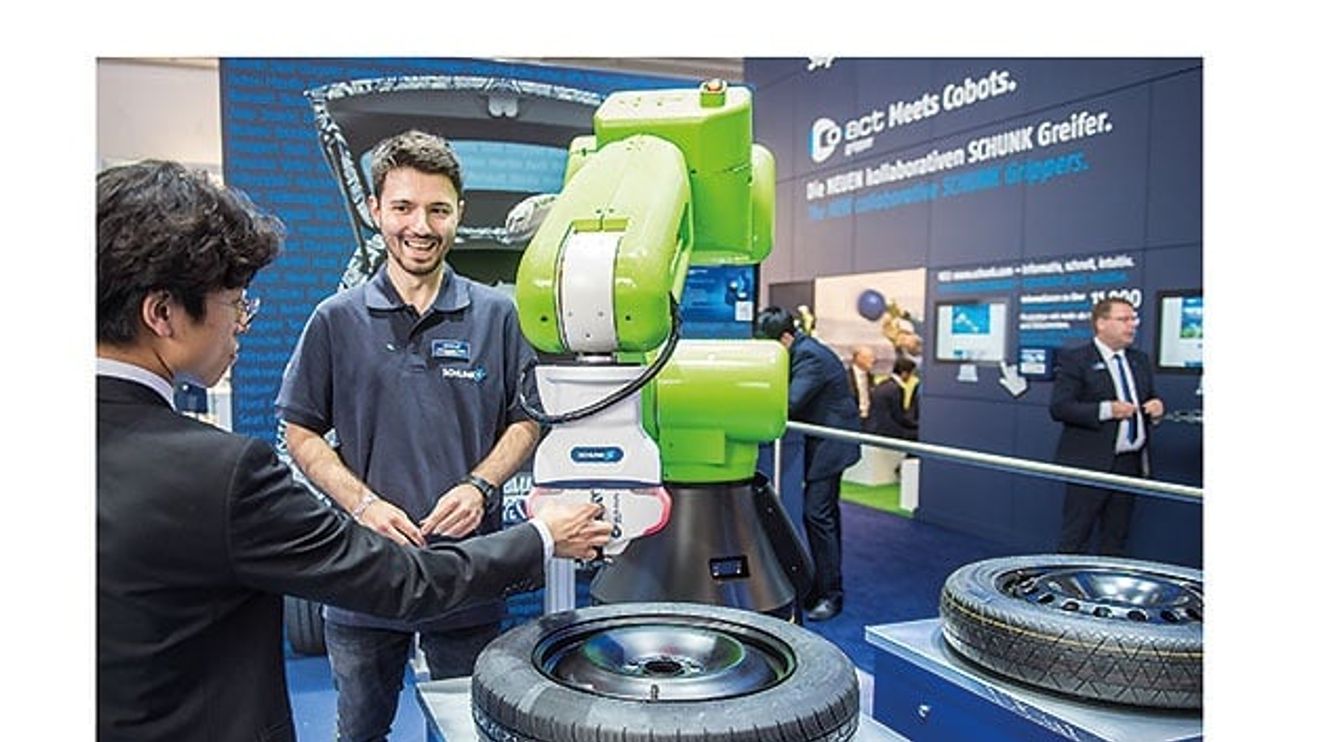
From June 21 to 24, robotics manufacturers and companies from the field of assembly and handling technology as well as automation specialists will meet at Automatica in Munich. The leading trade fair for intelligent automation and robotics lists over 500 exhibitors (as of May 9, 2022). In addition to industry giants such as ABB, Kuka and Omron, newcomers such as Franka Emika, Fruitcore Robotics, Robominds and Wandelbots can also be found at the trade fair. The companies will be exhibiting in the eastern halls A4 to A6 and B4 to B6.
This year, the exhibiting companies will once again focus on the trending topics of 'Digital Transformation', 'Artificial Intelligence' and 'Man and Machine', with the addition of the 'Sustainable Production' cluster. One of the reasons for this is the EU's goal of becoming climate-neutral by 2050. This can only be achieved with changes in production, and automation technology plays a decisive role in this.
Sustainability in robotics and production
When it comes to 'sustainable production', the automotive industry is considered a pioneer in Germany. Mercedes, for example, is aiming for complete CO2 neutrality by 2039 and is testing various energy-saving production technologies in its 'Factory 56' pilot factory in Sindelfingen. BMW is pursuing similar goals. OEMs also want to achieve these goals with intelligent automation systems, as can be seen in the automotive industry. As a rule, a vehicle model is manufactured on a classic production line with stationary conveyor technology. If the model is discontinued, the production line is also at the end of its life. The smart factory offers an efficient and sustainable alternative: robots and AGVs (Automated Guided Vehicles) take over all process steps - including transportation from one station to the next. This makes it possible to change models by reprogramming: The successor model is manufactured using the same flexible system as its predecessor. In addition to costs, this production model also saves resources.
The same applies to the robots themselves: In addition to energy consumption, their service life is the determining factor for sustainability. Companies such as Stäubli rely on drive technology developed in-house and overhaul old robots so that they can be given a "second life". Fanuc also focuses on longevity: some of the Japanese company's robots have been in use for over 20 years; Fanuc therefore keeps spare parts in stock for decades and guarantees lifelong service.
Another point is energy efficiency: every movement consumes energy. The lower the weight, the less energy is required. Many companies are therefore focusing on lightweight construction and designing components such as linear axes, robots, grippers and tools accordingly.
Robotics and automation on course for growth
According to the International Federation of Robotics (IFR), Germany is the most automated economy in Europe: with a total of 230,600 units, Germany has a 38% share of the total number of industrial robots in operation in Europe. This corresponds to a robot density of 371 units of industrial robots per 10,000 employees in 2020. And the demand for robots will continue to rise: The VDMA Robotics and Automation Association, the conceptual sponsor of Automatica, expects strong industry growth of 10% for the current year, as the association announced in a press release in December 2021. Industry sales are expected to reach 14.7 billion euros in 2022, which is the pre-crisis level of 2019.


You might also be interested in
For loads from 480 to 800 kg
The robots in Kuka's KR Fortec ultra family are designed for the heavy payload range from 480 to 800 kg.
 read more...
Joint pay-on-production models
Kuka Systems and FlexFactory have launched a strategic cooperation to jointly offer pay-on-production. The aim of the cooperation is to offer customers adaptable production capacities that are booked as a service.
read more...Future-proof production
Reducing the vulnerability of global supply chains, conserving resources and a rapid transition to digital production in Europe are challenges to which Automatica aims to provide answers.
read more...Replacement solution for pneumatic cylinders
Smela is exhibiting at Automatica for the first time and will be showing telescopic electromechanical linear actuators equipped with up to 800 N force and integrated anti-rotation protection.
read more...5G helper for restaurants, hotels and care facilities
The 5G high-speed mobile communications standard is also set to become a communication channel for service robots. Vodafone and Hyundai presented a corresponding solution at the Hannover Messe.
read more...Real-time monitoring of robots
Nabtesco launches predictive maintenance project
Nabtesco is planning to monitor robots in real time using digital gearbox models. The aim is to create software-based predictive maintenance concepts based on example-specific gearbox data.
read more...Drive technology for robotics and automation
Melior Motion's precision gearboxes are suitable for robotics and automation solutions in packaging and medical technology, machine tools and welding applications, for example. They can be seen at Schaeffler, as the company has been part of the...
read more...New Vice President elected
Marina Bill has been appointed as the new Vice President of the International Federation of Robotics with immediate effect. She represents the IFR together with IFR President Milton Guerry.
read more...Robot density in Germany at record high
Germany is the most automated economy in Europe: according to the IFR, robot density - i.e. the number of industrial robots per 10,000 employees - has risen to a record 371 units (2020).
read more...