
TQ-Robotics
Cobots automate electronics function tests
Increasing quality requirements and growing cost pressure are forcing electronics service providers to achieve a higher degree of automation. Frank Elektronik relies on a collaborative robotics solution from TQ.
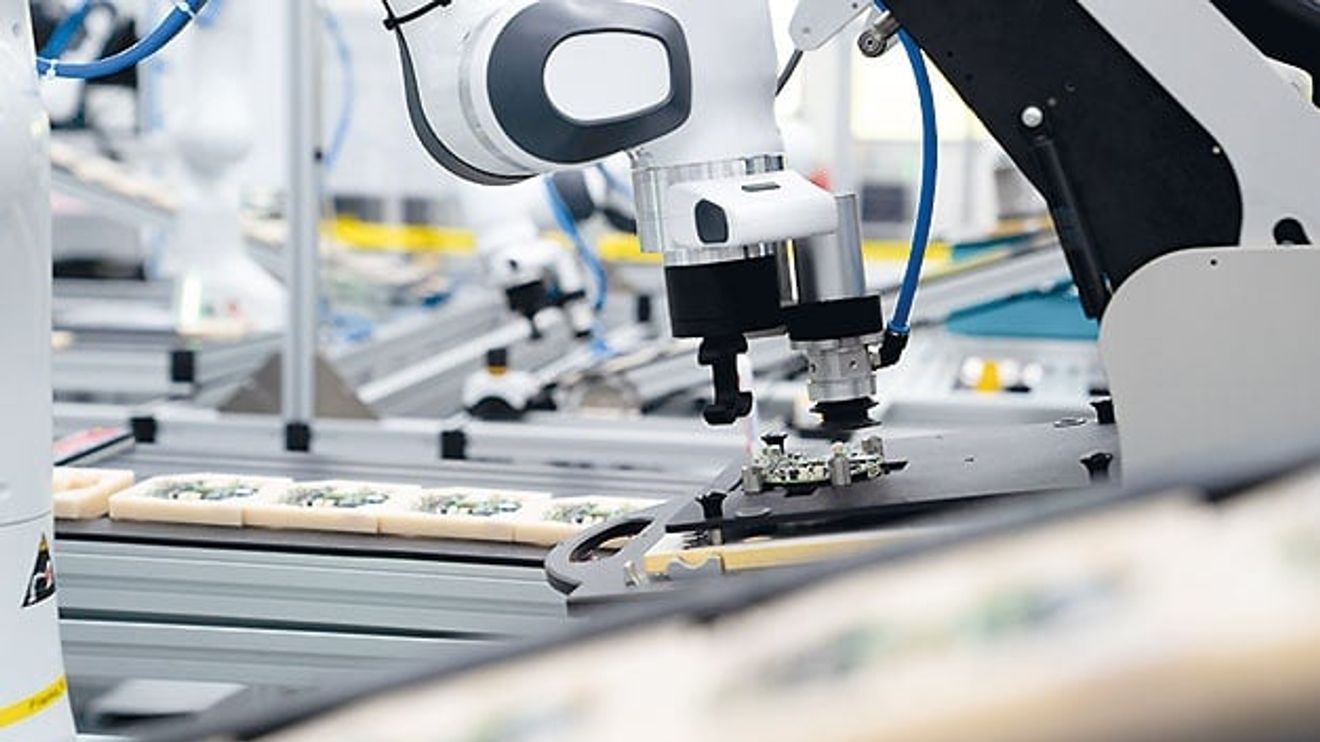
A cobot from Franka Emika during the testing process.
© TQ GroupAgility is the key to success for electronics manufacturers and therefore also brings challenges with it. Quality standards are rising in the industry, as is the desire to customize products. Added to this is growing cost pressure in production. Sophisticated process automation helps to meet these requirements.
Electronics service provider Frank Elektronik therefore relies on a collaborative robotics solution from TQ for testing PCBs. The automation solution has stabilized the precise test process and doubled production capacity. In addition, the cobot used makes the work of the factory workers considerably easier, as the collaborative robot takes over the monotonous, manual testing work and thus creates capacity for the more demanding assembly work.
The electronics service provider from Traunstein in Bavaria is part of the Elektronik Group, a supra-regional association of medium-sized EMS service providers. The company specializes in lighting technology and the assembly of circuit boards and modules. TQ's collaborative robotics solution has been in use since the end of 2020 for the automated functional testing of two different flat assemblies. Before the cobots were deployed, the test process was carried out by the same employees who subsequently assembled the PCBs. At that time, between 430 and 450 devices could be produced per shift. Since the cobot has taken over the test handling and the employees only assemble, the production capacity has doubled.
Two variants, two electronics function tests, one cobot
Specifically, the use case looks like this: The two device variants to be tested are placed in an infeed conveyor and then - depending on the variant - transported to the cobot in two separate tracks. The cobot places them in a buffer, removes the printed circuit board from the device and places it in the tester. It then closes the lid of the test device and scans the serial number via a barcode, which is the signal to start the test. Once the test is complete, it opens the lid and the test program sends a 'pass' or 'fail' signal to the controller. This tells the cobot where to place the unit: The units rated as good into the green area of the outfeed conveyor, the failures into the red. In total, a test process takes around 100 seconds. As two test devices are used, i.e. one for each device type, one mechanical challenge was to ensure that the cobot can grip two different flat assemblies at the same time. The robot used by Franka Emika solves this requirement by means of a double gripper, which ensures that the two variants can be handled without any retooling.
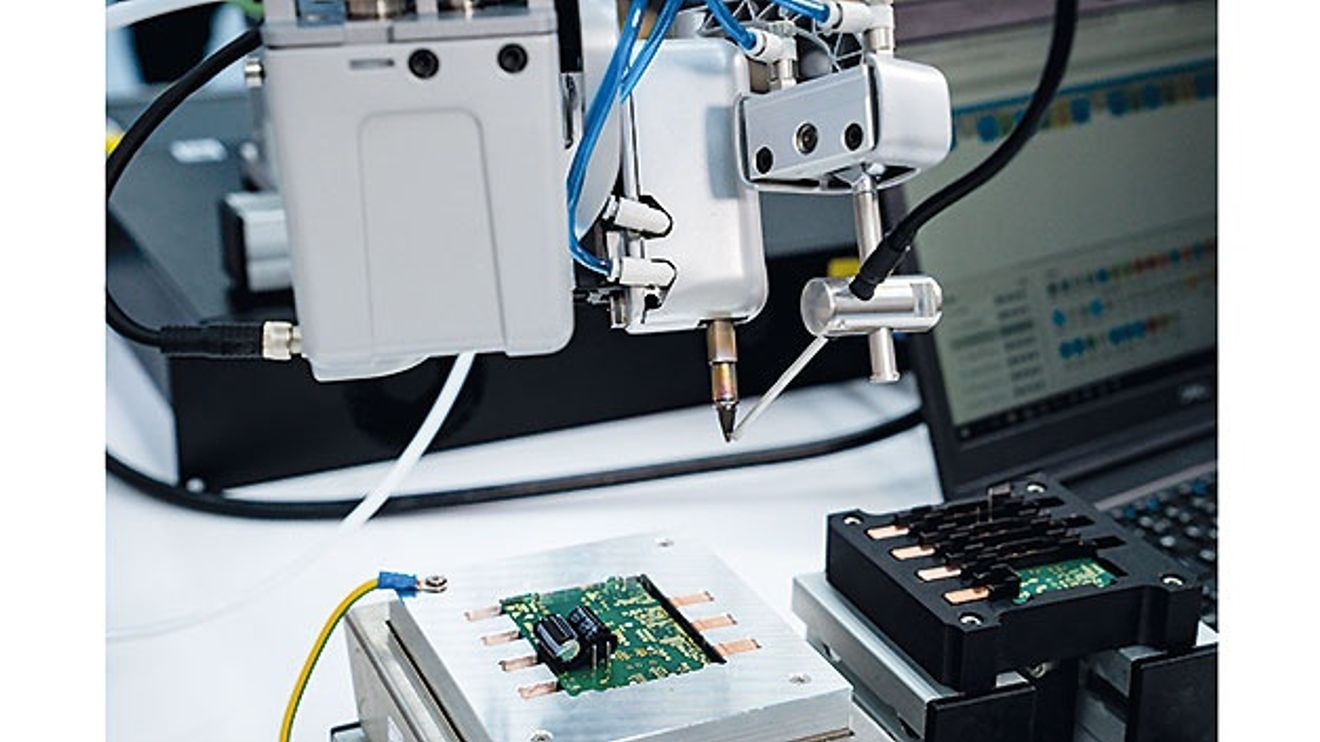
In general, the cobot can learn various motion sequences to be automated using manual instructions and can be operated easily and intuitively via a touch display. To program various sequences, for example gripping an object, different apps are selected from a menu on the laptop using drag-and-drop, arranged and then executed by the robot. With the correct programming of the apps provided by TQ, the electronics service provider has been able to gradually reduce the cycle time of the test sequence by a further 30% since the start of the project. The movement speed is now optimally adjusted to the duration of the test process, so that it is the test process itself that marks the performance limit, not the cobot. At the moment, the company's process is at around 80% of the volume that the cobot could theoretically process.
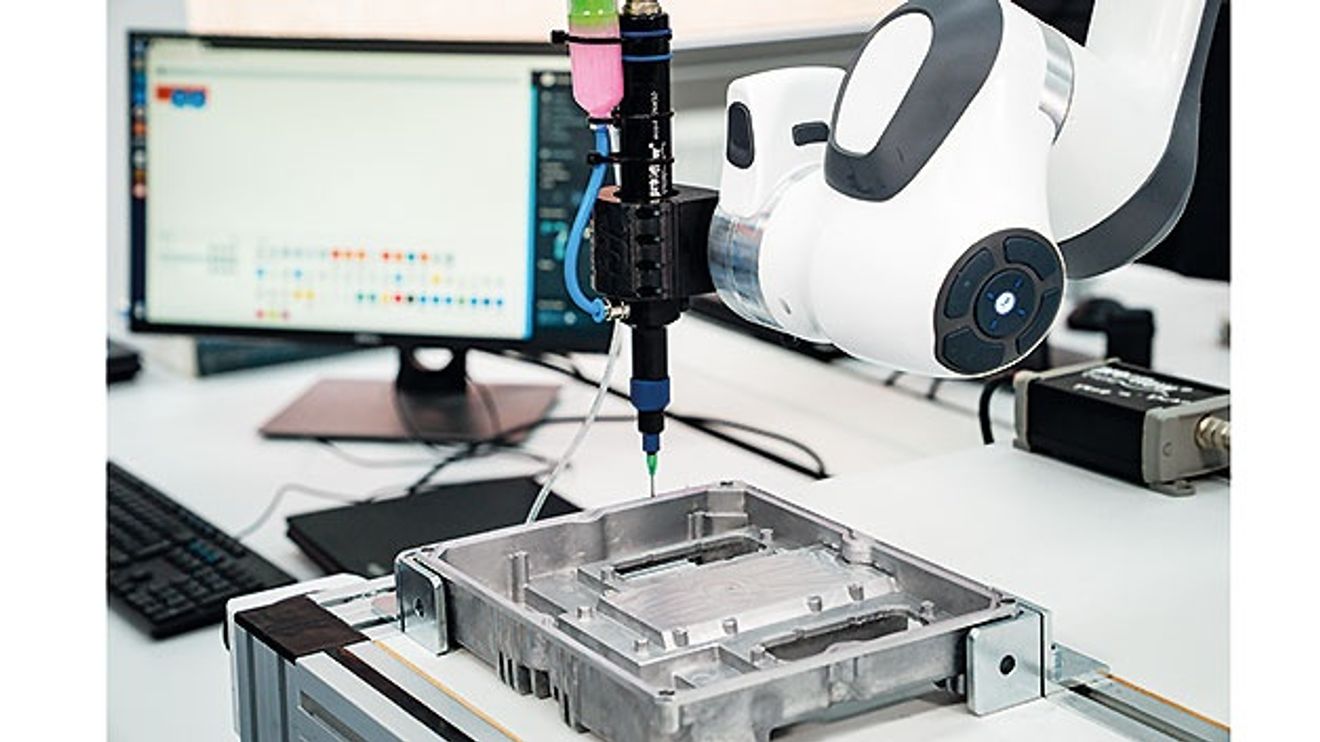
Another advantage of the Cobot system is that the programming is self-explanatory. No previous knowledge is required. Frank Elektronik used two months for testing and completed the conversion of the two test stations in February 2021. In total, the switch to robot automation took around four weeks. The employees who operate the device can also easily carry out a program change or restart the cobot after a potential standstill without any previous knowledge of robotics and with a little instruction. So far, the cobot solution has run without any unplanned downtimes.
Flexible retooling

The station as it is currently set up will soon no longer exist, as the products will be replaced by successor products. Although the set-up will be similar, it will be extended by one step: the new devices will also have to be tested in a closed state. For this second test process after assembly, an additional cobot will be used in the new product line, further increasing the level of automation and productivity. Due to this product change, the previous station would no longer have been usable without cobots, or it would have had to be completely rebuilt and all components procured anew. With the cobot solution, Frank Elektronik now benefits from a fast changeover time to the new product. Only a new gripper has to be designed and, if necessary, other trays procured.


You might also be interested in
Robot density in Germany at record high
Germany is the most automated economy in Europe: according to the IFR, robot density - i.e. the number of industrial robots per 10,000 employees - has risen to a record 371 units (2020).
 read more...
Service robots are experiencing a boom
The market for industrial robots tended to stagnate in 2020. Professional service robotics, on the other hand, achieved global sales growth of 12% in 2020. The market amounted to a total of 6.7 billion US dollars.
read more..."A modular hardware approach is an advantage"
The high volume of data combined with the increasing complexity of the data at the edge places certain demands on the hardware. Harald Maier from TQ knows what users need to look out for when making their selection.
read more...First industrial robot based on the modular principle
With the ILM-E frameless motor, the TQ Group supplies the heart of the world's first modular industrial robot. The plug&play robots from Kea Robotics are assembled according to the modular principle.
read more...TQ-Group supplies Kea Robotics
First industrial robot based on the modular principle
With the ILM-E frameless motor, the TQ Group supplies the heart of the world's first modular industrial robot. The plug & play robots from Kea Robotics are assembled according to the modular principle.
read more...Development Collaboration for Humanoid Robotic Hands Launched
Schunk is entering into a new development partnership with Robert Bosch Robotics. Their shared goal is to develop an industrial-grade robotic hand that can be integrated into various humanoid robot systems.
read more...Nominations for Electrifying Ideas Award have been announced
An independent jury of top-class experts from business, research and society has nominated three companies for the Electrifying Ideas Award 2026: Ideas from Philips, Rittal and ZeMA - Center for Mechatronics and Automation Technology convinced the...
read more...Circular economy for flexible materials
With a budget of 7.5 million euros and twelve partners from six countries, the European research project 'FlexCycle' is pursuing the goal of making recycling processes for the reuse of flexible materials suitable for industrial use. To this end, it...
read more...Schunk founds tech spin-off for humanoid robot hands
Schunk is bundling its activities in humanoid robotics by founding its own spin-off at the beginning of January. The aim of the new company is to develop modular humanoid robot hands for industrial applications.
read more...