
drag and bot
Programming via drag & drop
A weighty argument that is often put forward against the purchase of an industrial robot - in addition to the price - is the effort required for programming. But what if this could be done via software as easily as setting up a smartphone?
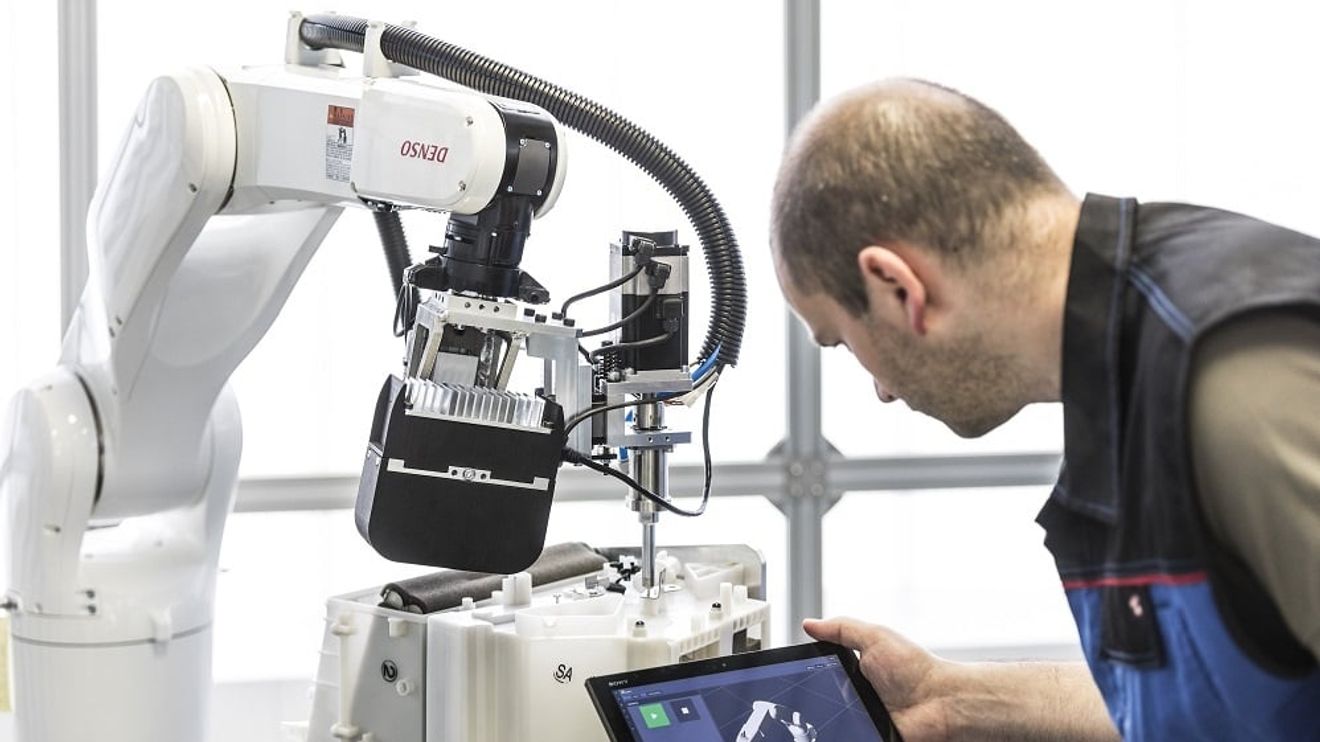
Four million industrial robots will be in use by 2022, according to the International Federation of Robotics (IFR) World Robot Report 2019. According to the report, Germany is currently the country that buys the most robots after China and Japan. There are 338 industrial robots for every 10,000 employees, and sales increased by a further 27% last year. The automotive industry is one of the sectors that is already the most automated. However, industrial robots are also becoming increasingly interesting for other manufacturing sectors - especially for SMEs. After all, the range is constantly improving and robots are becoming smaller, more flexible and easier to program.
The latter point in particular is important: in addition to the price, it is often the assumed effort required for programming that speaks against the purchase of an industrial robot. As this know-how is usually not available in-house, external partners have to be used. However, if this argument can be refuted, many small and medium-sized companies have almost nothing to say against the use of robots. One example of simplified programming is the 'drag&bot' software.
Robot programs are currently created using various methods - depending on the manufacturer, planned use and the required flexibility of the industrial robot. Known methods include teaching with a teach pendant, manual guidance for collaborative robots or program creation in a CAD-based simulation environment. The latter option in particular is very complex and requires in-depth knowledge of the robot manufacturer's programming language. Programming and function extensions are therefore time-consuming and cost-intensive, which prevents the flexible use of robots.
As simple as setting up a smartphone
This is where drag and bot comes in with its software of the same name. The company is a spin-off of the Fraunhofer IPA in Stuttgart, which has set itself the goal of enabling production employees without robotics expertise to program industrial robots using drag and drop. So that even untrained personnel can create new function sequences quickly and intuitively, they are supported by various operating and input aids, so-called wizards.
This enables simple parameterization of the program sequences. The program modules, known as function blocks, are then combined to form executable applications. This means that robot programs can be created five times faster than with text-based programming. Programs that have already been created can simply be loaded from the cloud, allowing robots to be reprogrammed within minutes. This makes the use of robots profitable even with small quantities, fluctuating order situations and a high number of variants.
The program modules are independent of the robot manufacturer and other hardware. The drag&bot software already supports ABB, Denso, Epson, Fanuc, Kuka, Mecademic, Stäubli, Yaskawa and Universal Robots as well as various grippers, screwdriving tools, other tools that can be controlled via I/Os and various cameras and image processing libraries. The integration of further tools and peripheral devices is ongoing. The modular structure of the software facilitates these integration processes.
Each robot requires a commercially available, high-performance industrial PC on which the software is executed. The relevant hardware is connected to the PC, which is installed in the robot cell, via Ethernet cable or USB. Hardware with an I/O interface can be integrated via an I/O module, the interfaces of the robot controller or via a PLC.
Robots in the automotive industry
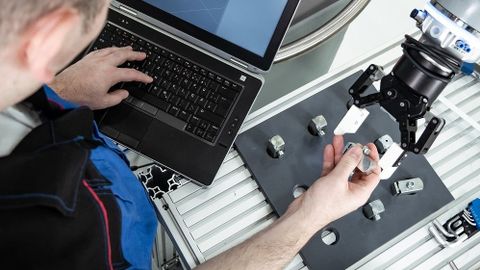
Industrial robots are still mainly used in the automotive industry in large-scale production and perform the same tasks over several years without requiring any changes to processes. Due to the shortage of skilled workers and the current pandemic, there is an increasing demand for the automation of processes that were previously carried out manually due to their flexibility requirements, such as the assembly of components.
Automotive supplier Denso has used drag&bot to automate a pre-assembly process that was previously carried out manually. As various processes are required here, it is important that the robots collaborate with the employees in the workspace. For this purpose, one of the Denso robots used was equipped with an 'Air-skin', a pressure-sensitive safety cover for industrial robots and grippers from Blue Danube Robotics. Using the software's graphical programming interface, the robots can be (re)programmed by the maintenance staff themselves on site. Thanks to so-called 'guides', the user is led step by step through typical applications such as screwing, palletizing parts or camera calibration.
Expansion modules can also be used to implement sensitive functions for adapting the behavior in the event of unforeseen situations in the production process or if more complex robot movements are required for assembly, for example. With the 2D vision module, for example, 2D cameras can be used for image processing to determine the exact position of a component in the workspace so that the robot can grip the component reliably even with variable pick-up positions.
Robots in the metalworking industry

Martin Naumann is the founder and managing director of drag and bot, a spin-off of the Fraunhofer IPA in Stuttgart.
© drag and botPlacke offers press brakes as well as suitable accessories and automation solutions. Sheet metal parts such as cladding parts, housings or machine components are shaped in a press brake. One of Placke's current products is an automated cell that contains the manufacturer's smallest press brake to date and a Fanuc robot. drag&bot is available as part of the automation solution for the end customer.
The software is used both to set up new parts and to operate the system in production. Set-up is based on an existing program template, which already contains all the functions required to pick up raw sheets from different stacks and set them down after processing. The operator only has to specify the part dimensions, the gripping point and the number of the blank magazine. The actual bending process can also be adapted by the end user if required. For this purpose, predefined sub-programs, each comprising one work step, are linked together in the graphical user interface and re-parameterized if necessary. For teaching, the software offers the option of moving the robot to predefined positions in the graphical user interface. From there, the positions can be adjusted by using arrows to move the robot in the direction of the press brake, away from the press brake, to the left or right and up or down relative to the press brake. The finished program can be tested directly on the robot and modified iteratively. Depending on its complexity, it is possible to set up a new workpiece or sheet metal with a bend in a maximum of half an hour.
During production, the system operator has access to the most important functions and information via drag&bot: He can choose between the programs released for him, still parameterize them within narrow limits, start production and monitor processes using key figures, for example based on the parts already produced. In the event of an error, he can simply move the robot back to the start position using the software and restart the process.


You might also be interested in
Robotic artificial intelligence you can touch
Making artificial intelligence tangible through humanoid robots - this is the aim of the 'Robotic Artificial Intelligence' real-world laboratory at the Karlsruhe Institute of Technology (KIT).
 read more...
Artificial intelligence on board
How can human error analysis be minimized and automated when inspecting assemblies or entire system units? One possibility is a robot system with AI.
read more...German Robotics Association launched
The German Robotics Association was founded in Nuremberg in October 2020. The aim of the association is to promote the use of robot technology, particularly in small and medium-sized companies.
read more...3D measurements with high accuracy
Creaform is launching automated quality assurance solutions in the R-Series range, including the 'MetraScan-R Black|Elite' and the addition of four different models of the 'Cube-R' 3D scanning measurement device.
read more...Disinfection robot acts independently
In order to contain the spread of the coronavirus, the Stuttgart-based Fraunhofer IPA has developed a prototype of a mobile cleaning and disinfection robot that autonomously travels to potentially contaminated objects such as door handles and...
read more...Gripper for multi-variant production
Adapting grippers quickly and cost-effectively to changing products is made possible by a new process developed by Fraunhofer IPA.
read more...Robots learn to assemble thanks to AI
Flexible robot programming for assembly tasks is still complex. The aim of the 'Rob-akademi' research project is to improve this.
read more...Robotics Institute Germany co-founded
Fraunhofer IPA is a co-founder of the Robotics Institute Germany, which aims to bundle Germany's cutting-edge research into AI-based robotics.
read more..."Manufacturing-X data room preliminary study" presented
Manufacturing-X is seen as the next step on the road to Industry 4.0, but how could a data room be designed for the data ecosystem? A study presented by VDMA and ZVEI gets to the bottom of this question.
read more...