
ZF Friedrichshafen
Integrate robots more easily
ZF Friedrichshafen relies on special programming software to simulate robot applications, generate modular program codes, reduce maintenance costs and alleviate the shortage of skilled workers.
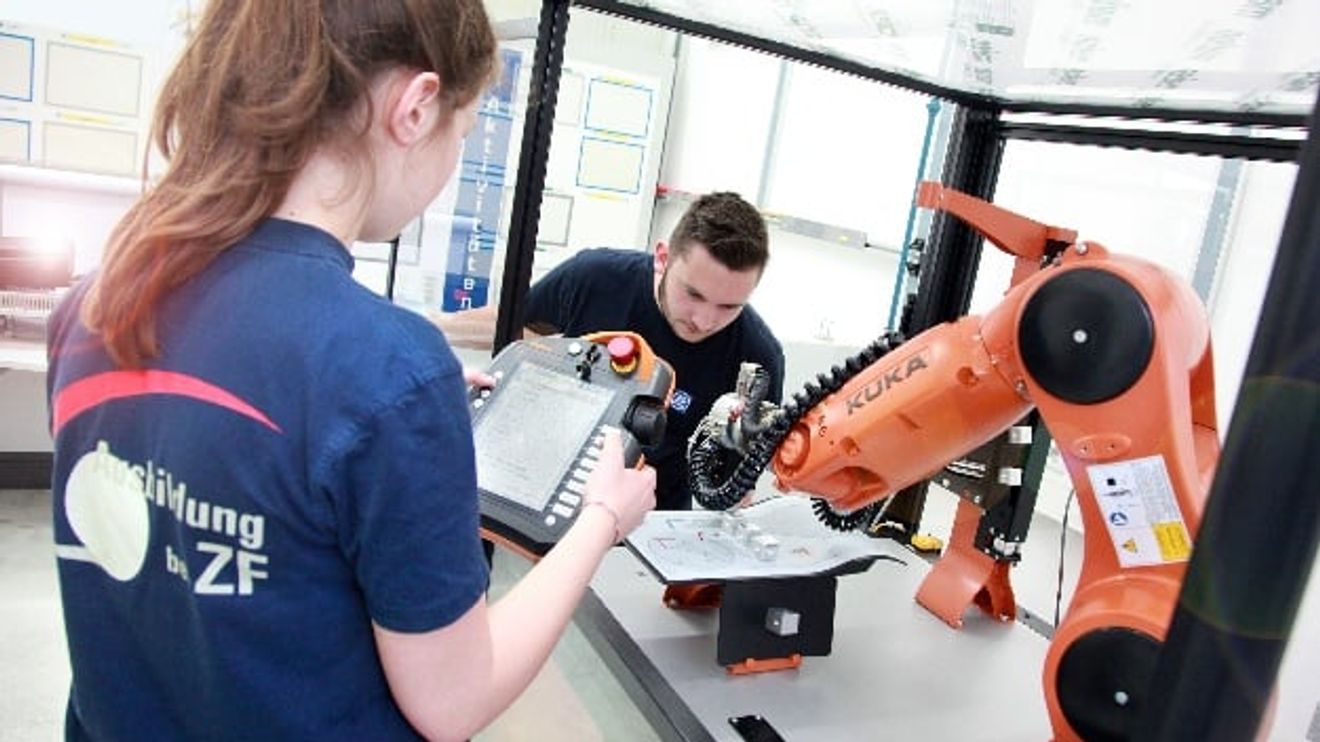
ZF Friedrichshafen uses industrial robots from various manufacturers for production. Uwe Wachter is Head of the Production Tech Center Robotics and Vision (PTCRV). He reports: "We founded the PTCRV, based in Schweinfurt, about three and a half years ago. We are the division within the ZF Group that deals with new technologies such as lightweight robots, camera systems and software solutions for production." This is how he became aware of the Robot Programming Suite (RPS) from ArtiMinds. Once a robot application has been developed, it can be run on different robot systems at any time. Wachter explains: "If we develop an application for robot manufacturer A in Schweinfurt, for example, we can then generate the executable program for robot manufacturer B from this source code and send this program by e-mail to our plant in Portugal. Then our colleagues in Portugal can run the same production as we do in Schweinfurt."
First simulate, then realize
One area of application for which Jonas Arnold, engineer for collaborative robots and Wachter's colleague, regularly uses the RPS is simulations. "We are often confronted with the task of estimating whether a robot can fulfill a certain cycle time in a given situation." In the past, ZF had to install the robot system on site at great expense, develop the appropriate application and then test whether the system could meet the specified cycle time.
With the RPS, ZF can now not only program applications, but also simulate them. Special standards must also be observed when using collaborative robots.
Arnold explains: "For example, we have to evaluate in advance where collisions between humans and robots are possible. Can the robot arm reach head height? Are there any potential pinch points? To ensure safety, we have to comply with force and pressure values and limit the robot's speed of movement. We have to allow for inaccuracies in the gripping process that cause time delays. Simulation makes it easier for us to assess all of this." On this basis, ZF is then also able to estimate whether the use of robots is financially worthwhile for the task in question. Wachter explains: "Ultimately, it's always about whether we can meet a certain target. A lightweight robot that is to work with a cycle time of 20 to 30 seconds must not exceed a defined price for hardware, programming and installation. With the help of a simulation, we can quickly estimate at an early stage whether we can meet this target."
Minimize maintenance effort and downtime
ZF is currently evaluating the Learning & Analytics for Robots (LAR) tool. Arnold already knows how this feature can help him: "The cost of maintaining robot systems is a major problem for us. We have some applications where the entire system changes over time due to changes in material properties. The LAR could help us to intervene at an early stage and make corrections with just a few clicks or even allow the robot to adapt autonomously."
Avoid failures
For larger systems, re-teaching can take several days, during which the system is at a standstill. This is exactly where LAR comes in. It continuously collects data on every movement carried out during operation. Based on this data collection, the software can detect and warn at an early stage if there are inaccuracies in the gripping movement, for example. Costly maintenance work is avoided. Arnold sums up: "By using ArtiMinds RPS, we have been able to reduce the costs of developing robot applications. With LAR, we will also be able to reduce maintenance costs in the future."
The author: Matthias Lohrer, freelance editor, Silke Glasstetter, Head of Marketing at ArtiMinds Robotics.
This article first appeared in our sister magazine INDUSTRIAL Production.


You might also be interested in
Development Collaboration for Humanoid Robotic Hands Launched
Schunk is entering into a new development partnership with Robert Bosch Robotics. Their shared goal is to develop an industrial-grade robotic hand that can be integrated into various humanoid robot systems.
 read more...
Nominations for Electrifying Ideas Award have been announced
An independent jury of top-class experts from business, research and society has nominated three companies for the Electrifying Ideas Award 2026: Ideas from Philips, Rittal and ZeMA - Center for Mechatronics and Automation Technology convinced the...
read more...Circular economy for flexible materials
With a budget of 7.5 million euros and twelve partners from six countries, the European research project 'FlexCycle' is pursuing the goal of making recycling processes for the reuse of flexible materials suitable for industrial use. To this end, it...
read more...Schunk founds tech spin-off for humanoid robot hands
Schunk is bundling its activities in humanoid robotics by founding its own spin-off at the beginning of January. The aim of the new company is to develop modular humanoid robot hands for industrial applications.
read more...Second generation of vacuum grippers
Coval has redeveloped the carbon face gripper 'CVGC'. The new generation also takes into account current and future trends in the market for collaborative robots.
read more...Schunk receives the Hermes Award 2024
Schunk was honored with the Hermes Award for its AI-based project during the opening ceremony of the Hannover Messe.
read more...Schunk at the Hannover Messe 2024
Digital and automated for healthy production
Schunk is focusing on two key topics in Hanover: 'The Healthy Factory' and 'Innovation through Collaboration'. The aim is to design a healthy and economically successful production for people and the environment.
read more...These are your winners!
We put 96 products in twelve categories to your vote in December, and now the winners have been chosen! The trophies were presented at a 'Winner's Dinner' at the Seehaus in Munich. These are your "Products of the Year 2024"!
read more...Robotics & Handling - The winners
They ensure fast and safe handling of components and get them reliably from A to B: the winning products in the 'Robotics & Handling' category.
read more...